How to Forage and Use Wintergreen in the Appalachian Mountains
How to forage wintergreen in Appalachia by smell, gather it without stripping a patch, and keep it for a winter cup or a tin of salve, the way I learned it.

The first hard frost in the coves above Marshall flattens most of what I gather, and about then I quit looking up and start looking down. By November the forest floor under the oaks and pines has gone brown and gray, and the one thing still green and shining is wintergreen, with its red berries sitting up over the leaves like somebody set them there on purpose.
My grandmother kept a quart jar of dried wintergreen leaf on the shelf by the stove from the first snow until spring, and I have done the same for most of my life. It is a small plant and a patient one, which is exactly why it deserves some care in the gathering. What follows is how I find it, how I take it, and what I do with it afterward.
Know it by smell before anything else
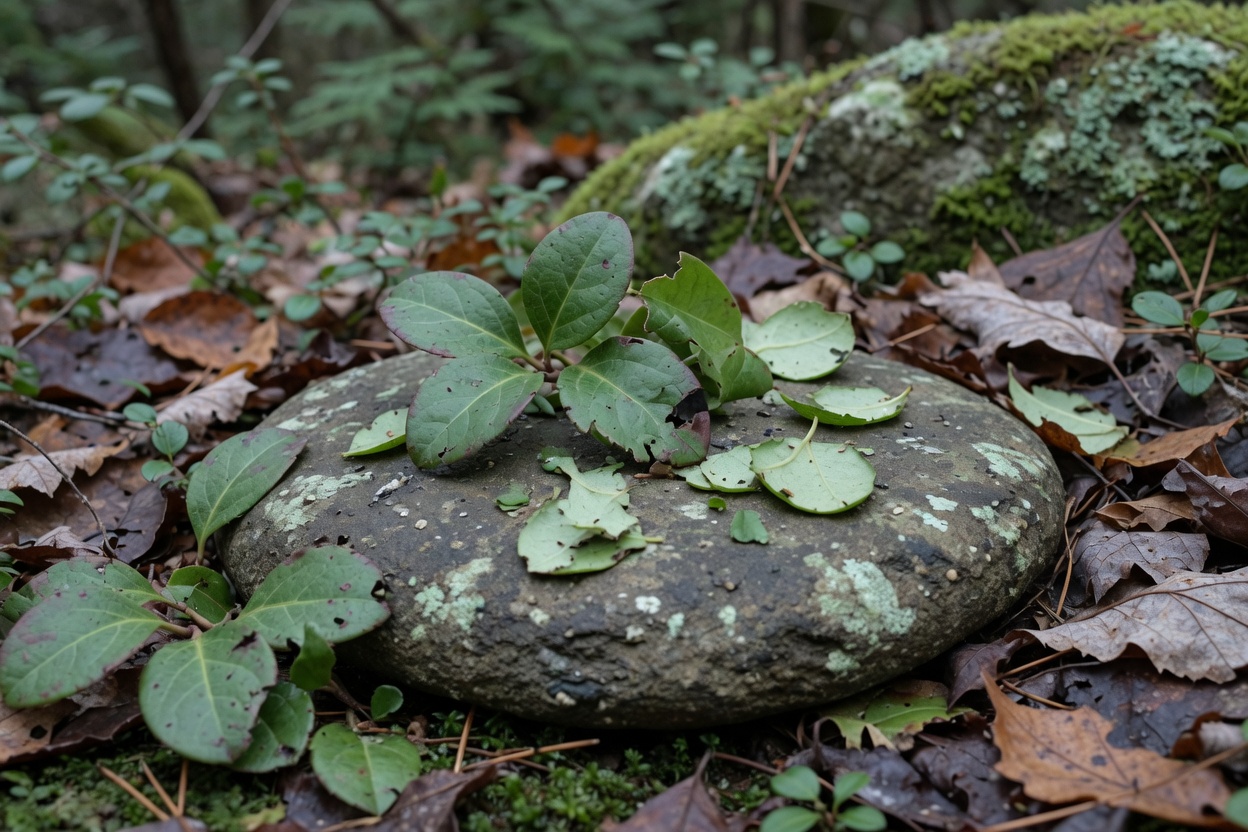
Wintergreen (Gaultheria procumbens, which some of my neighbors call teaberry or checkerberry) stays low, rarely taller than a hand, with a few glossy, leathery, oval leaves clustered at the top of each short stem. In the southern mountains it likes acidic ground under pine and oak, often on dry ridges and the upper slopes of a north-facing cove. From late summer into winter you may see bright red berries tucked under the leaves.
Looks alone will not settle it, and that is the rule I want you to carry. Crush one leaf between your fingers and smell it. Real wintergreen smells unmistakably like wintergreen candy, sharp and sweet, and nothing else on that ground does. Partridgeberry, the trailing little vine with paired round leaves and a pale stripe down the middle, grows in the same woods and carries red berries too, but it has no scent at all. If you smell nothing, put it down.
Do not use the taste test to find out. Smell, then confirm against more than one reliable guide and, if you can, an experienced local who has picked it before. I go through the lookalikes that cause real trouble in dangerous look-alikes of Appalachian medicinal plants, and I would read it before your first outing.
Gather a little from a lot of plants

Wintergreen spreads slowly. A patch you strip can take years to look like itself again, so I take a few leaves from each plant and keep walking, never more than a fifth of what is growing in any one spot. I pinch the leaf off and leave the stem and the berries where they are. A handful from a wide patch beats a bagful from a small one.
Know whose ground you are on. Gathering is fine on your own land or with the owner’s say-so, but national forest and state land have their own rules about plant collecting, and they differ by district and by state. Call the ranger station before you go. It takes five minutes and keeps you on the right side of the law.
The Cherokee knew this plant long before any of my people came to these mountains, and it is documented in Hamel and Chiltoski’s Cherokee Plants and Their Uses. I credit that tradition and I will not speak for it. What I share here is what my own family did.
Dry it, then keep it dry

Shake the leaves free of grit and spread them in a single layer on a screen or a clean cloth in a dry, airy room out of direct sun. In my drying shed they are crisp in about a week; in a damp fall it can take longer, and I will not jar a leaf that bends instead of snapping. Mold in the jar is how a whole season of gathering gets lost, and I have lost a batch that way.
Once crisp, I pack them loosely into a wide-mouth pint mason jar, label it with the date, and keep it on a dark shelf. The jars are heavy and the metal lids will rust eventually if the oil or steam gets at them, so I keep a few spare lids. Mountain winters are damp enough to undo good drying, and my notes on storing mountain herbs through a humid winter cover what I do about that.
A winter cup

The old way is simple. Crush a small pinch of leaves, cover them with hot water that has gone off the boil, put a lid on the cup, and let it sit while it turns the color of weak tea. Then pour it through a square of grade-90 cheesecloth so no leaf bits end up in the cup. The cloth is tight enough to do the job, though it sheds a little lint the first time, so I rinse a new piece before I use it. It is a mild, sweet, minty cup, good on a cold evening, and that is all I will claim for it. If you want to blend it, my white pine needle tea is a natural partner.
One safety note, said once. Wintergreen carries salicylates, the same family of compounds found in aspirin. If you are sensitive to aspirin, take blood thinners, are pregnant, or are making this for a child, leave it alone. Keep it a small cup now and then, not a daily habit, and never use the concentrated oil sold in little bottles, which is a different and far more dangerous thing than a leaf steeped in water.
A tin of wintergreen salve

Mountain families also kept wintergreen in a rub for winter hands and weathered joints, and I make a small batch the way I make my yarrow salve. Fill a jar about halfway with fully dried leaf, cover it with jojoba oil by an inch, and leave it on a warm shelf for three to four weeks. Jojoba keeps longer than olive, though it costs more, and for a salve that may sit in a drawer a year I think it earns its place.
Strain through cheesecloth, warm the oil, and stir in beeswax pellets at about an ounce to a cup of oil. Pellets melt evenly and need no grating, but they are a bit pricier than a block, and I run the cold-spoon test before I pour to check the firmness. Pour into two-ounce tins, let them set uncovered, then cap and label them. The tins dent in a coat pocket and the lids can be snug at first, but they keep the salve dark, which is what keeps it from going flat.
Patch test on the inside of your wrist first. Keep it off broken skin and away from children, and remember the same salicylate caution applies. It is a strong-smelling salve, so a little goes a long way.
Where to go next

Wintergreen is one of the easy plants to start with because the nose does the identifying, but it is a gentle introduction to a much larger woods. I put a good deal more of this into my book, Appalachian Medicinal Plants, with how to identify each plant without guessing, when to gather it, and how mountain families prepared it. The jars and tins are the easy part. The book is how you learn what is worth putting in them. And if you are setting up your first shelf, my short list of mountain apothecary supplies is a good place to begin.
