How to Forage and Use Boneset in Southern Appalachia
Learn to identify boneset in the Southern Appalachians, tell it from deadly white snakeroot, harvest it with care, and dry and store it the mountain way.
Granny kept a bundle of boneset hanging in the drying shed, gone pale and papery by October, and she would not let us children touch it without asking. I did not understand why until I was grown and had read what the old herbals actually said about it.
I live up a creek hollow outside Marshall, in Madison County, North Carolina, and boneset has grown along my bottomland since before the fence went up. It is a plant I respect, and one that has a dangerous cousin growing in the same ground. So this is half a gathering guide and half a warning. Here is how I know it, how I gather it, and how I put it up.
You’ll also want sharp pruners, kitchen twine, a basket, and a notebook. I’ll leave those to your own toolbox.
Know it first, and know the one that can kill you
Say this part with me, once: never use any wild plant on the strength of one book, one app, or one article, this one included. Confirm it against more than one reputable guide and with an experienced local forager, and when there’s any doubt, leave it where it stands.
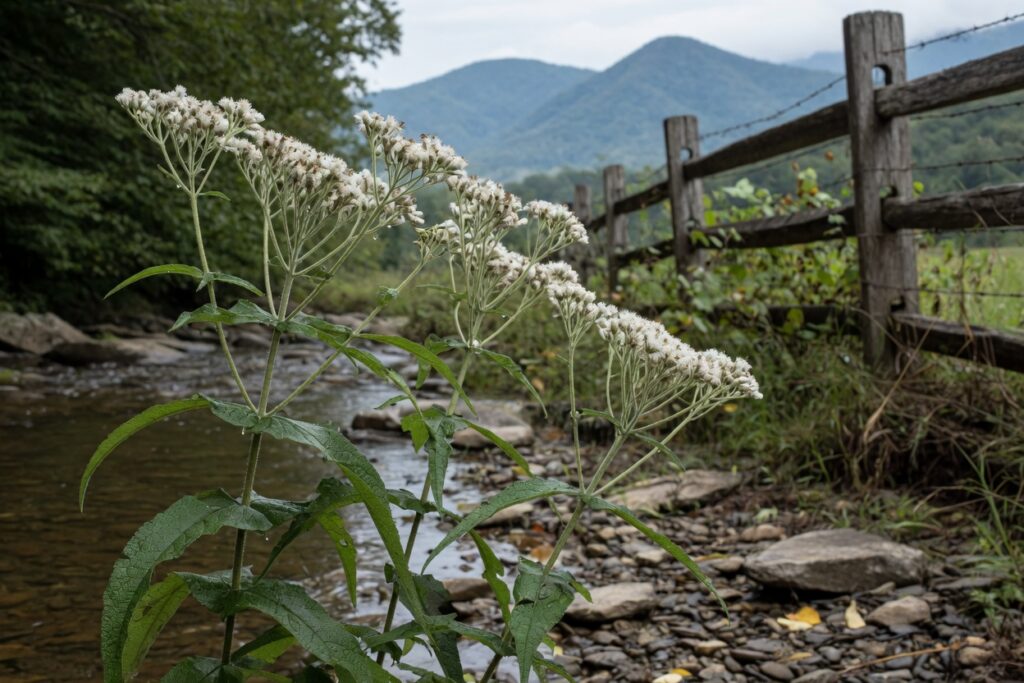
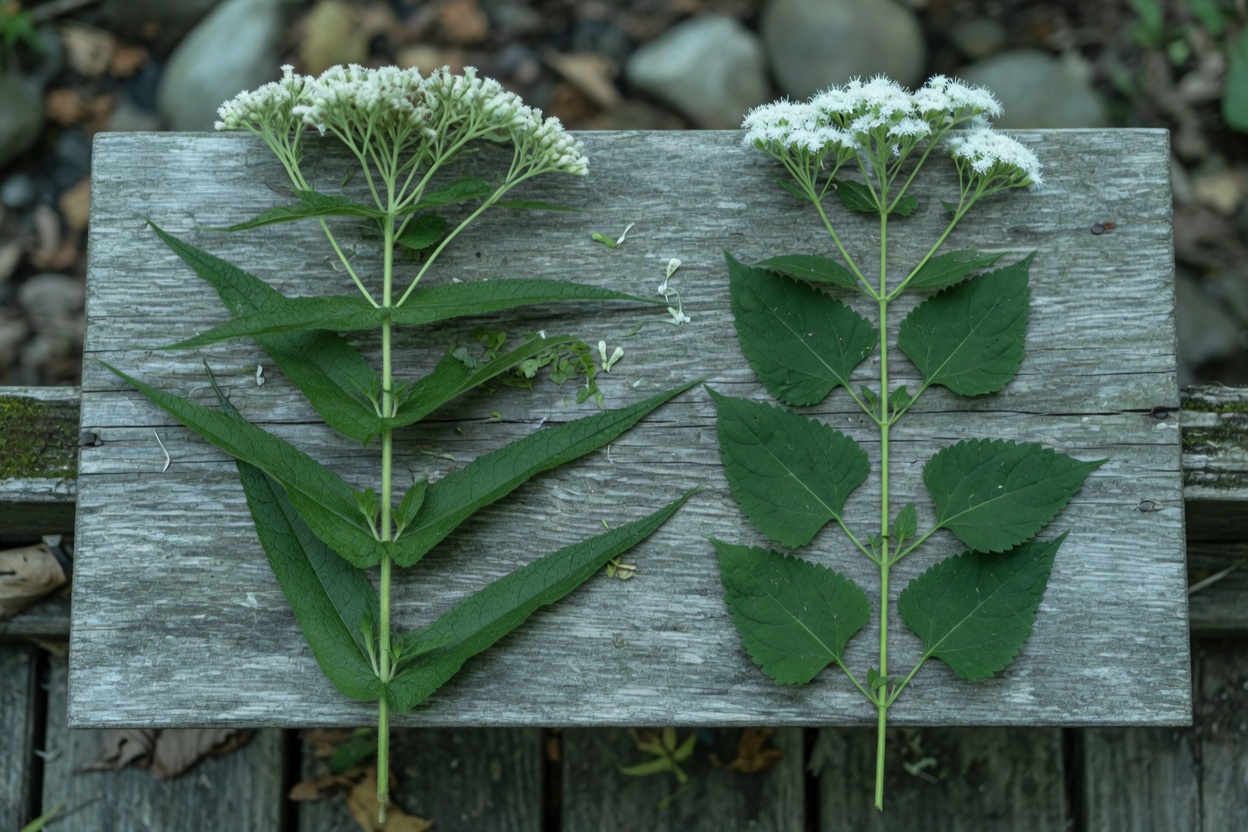
Boneset (Eupatorium perfoliatum) is a tall, rough-hairy plant of wet ground, two to five feet high. The giveaway is in its name. The leaves grow in opposite pairs, and each pair is joined across the stem at the base, so the stem appears to pass right through the middle of the leaves. The Latin word is perfoliatum, “through the leaf.” The leaves are long, narrow, tapered, and wrinkled, and green above with fine hair beneath. In late summer and fall it carries flat clusters of small, dull-white flower heads.
Now the cousin. White snakeroot (Ageratina altissima) grows in the same shady woods and creek edges, flowers white at the same time of year, and is poisonous. It is the plant behind the “milk sickness” that killed settlers and their cows in these hills. Its leaves are broader, with a toothed edge and a visible stalk on each leaf, and they are not joined across the stem. If the leaves have stalks and sit on opposite sides of the stem without joining, walk away. If you cannot tell the two apart with certainty, do not gather either one.
Joe-pye weed is another neighbor, but it grows its leaves in rings of three to five up the stem. Boneset’s leaves come only in pairs.
Winter is for finding it

It is the end of October as I write this. Boneset’s flowers have gone, but the dead stalks stand through the winter, still showing those paired leaf bases, and that is when I walk the creek bank and mark the stands. I tie a strip of cloth on a nearby branch and write the spot in my notebook. Then I come back in August when it flowers and confirm everything again before I cut one stem.
Look in wet places: bottomland, ditch banks, wet meadows, and the edges of ponds and creeks. It likes sun and moisture.
Where and when to gather

Only gather from ground you have permission to use. Public land rules vary: many national forests and parks restrict or ban gathering, so call the ranger district before you take anything. Stay away from roadsides, ditches that catch runoff, and places that might have been sprayed.
Gather the leafy top third of the plant in late summer, as it comes into flower, on a dry morning after the dew has lifted. Take no more than a quarter of a stand, and leave the rest to set seed. A patch that gets stripped does not come back.
Drying and storing it
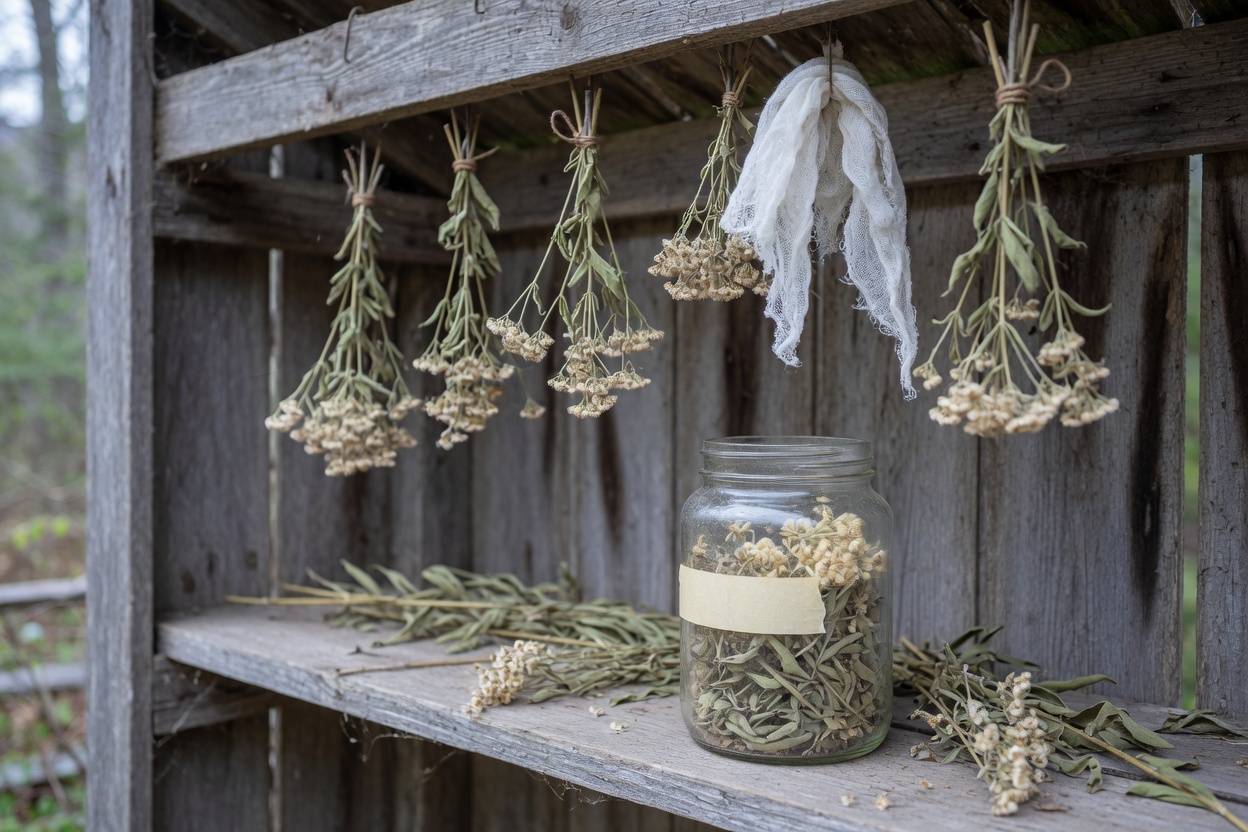
Tie small bundles of five or six stems with twine and hang them head-down in a shaded, airy spot. I drape cheesecloth loosely over mine. Give them one to two weeks, until the leaves crumble when you crush them.
Strip the leaves and flower tops from the stems and pack them loosely in a wide-mouth jar. Write the plant, the place, and the date on a strip of masking tape. I keep mine in a dark cupboard. For more on keeping dried herbs, see how to store dried herbs so they last.
How it has been used, as history

Boneset’s name comes from the old belief that it helped with “breakbone” fevers, the deep aches that came with some sicknesses. The Cherokee and other Native peoples of these mountains knew this plant long before my people arrived, and I credit that and do not claim it as mine. What I can tell you is how my family kept it: as a bitter tea, taken hot, in the old folk way when a household was laid low with a cold.
I tell you that as history, not advice. I do not claim that boneset treats anything, and I do not give amounts. It is very bitter, and sources I trust advise caution. That goes especially for anyone who is pregnant, who has liver trouble, or who is allergic to the daisy and ragweed family. See a qualified practitioner for anything that touches your health.
What I got wrong

When I was first learning, I picked a handful of what I thought was boneset on a shady bank, and my aunt took one look and made me throw it in the creek. It had stalked leaves. I have never forgotten the cold feeling. I check the stem now every single time.
Learning the whole shelf

A jar of dried leaf is the easy part. Knowing a plant in every season, and knowing its dangerous look-alike by heart, is the long study. I walk through that plant by plant in my book, Appalachian Medicinal Plants: how to identify each one without guessing, how to gather with care, and how the mountain people kept them.
If you want to keep going, my notes on how to forage and use persimmon bark and how to forage and use jewelweed are good next steps.
Look twice.
