How to Forage and Use Jewelweed in Southern Appalachia
How to find jewelweed in Appalachian creek hollows, tell it from look-alikes, when to gather it, how to dry or infuse it, and its traditional folk use.

Every child on our creek knew jewelweed by the seedpods before they knew it by any other name. Touch a ripe one and it bursts in your fingers, curls up like a spring, and flings its seed off in every direction. My brother and I would sneak up the creek bank in September to see who could set off the most pods before Mama hollered us in for supper.
That’s why one of its other names is touch-me-not. The plant has a good many names, and the ones in the books are Impatiens capensis, the orange one, and Impatiens pallida, the pale yellow one. It grows thick in the wet ground of the southern mountains, and by now, late October, the frost has laid it flat. That makes this a good time to write about it, because the best use of a cold month is learning where a plant lives so you can find it come summer.
What it looks like

Jewelweed is a soft, watery annual that grows two to five feet tall in a bunch of branching stems. The stems are pale and juicy, almost translucent, with swollen joints, and they snap easily. The leaves are oval with scalloped edges, arranged alternately along the stem, and thin as tissue. In a heavy dew, a jewelweed leaf holds water in beads that shimmer silver, which is where the “jewel” in its name comes from.
The flower is the giveaway. From July into September it carries small, hanging, trumpet-shaped blossoms, orange spotted with brown or pale yellow, each with a little curled spur on the back. Then come the narrow green seedpods that burst when ripe.
Now the rule I give everybody and don’t bend: never use a wild plant on a book, an app, or a single source alone. Match it against more than one good guide, and then against someone local who knows it by sight. When in doubt, leave it.
Look-alikes to rule out

A few plants share the same wet ground and are worth knowing. Clearweed (Pilea pumila) has the same pale, translucent stem, but it has no showy flowers and no seedpods that burst when touched, and its leaves are more coarsely toothed. Several nettles grow in the same places, and their stinging hairs will settle the matter the hard way. If you see the trumpet flower or the spring-loaded pod, you have jewelweed. If it has neither, you may be looking at something else, or at a plant out of season.
I wrote about the ones that fool people most in how to identify dangerous look-alikes of Appalachian medicinals. Read it before you carry a bag out.
Where it grows, and why to learn it now
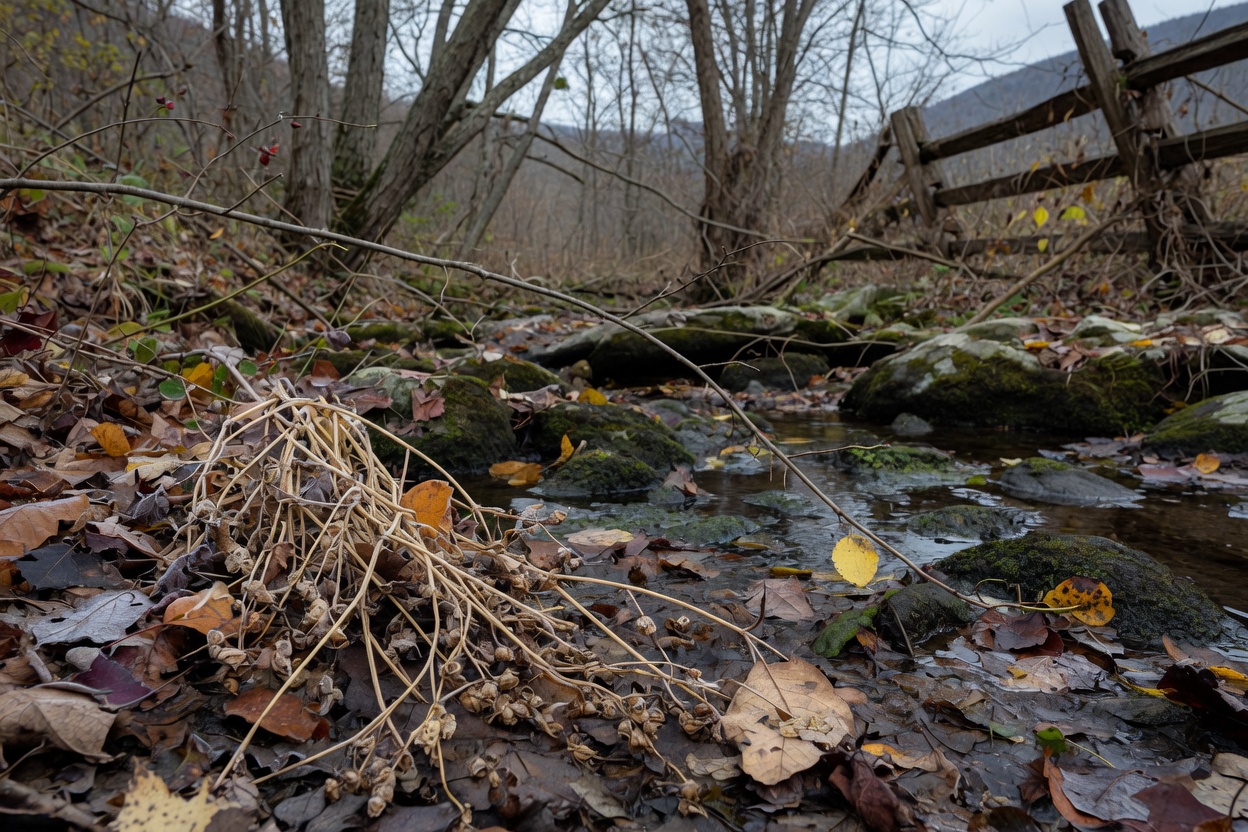
Jewelweed wants wet, shaded ground: creek banks, seeps, the lower edge of a hollow, the muddy margin of a spring branch. It likes rich soil and light shade. Where it grows, it grows in thick drifts.
Because it’s an annual, it dies back at the first hard frost and leaves nothing above ground to find in winter. So this month is the time to mark the places where you saw it. Take a photo with a landmark, or a pin on your phone. Come back in May and June and you’ll see the seedlings emerge in the same spots, in a bright green flush.
Mind the ground you’re on. Creek banks are often posted, and runoff from pastures or roads can carry things you don’t want in a plant you’ll use. Gather only from clean water with clean surroundings, ask the landowner first, and learn the rules on public land.
When and how to gather

I gather leaves and tender stem tops in summer, in the weeks before the plant flowers heavily, when it’s lush and green. Go in the morning once the dew has lifted. Take a handful from a drift that has plenty of plants, never from a thin stand. Jewelweed reseeds by those popping pods, so leave plenty of ripe plants standing to keep the patch going. I take no more than a third of any stand. A good rule is to leave a plant alone if it has few neighbors.
A hori-hori isn’t necessary for jewelweed. Scissors or a sharp knife and your hands will do. I carry my Nisaku hori-hori up the creek anyway, mostly to loosen a muddy footing, but I wouldn’t buy one for this plant alone.
Drying it, and a caution about moisture

Jewelweed is full of water, and it molds fast, which is the thing that trips up new gatherers. Spread the leaves in a single layer on a clean cloth or screen, with cheesecloth laid loosely over the top to keep dust and flies off. Keep it in the shade with moving air. In a mountain summer it can take a week, and longer in damp weather. It is dry only when it crumbles. If it bends, give it more time. A leaf that still holds moisture will spoil a jar.
Pack the dry leaf loosely in a wide-mouth mason jar, label it with the plant and the date, and store it out of the light.
How it has been used
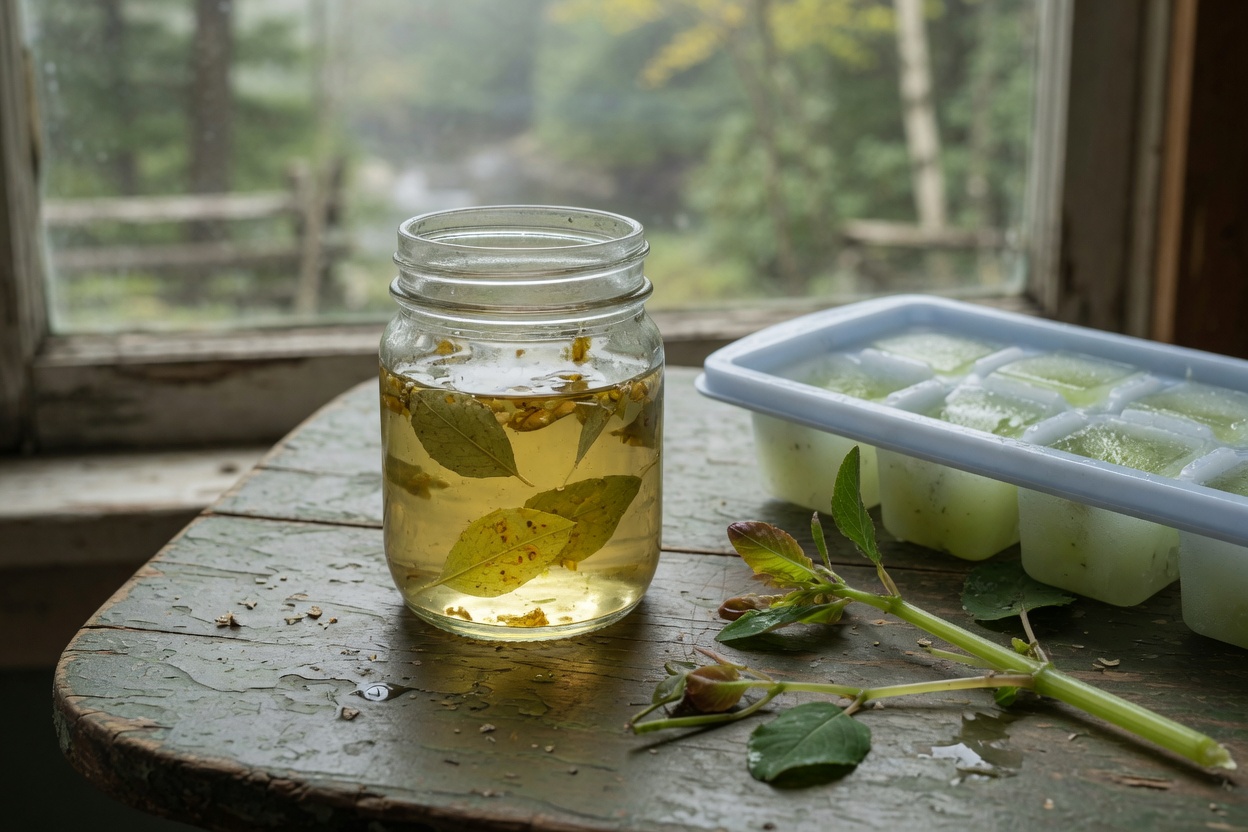
I make no claim about what jewelweed does for the body, and I’d distrust any page that does. What I can tell you is how my family has used it. Folks in these mountains have long rubbed the crushed fresh stem on the skin after a walk through the woods, and some make an oil by infusing dried leaf in a carrier like jojoba or by freezing the juice in ice trays. That’s the folk practice. Whether it works is not something I’ll promise you.
If you try it, do a small patch test on the inside of your arm first and wait a day. Plants can irritate skin, and a rash is not a thing to guess about. Do not put any wild plant on broken skin, a bad rash, or a child’s skin without asking a doctor first. This is traditional use, not advice, and I’m not a doctor.
I’m also sharing a settler-mountain use of the plant, handed down in my own family. The Cherokee knew these plants long before any of us did. For what’s recorded of their use, I’d point you to Hamel and Chiltoskey’s Cherokee Plants and Their Uses rather than guess at it. I credit them, and I won’t claim that knowledge as mine.
Where to go from here
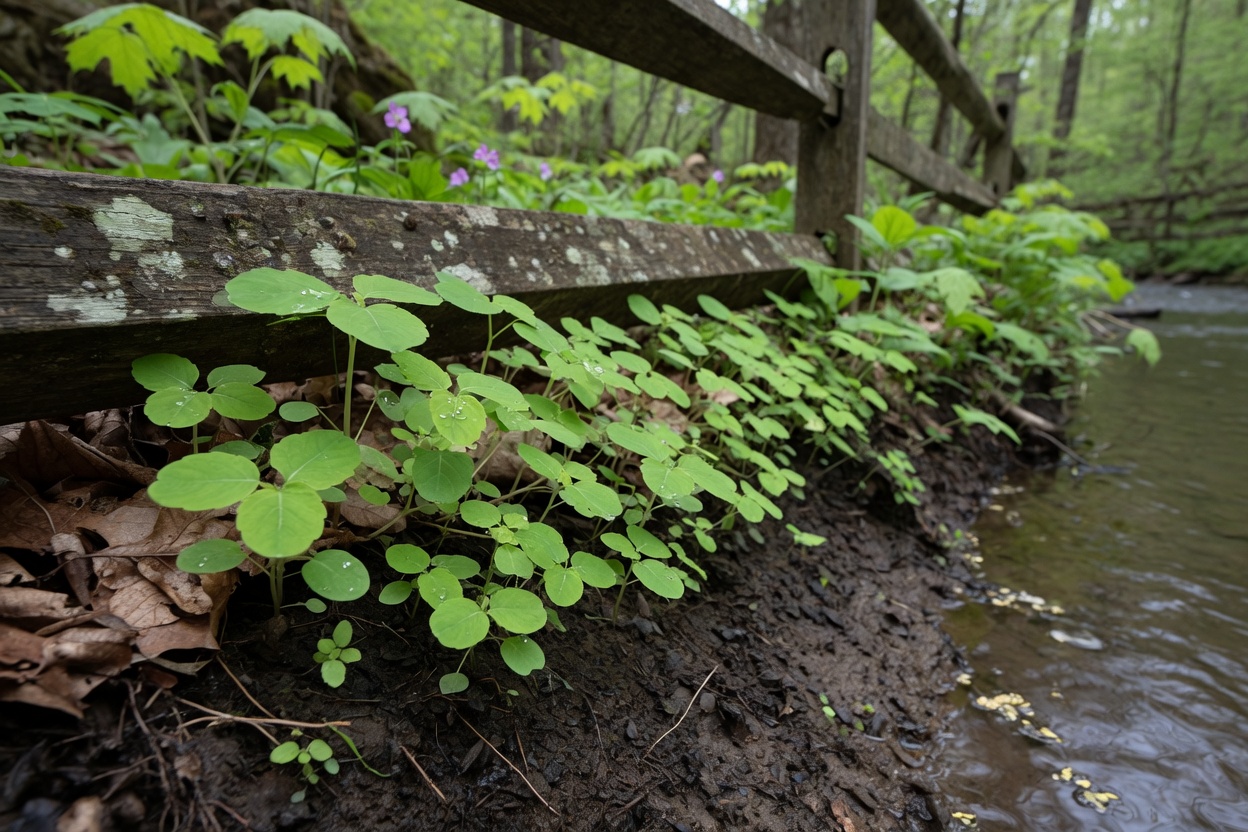
Pick a creek bank this winter, even in the cold, and look for the dead brown stalks lying flat in the leaf litter. Mark the spot. When the first soft green leaves come up in late spring, you’ll know exactly where to go.
If you’d like the mountain plants laid out one at a time, with how to tell each one from its kin, that’s what I put into Appalachian Medicinal Plants: Appalachian Medicinal Plants. And for another low, wet-ground plant to learn while the weather is slow, read how to forage and use lamb sorrel.
