How to Make an Herbal Solid Perfume From Your Own Dried Herbs
Make an herbal solid perfume from beeswax, jojoba, and the lavender and rose petals you already dry. The double-infused oil, the ratio, and the pour into tins.
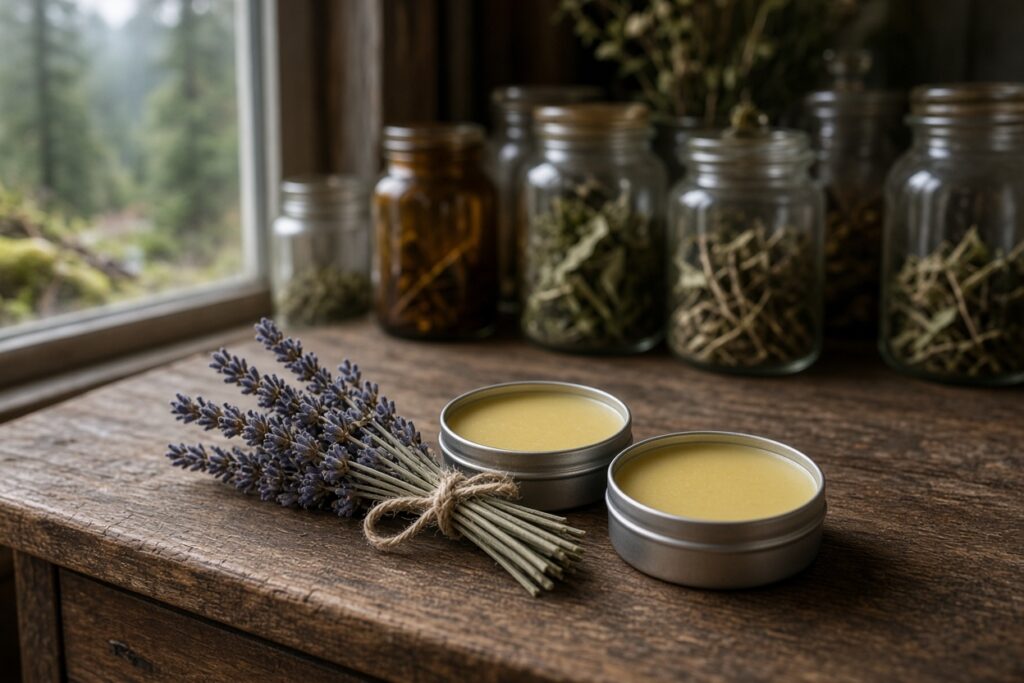
The week before Valentine’s Day last winter, a sleet storm took the power out across the north end of the Peninsula for most of a Saturday. I had a jar of lavender-steeped jojoba on the shelf, a handful of beeswax pellets, and a woodstove, and by dark I had poured my first solid perfume into a little tin that still sits on my dresser.
A solid perfume is the smallest, plainest thing I make: a scented oil set firm with wax, carried in a pocket tin, rubbed on the wrist with a fingertip. It asks nothing of you that a lip balm doesn’t. I’m writing it up in November because the oil wants a few weeks of attention, and the jars of lavender and rose petals I dried in July are as full right now as they’ll be all year. Start the oil this month and you’ll pour in early February with time to spare.
What a solid perfume is, and what it isn’t

Think of it as a firm salve that you make for the smell instead of for the skin. The wax-to-oil ratio sits close to a herbal lip balm, so it holds its shape in a warm pocket and comes off on a fingertip in a thin film. If you’ve made a salve or a balm, you already know every step here.
Be honest with yourself about what you’re getting. An oil steeped in dried garden herbs makes a quiet scent, the kind a person notices when they lean in, not across a room. It fades in an hour or two. I like that about it. If you want something that carries across a room, that’s what the perfume counter is for.
This is an aromatic craft and nothing more. I make these because they smell good and make a nice gift, and I make no claim about what they do beyond that.
The aromatics I already dry
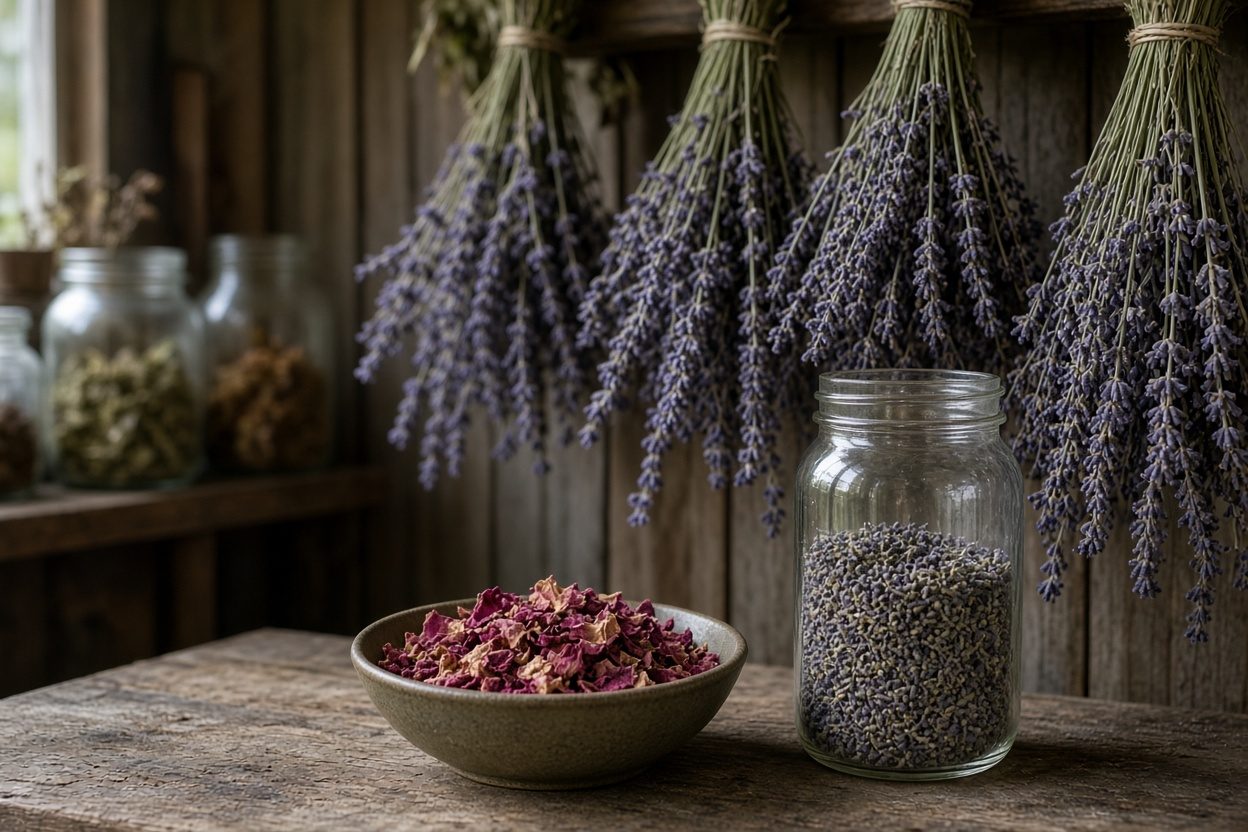
I stay with plants that hold their scent once dried and that I’d be drying anyway. Lavender (Lavandula species) is the workhorse. Sequim grows a great deal of it, and I keep a short row by the hoop house: ‘Grosso’, a lavandin with a sharp, resinous smell, and a few ‘Hidcote’ plants for something softer and sweeter. I cut the stems in July when the lower buds on the spike have just opened, hang them in bundles in the shed, and rub the buds off into a jar in August. Lavender gives you the most scent for the least trouble.
Rose petals are the one that disappoints people the first time. Dried petals from a fragrant old garden rose, or from the wild Nootka rose (Rosa nutkana) along the field edges here in June, give a soft, tea-like smell in oil, not the heady one you get with your nose in the bloom. I use rose blended with lavender, about one part rose to two parts lavender, so it rounds the lavender off rather than carrying the tin alone.
For anything you gather wild instead of growing, the usual line, said once: never use a wild plant on the word of one book, one app, or one article, this one included. Check it against more than one good guide and an experienced local forager, and when there’s real doubt, leave it. Pick roses away from sprayed roadsides and the edges of fields you don’t know the history of.
Everything that goes into the oil must be fully dry, crackling between your fingers. Fresh petals carry water, and water in an oil is how you get a tin of something gray and fuzzy by March. I keep my dried lavender and rose the way I describe in how to store dried herbs so they last, and old, faded herb makes a faded perfume, so use this year’s.
Double-infuse the oil

A single steeping, the way I’d make oil for a salve, isn’t strong enough for scent. I infuse twice. The full method is in how to make an herbal infused oil; here is the short version for a perfume.
Fill a pint mason jar about half full of dried lavender and rose and pour jojoba over it until the herb is covered by an inch. Stand the jar in a saucepan of barely-trembling water, the lid set loosely on top, and keep it there two to three hours. Low heat matters more for a perfume than for anything else I make. Overheated oil smells cooked, and that smell doesn’t leave.
Strain the oil through doubled cheesecloth, squeezing hard, then pack the jar with a fresh batch of dried herb and pour the same oil back over it. Warm it again, or let it sit on a sunny windowsill for two to three weeks if you’re not in a hurry. Strain once more, this time letting it drip through the cloth for a while so no fine bits of bud get through. The oil should smell clearly of lavender when you open the jar, not just faintly.
The ratio and the pour

For about four tablespoons of finished perfume, enough for two tins poured half full:
– 2 tablespoons beeswax pellets
– 3 tablespoons double-infused jojoba
Melt them together in a small clean jar set in the same pan of barely-simmering water, stirring with a bamboo skewer until the wax is completely clear. Before you pour, dip a cold spoon in the mixture and set it in the freezer for a minute. Rub it with a fingertip. If it’s too hard to pick up any on your finger, add a teaspoon of oil; if it smears soft and greasy, add a few more pellets.
Pour into the tins straight away and leave them open on the counter until they’ve set all the way through, an hour or so. Lid them only once they’re cool, or condensation collects under the lid. A half-full tin is plenty. One will last someone most of a year, and a shallow pour is easier to reach the bottom of with a fingertip.
If you want the scent stronger still, a few drops of lavender essential oil stirred in just before pouring will do it. I keep it to a very light hand, two or three drops per tin, since essential oils are concentrated and can bother skin. For gifts I usually skip it, for the same reason.
Honest notes on the gear

Beeswax pellets. They measure easily and melt evenly, which is all I ask. The catch for a perfume is that yellow beeswax has its own honey smell, and with a delicate scent like rose it competes. Lavender holds its own against it. Rose needs the double infusion.
Jojoba. It’s a liquid wax rather than a true oil, so it has almost no smell of its own and keeps far longer than olive or sunflower oil would, which is exactly what you want in a tin that sits in a drawer for months. It isn’t the cheapest oil on the shelf, but a perfume takes so little that one bottle covers years of these.
The 2 oz tins. Flat, light, and they fit in a coat pocket or a small purse. The lids are snug, which is good when it’s riding in a pocket, though the thin metal will dent if it’s dropped on a hard floor. I’ve lost one to a kitchen tile.
Patch-test it, label it, give it

Before you give a tin to anyone, rub a little on the inside of your own wrist and wait a day. Some people react to lavender or to beeswax, and some don’t find out until they try. Tell anyone you give one to that it’s for a dab on the wrist or behind the ear, not for broken or irritated skin, and to stop using it if it bothers them.
Label each tin with what’s in it and the date you poured it. Kept cool and out of the sun, a perfume made with dried herb and clean jojoba holds its scent for six months to a year; when it starts smelling flat or waxy, it’s done. I tie mine with a scrap of twine and a single dried lavender stem. If you’re making a few at once, the same beeswax and jojoba also make an herbal body butter, and a small tin of each makes a handsome pair.
Where the plant ends and the study begins

The pour takes an evening. Knowing which plants are worth growing and drying, when to cut them, and which wild ones you can gather with certainty is the longer study, and it’s the one I care about most. I go through it plant by plant in Pacific Northwest Medicinal Plants: how to identify each herb of this coast without guessing, when to gather it, and how the people before us prepared it. The wax and the oil are the easy part. The book is where you learn what’s worth steeping in them.
