How to Make a Western Red Cedar Salve for Winter Hands
A simple western red cedar salve for winter hands, made from foraged cedar tips, jojoba oil, and beeswax at your own kitchen table this holiday season.

By November my hands have already started to go. Twenty years of dish soap and cold garden hoses will do that to a person, and the Peninsula doesn’t help — the damp gets into your knuckles the way it gets into everything else out here. My grandmother’s answer to this was a coffee can of something greasy kept under the kitchen sink. Mine is a cedar salve, and it costs about the same to make.
Western red cedar (Thuja plicata) is the tree holding up half the understory around here, and it’s available every month of the year — no waiting on a spring flush of new growth the way you would with fir. That makes it the easiest thing I forage all winter, and the salve it makes is one I actually reach for daily, not one that sits in a drawer.
Know what you’re cutting before you cut it

Western red cedar has flat, scale-like sprays that feel almost braided up close, and if you turn a spray over you’ll see a faint white butterfly pattern pressed into the underside — that mark is the single best confirmation you’re holding cedar and not something else. The scent is the second confirmation: crush a few scales and it should smell sharp and resinous, closer to a cedar chest than to anything sweet.
The reason I make you do both checks is Pacific yew, which grows in some of the same wet, shaded draws and can superficially read as “another dark evergreen” to a hurried eye at a distance. Yew is a different genus entirely, with flat needles arranged singly rather than in cedar’s braided sprays, and it carries compounds that are genuinely dangerous. I’m not asking you to memorize a taxonomy — I’m asking you to look closely, every time, before the knife comes out. Never work from a book, app, or single source alone. Confirm with more than one reputable guide and, if you can, an experienced local forager. When in doubt, throw it out.
Once you’re certain, snip the last four to six inches of a few outer sprays with clean scissors or the small blade of a folding knife. A gallon zip bag loosely filled is more than enough for a batch. Leave the older, woodier growth on the tree — it has less of the aromatic oil you’re after and it’s not doing you any favors anyway.
Cedar’s traditional use here is old and well documented

The Coast Salish peoples of this region — including the S’Klallam, whose territory includes the stretch of the Peninsula I live on — have used red cedar for skin, for cordage, for canoes, for nearly everything, for longer than anyone’s been writing it down. Ethnobotanist Nancy Turner’s Food Plants of Coastal First Peoples, compiled with multiple Coastal First Nations, documents cedar’s use as a traditional topical remedy for dry and chapped skin among several of the region’s peoples. I didn’t grow up with that knowledge — I learned it from her book and from the herbalist I apprenticed under in Port Townsend — and I credit it here rather than claim it. What I can tell you firsthand is that the salve works the way my grandmother’s coffee-can grease worked, and that’s the traditional, topical claim I’ll make and no further.
Infusing the oil

Pack your cedar sprays loosely into a clean glass jar and cover them completely with jojoba oil — you want the plant material submerged, not floating with tips poking above the surface, or you risk mold in the parts that stay damp and exposed to air. Set the jar, lid on loose, into a saucepan of water kept at a bare simmer for two to three hours, checking the water level so the pan never runs dry. You can also do this the slow way, on a sunny windowsill for two to three weeks, but December has a way of arriving faster than that patience allows.
Strain the finished oil through a double layer of grade-90 cheesecloth into a clean jar, pressing the spent cedar hard at the end — there’s always more oil left in the plant than you’d guess. The oil should come out a soft, faint green-gold, and your kitchen should smell like the inside of a cedar chest for the rest of the day. That part I don’t consider optional; it’s most of why I keep making this.
If you’ve made an herbal infused oil before, this is the same process with cedar standing in for whatever you infused last. If you haven’t, that article walks through the mechanics in more detail than I’ve got room for here.
Setting it into a salve
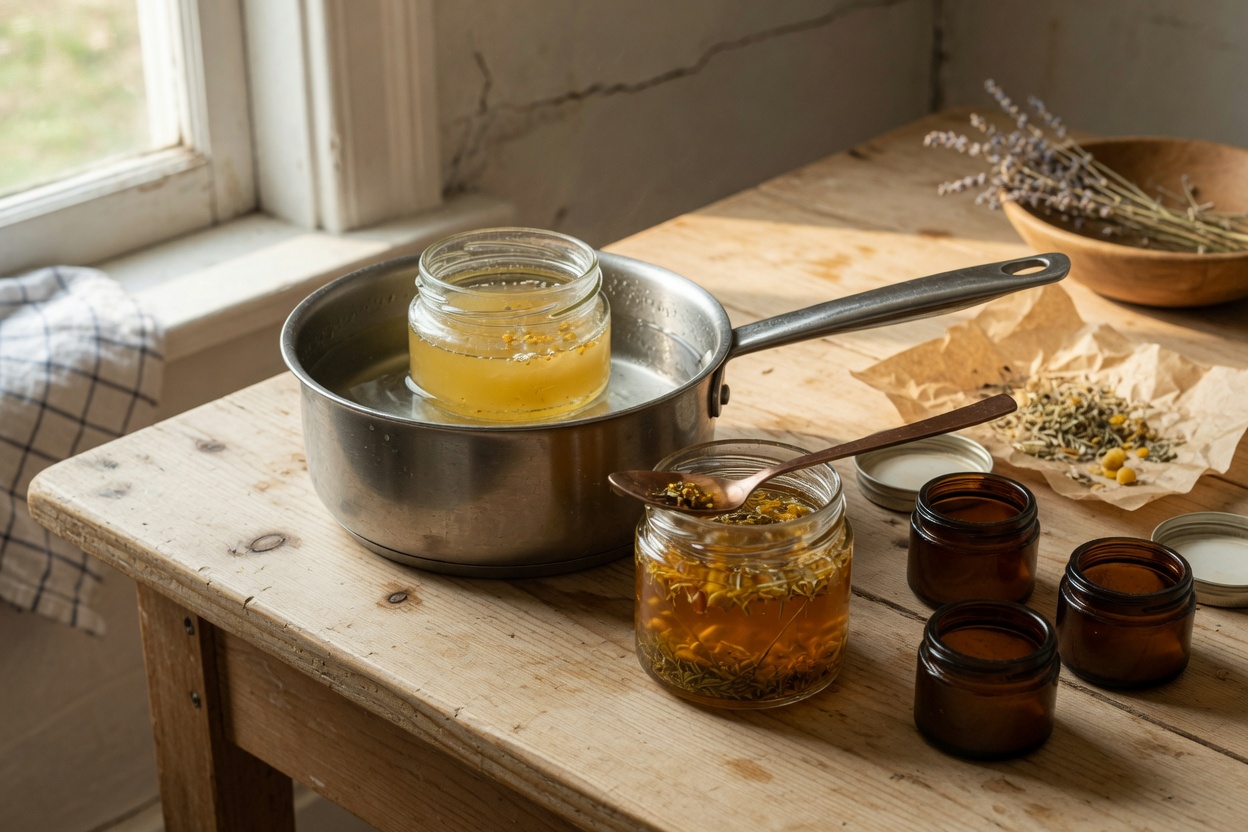
Combine the strained cedar oil with beeswax pellets at roughly four parts oil to one part wax, melted together gently over the same simmering water. Test the set the way I always do: dip a cold spoon in, let it firm for a minute on the counter, and check whether it’s soft enough to spread but firm enough to hold its shape in a tin. Too soft, add a little more wax. Too hard, a little more oil.
Pour while it’s still liquid into your 2 oz tins and set them somewhere flat and undisturbed to cool. I moved a batch too soon two winters ago and cracked the surface of every single tin — cosmetic, not fatal, but it bothered me more than it should have. Give it the hour. A full batch usually fills five or six tins, which is exactly enough for your own coat pocket and a few to hand off before the holidays.
What this salve is, and isn’t

This is a topical hand salve for the dry-knuckle, cold-wind kind of winter we get out here — the traditional, everyday use cedar has had in this place for a very long time, and the one I use it for myself. It isn’t a treatment for anything past that, and I’d rather say so plainly than let a jar of oil and wax imply more than it can deliver. If you’ve got skin that’s cracked and bleeding rather than just dry, that’s a job for a doctor, not a tin from my kitchen.
Keep a tin by the kitchen sink and one in your coat pocket. That’s the whole system, and it’s held up for me for longer than I’ve been keeping track.
Where this fits in the bigger picture

A cedar salve is a fine place to start if you’ve never made one before, but it’s really just one plant out of the hundred-some I cover in Pacific Northwest Medicinal Plants — how to identify each one with certainty, when to gather it, and how it’s traditionally been prepared and used on this coast. If you want the fuller method behind any salve, mine or otherwise, my first herbal salve walks through the basics start to finish. The cedar is just the plant I happen to reach for once the rain sets in.
