How to Label and Date Your Homemade Herbal Preparations
Learn how to label herbal preparations so you can trust them months later: what to write, what holds up on glass and tin, and a simple system for gifts.

Every January I find one. Somewhere at the back of the pantry shelf, behind the good honey, there is a pint jar of something brown with a strip of tape that says only “root.” Root of what, dug where, steeped in what, and when? I can’t tell you. I open it, sniff it, and pour it on the compost, because a preparation I can’t identify is not a preparation. It’s a risk.
I’ve been putting up herbs for more than thirty years, and the single habit that has saved me the most grief is not a recipe. It is writing things down on the jar the day I make them. If you are about to fill your shelves for winter, or about to make gifts for the holidays, this is the part to get right before the jars multiply.
You’ll also want masking tape or painter’s tape, a fine-point permanent marker, and a pencil. I haven’t found a label product I’d put my name to, so I’m not linking one. Plain tape and a good marker have carried me this far.
What a label has to say

A label is a short record, not a decoration. After years of unlabeled and half-labeled jars, here is the list I settled on. Every jar gets all of it, even the small ones.
The plant, by common and Latin name. “Elderberry” will do for most of us, but blue elderberry, Sambucus cerulea, is what grows on my side of the Cascades, and the Latin name settles arguments. If a plant has a look-alike, the Latin name is the thing that tells you which one you actually picked.
The part used. Root, bark, leaf, flower, berry. A leaf infusion and a root decoction of the same plant are different things, and I have mixed them up on my own shelf.
Fresh or dried. This matters for shelf life and for safety. A jar of fresh plant in oil is a different animal from a jar of dried plant in oil, and I’ll say more about why below.
What it’s in. Alcohol, glycerin, vinegar, oil, honey, water. Include the ratio if you measured one, such as 1 part herb to 5 parts liquid. When I look at a jar in March, I want to know whether it’s a tincture, a vinegar, or an oil without opening it.
The date made. Month and year are enough for most things, but I write the full date. A second date, “ready” or “strain on,” saves you from the jar that sits steeping three months past its welcome.
Where it came from. For anything wild-gathered, I write the place in short form: “Dungeness, lower bank” or “back fence.” This is partly for me and partly for honesty. If I ever have a question about a batch, knowing the patch tells me whether the ground was clean.
A system that doesn’t fall apart

I learned the hard way that a label with eight fields written by a tired person at nine at night turns into scribble. So I use shorthand and a log.
My shorthand runs top to bottom on a single strip of tape: plant name, part, then “dry” or “fresh,” then the liquid, then the date. A line might read “Dandelion root / dry / glycerin 3:1 / 10-10-26.” That fits on a pint jar and it’s readable from across the kitchen.
The log is a small spiral notebook that lives on the shelf. Every batch gets a number, I put the number on the jar, and the notebook holds the long version: where I dug, what the weather had been doing, how much I made, what I’d change next time. When I lost most of a batch of berry tincture to a rushed straining job, the notebook is where I wrote down why. It is also the thing I’d reach for if anyone ever asked me what was in a given jar. I’d recommend it to anyone, and I mean that more than I mean most advice.
What actually sticks to glass, tin, and oil

This is where the practical grief lives. I’ve tried most of the options over the years, and here’s the honest report.
Masking tape and a permanent marker is my default. It’s cheap and it peels off clean, which matters when you reuse jars. The drawback: it lets go in damp or greasy conditions, and a salve jar that’s been handled with oily fingers will shed its tape in a few months. I press it down hard and write over a smooth spot, not across a seam.
Writing directly on the glass with a paint pen or a china marker works on a dry, clean jar and survives a wipe with a damp cloth, but it won’t survive a wash. I use it for the date only, as a backup.
Tins are the tricky one. The lid is the obvious place for a label, and the lid is also the part that gets swapped and lost. Write the plant and the date on the bottom of the tin with a permanent marker as well. When a lid wanders, you still know what you’ve got. I’ve handed out tins with a labeled lid and an anonymous base, and I’ve regretted it when the lid went missing.
Pencil is the sleeper. On a paper or tape label, a soft pencil doesn’t smear when it gets damp, and it doesn’t fade like some inks do in a sunny window. For a jar that will sit in the pantry all winter, I’ll use a pencil before I’ll trust a cheap marker.
Whatever you use, keep the jars out of direct light. Light fades ink and breaks down a good many plant preparations. A cupboard beats a windowsill every time.
Fresh versus dried, and why the label matters
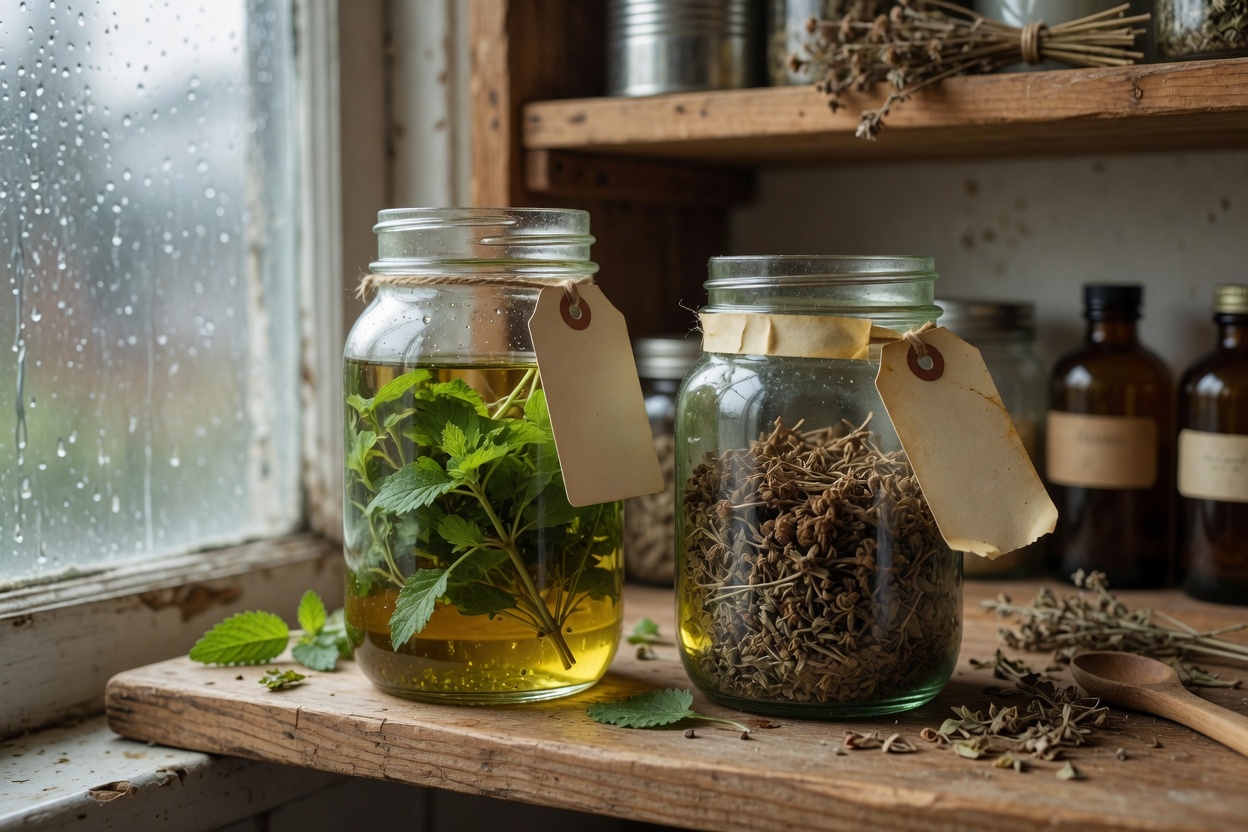
This is the one place I’ll get serious. Anything made with fresh plant in oil, with no alcohol and no vinegar to protect it, is a place where bad things can grow, and some of them are dangerous. That’s the reason my label says “fresh” or “dry” in plain letters, and the reason I make oil infusions from dried herb. I wrote about the method in how to make an herbal infused oil, and the same caution applies to anything you put in a gift box.
If a jar has no date, I don’t use it. If a jar has a date and it has gone cloudy, bubbled, or smells wrong, I don’t use it either. As a rough guide from my own shelf, oils and salves are at their best within a year, and glycerites about the same. Alcohol tinctures last much longer. That’s a rule of thumb, not a law, and your own nose is the last word. I covered storage in more detail in how to store dried herbs so they last.
Labeling for gifts

If a jar is leaving your house, the label is no longer only for you. Someone else will open it with no idea what it is. For holiday gifts, I add three things to the strip I use at home.
First, a full ingredient list, including carrier oils and beeswax, since people have allergies to things you wouldn’t think about. Second, “for external use only” on salves and balms, in plain words. Third, the date it was made and a “best within a year” note.
I don’t write what a preparation is “for.” I describe what is in the jar and how my family has used it traditionally, in a line or two on the gift card, and that’s all. I’m not a practitioner and I won’t hand out advice dressed up as a label. If you’re building a whole set, my notes on how to make herbal gift sets for the holidays walk through what goes in the box.
One last habit

At the end of each season, I pull everything off the shelf and read every label. Anything with a faded date, a missing plant name, or a lost lid goes out. It takes twenty minutes and I always find something. The jars I’m proudest of are never the ones I remember making, which is the whole argument for writing it down.
And of course the label starts with the identification. Never gather or prepare a wild plant on the word of a book, an app, or a single source, including this page. Confirm every plant with several reputable guides and, if you can, an experienced local forager. When in doubt, throw it out.
If you want the plants themselves, which to gather, how to tell them from their neighbors, and how they were prepared here long before any of us wrote it down, that’s what I put in my book, Pacific Northwest Medicinal Plants. The label is only as good as what you knew when you wrote it.
