How to Identify Appalachian Medicinal Plants in Winter
How to identify Appalachian medicinal plants in winter — the mullein, rabbit tobacco, witch hazel, white pine, and sumac I can still find on the mountain when the woods go bare.
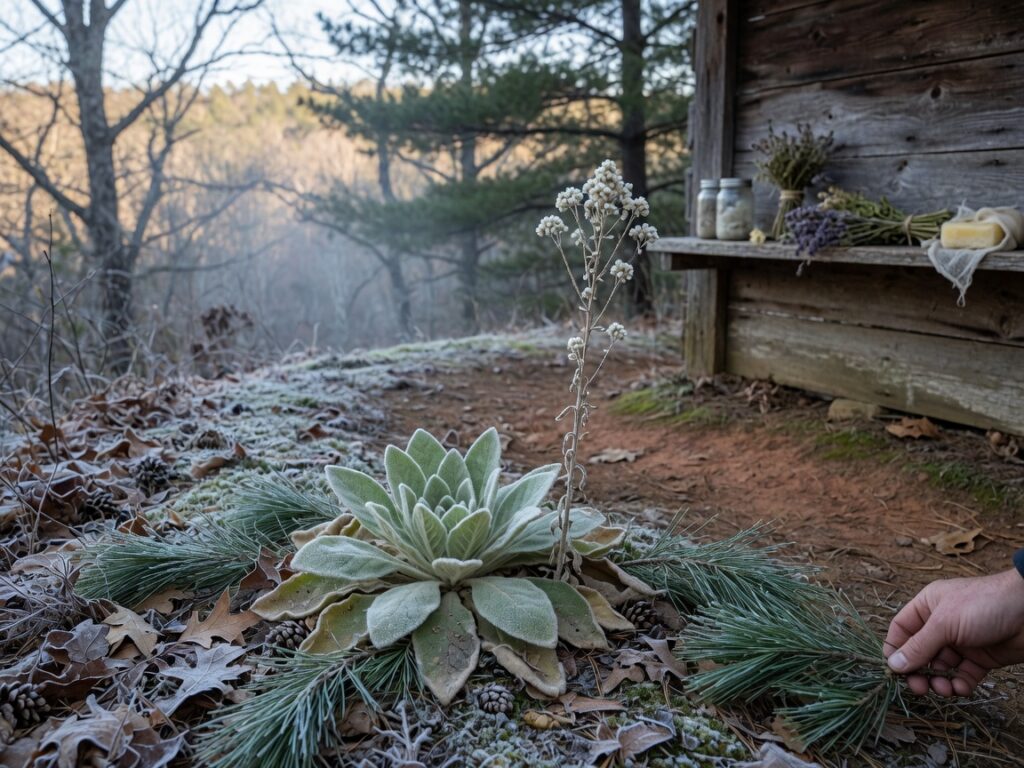
Most people up here hang up the basket after the fall dig and figure the plant year is finished until the ramps come in. My grandmother never did, and neither do I. Winter is when the woods go quiet and honest. The flowers are gone, the summer green that hides everything has fallen away, and what’s left standing is the very thing that teaches you to know a plant by its bones: a bare twig, a dried seed head, a rosette flat against the cold ground.
I’ve walked the same coves outside Marshall, in Madison County, in January for the better part of forty years. What follows is a working list of the medicinal plants a beginner can learn to find here in the cold months, and how I tell each one when there’s frost on the ridge. I’m not going to send you out to dig at-risk root in the dead of winter. This is a season for learning the plants and gathering the few that are honestly gathered now.
One rule first, and I’ll say it plainly the once, because you’re grown: winter identification is harder than summer, not easier. The flower and the full leaf that would confirm a plant for you are gone, so a dried stalk or a bare twig can fool a hurried eye. Learn a plant while it’s growing before you trust yourself to it in winter, confirm it against more than one good guide, and never use a wild plant on the strength of a single source. When in doubt, leave it be.
Mullein, the rosette flat on the ground
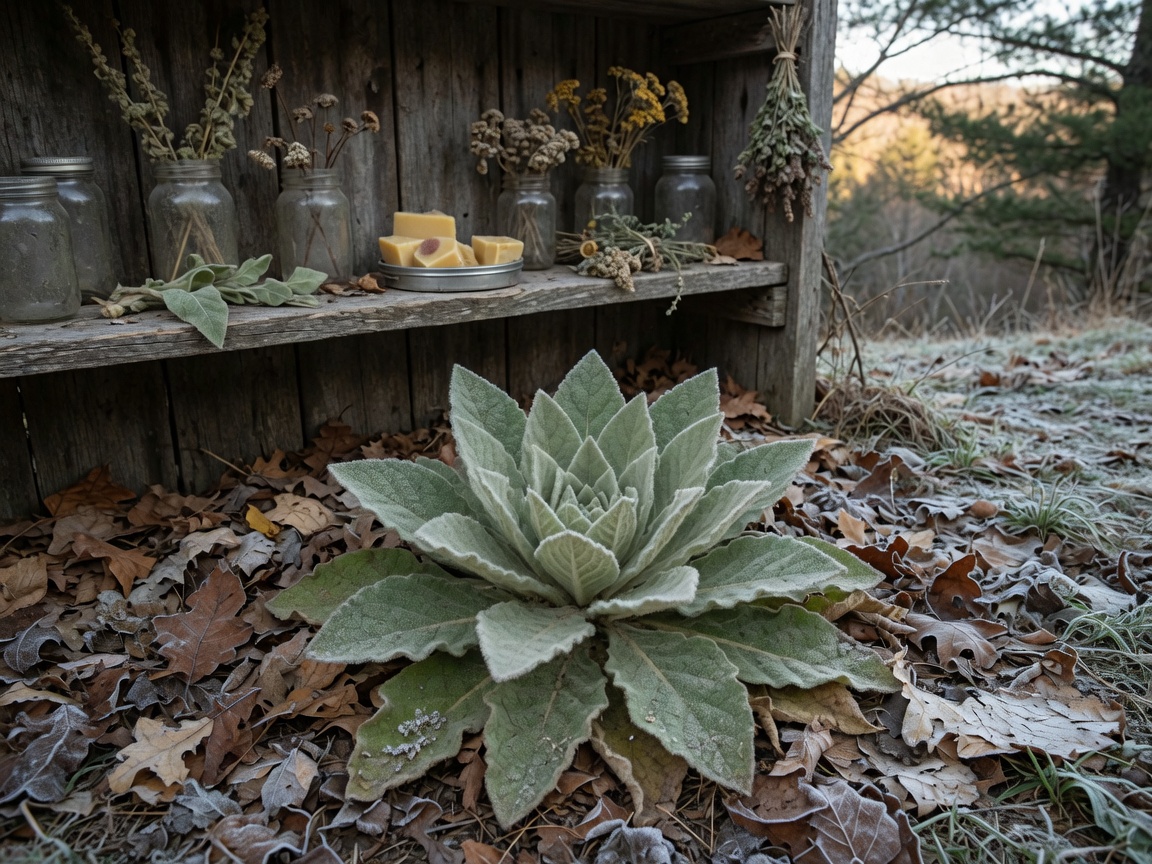
The easiest winter plant to learn here is common mullein (Verbascum thapsus), what the old people on this mountain called flannel-leaf or velvet-dock. In summer it throws up a tall spike of yellow flowers you can’t miss, but in winter it does something more useful for a beginner: the first-year plant sits out the cold as a flat rosette of thick, pale, felted leaves, soft as a lamb’s ear, pressed close to the bare ground where nothing else is growing.
You’ll find it in the same disturbed, sunny ground it always favors: roadsides, old pastures, the edge of a gravel lot, a cut bank. Run your thumb across a leaf and you’ll know it at once; nothing else in a winter field is that woolly. Beside the living rosettes you’ll often see last year’s dead stalk still standing, tall and gray with its seed capsules, which is a good confirming marker.
Mullein leaf has been used in these mountains for the chest and the cough as far back as anyone’s grandmother remembers, dried for a tea or infused into an oil. I’ll leave it at traditional use and let you read further before you lean on it. As a plant to learn, though, the winter rosette is the friendliest teacher on the mountain.
Rabbit tobacco, standing silver in the field
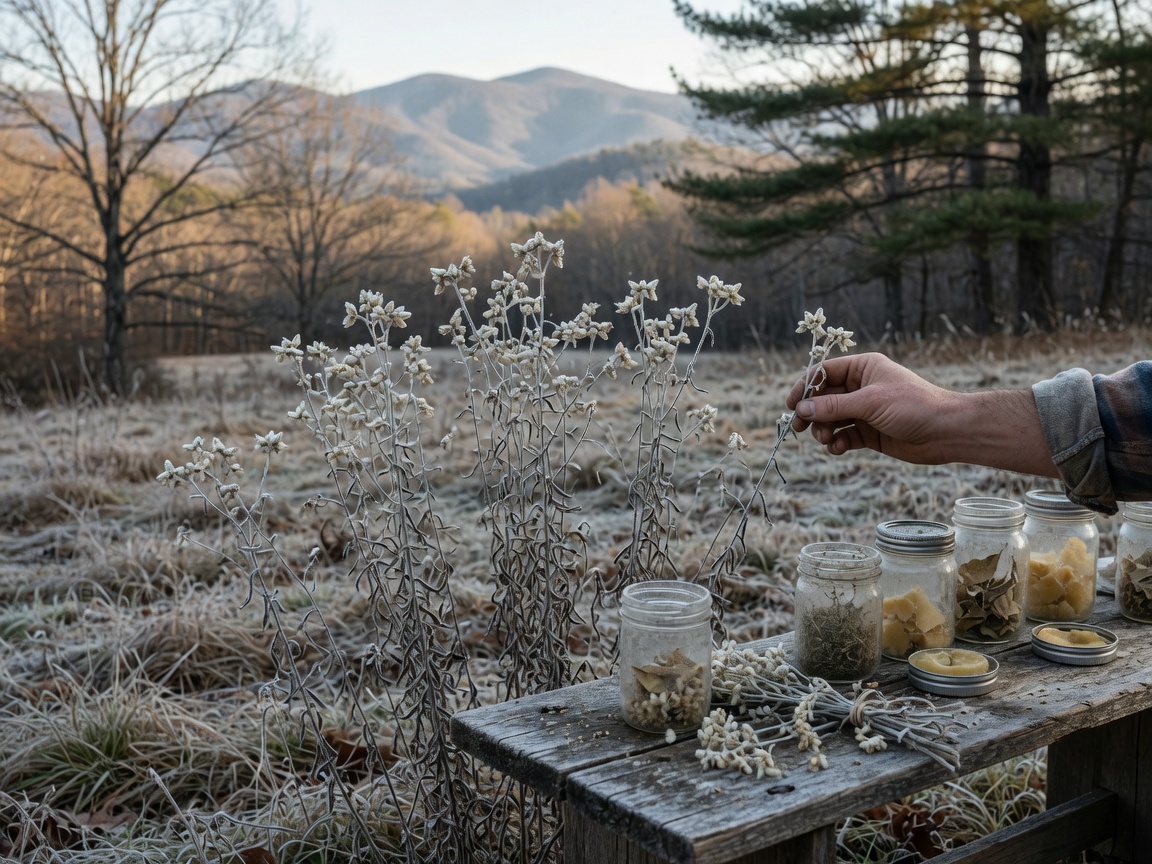
If you grew up in the southern mountains you may already know rabbit tobacco, and if you don’t, winter is the season it announces itself. Sweet everlasting (Pseudognaphalium obtusifolium) dries to a pale silver-white and stands stiff and upright in old fields and roadside edges all through the cold months, long after the softer weeds have fallen over. Crush a bit of the dried flower head between your fingers and you’ll catch the scent that gives it away, a sweetish, maple-and-tobacco smell that nothing else out there has.
The whole standing plant is silvery and woolly, a foot or two tall, with narrow leaves and clusters of small, papery, straw-colored flower heads at the top. That combination of the height, the silver wool, and above all the sweet crushed-leaf smell is how you separate it from the other gray dead weeds around it.
Rabbit tobacco is one of the deep folk plants of Appalachia, traditionally dried and smoked or steeped for the chest and the head-cold. The Cherokee, whose homeland this is, used it as well; I learned about that from books, and I’d point you to Paul Hamel and Mary Chiltoskey’s Cherokee Plants and Their Uses as a documented, respectful source rather than take the credit for knowledge that isn’t mine. Gather the standing dry heads on a dry day and they’ll keep on the shelf as they are.
Witch hazel, the shrub that flowers in the cold
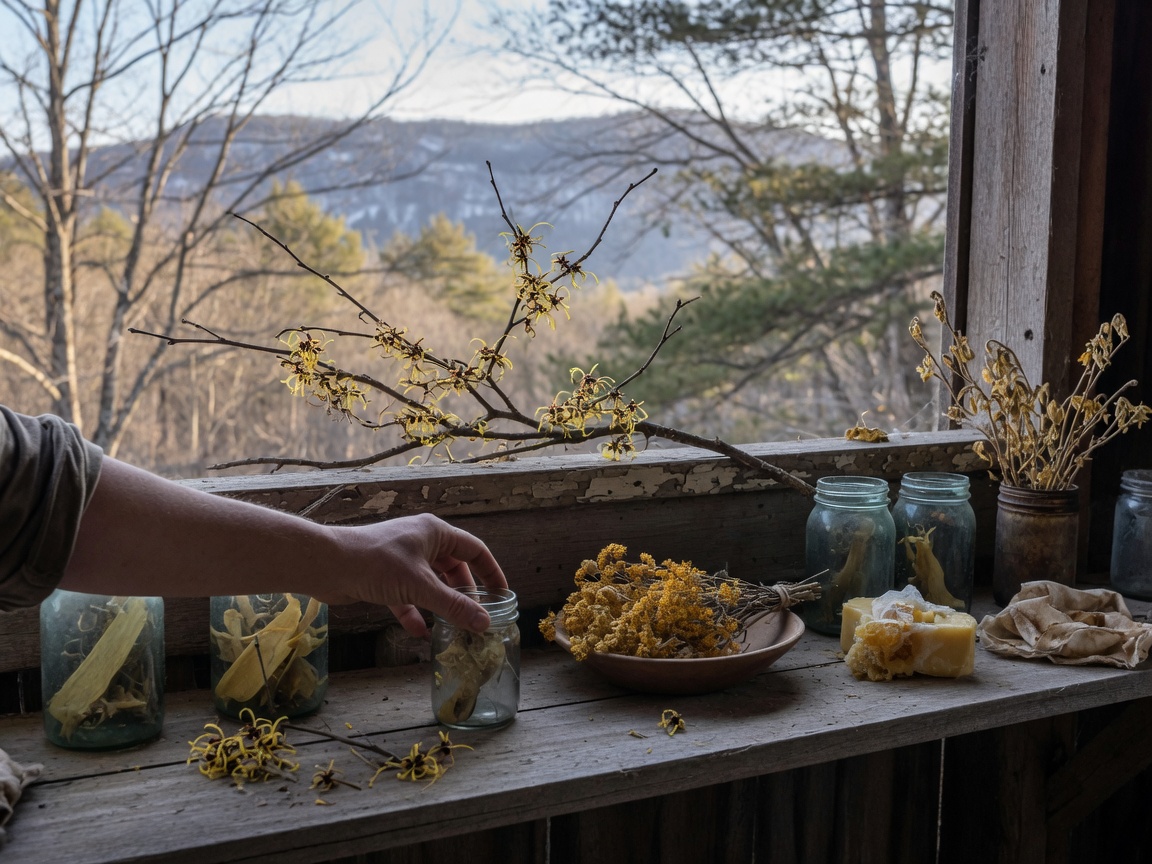
Here is the one plant on this list that does the opposite of everything around it: witch hazel (Hamamelis virginiana) waits until the leaves have dropped and the woods have gone bare, then opens strange, spidery yellow flowers along its gray twigs, sometimes right through the first hard frosts of late fall and into winter. Once you’ve seen those thin, crumpled, ribbon-like petals on an otherwise naked branch on a cold day, you’ll never mistake the plant again.
It’s an understory shrub or small crooked tree of moist wooded slopes and creek banks, with smooth gray bark and a forked branching habit. That forked branch is the one the old water-witches cut for divining, which is where the name comes from. The seed capsules from the year before sit on the same twigs as the fresh flowers, another good winter tell.
Witch hazel bark and leaf have a long-standing use as an astringent wash, and a distillation of it still sits in half the medicine cabinets in this country. Trim a few twigs from a healthy shrub, never strip one bare, and you have something worth learning to prepare. As always, traditional use is the whole of what I’ll claim for it.
Eastern white pine, green against the snow
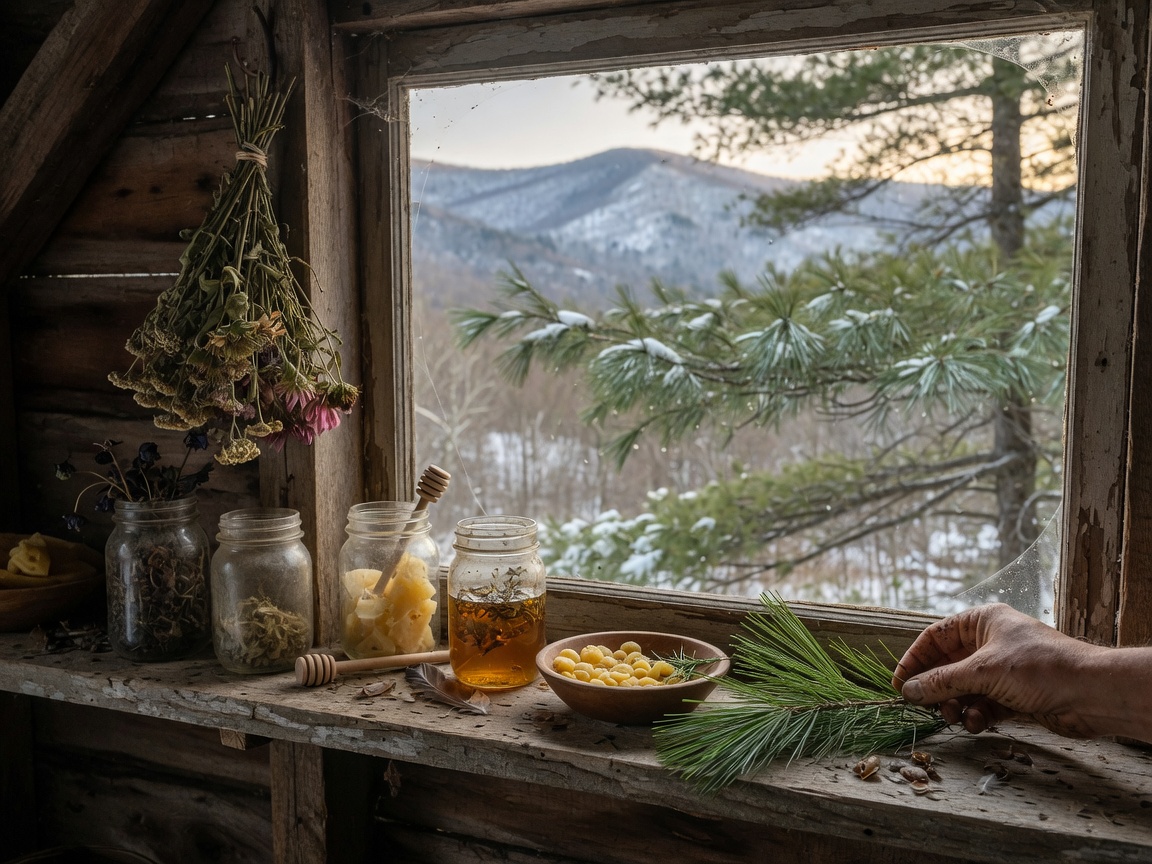
When the hardwoods are bare, the evergreens are suddenly the most visible thing on the ridge, and the friendliest of them to a beginner is eastern white pine (Pinus strobus). The tell is simple and worth memorizing: white pine carries its soft blue-green needles in bundles of five, and the word white has five letters to help you remember. Our other common mountain pines hold their needles in twos and threes and are stiffer to the touch. Count the needles in a bundle and you’ve settled it.
A small handful of the young needles, snipped fine and steeped rather than boiled, makes the winter tea that mountain families and the Cherokee both relied on through the cold season, tart with what we’d now call vitamin C. Strain it through a bit of cheesecloth to catch the fine bits. I go deeper on making that tea properly in a separate piece; here it’s enough to be able to stand under a pine in January and know for certain which one you’re under. Steep gently and keep it as a pleasant, traditional winter drink, nothing more.
Sumac, red cones above the snow, and the one to avoid
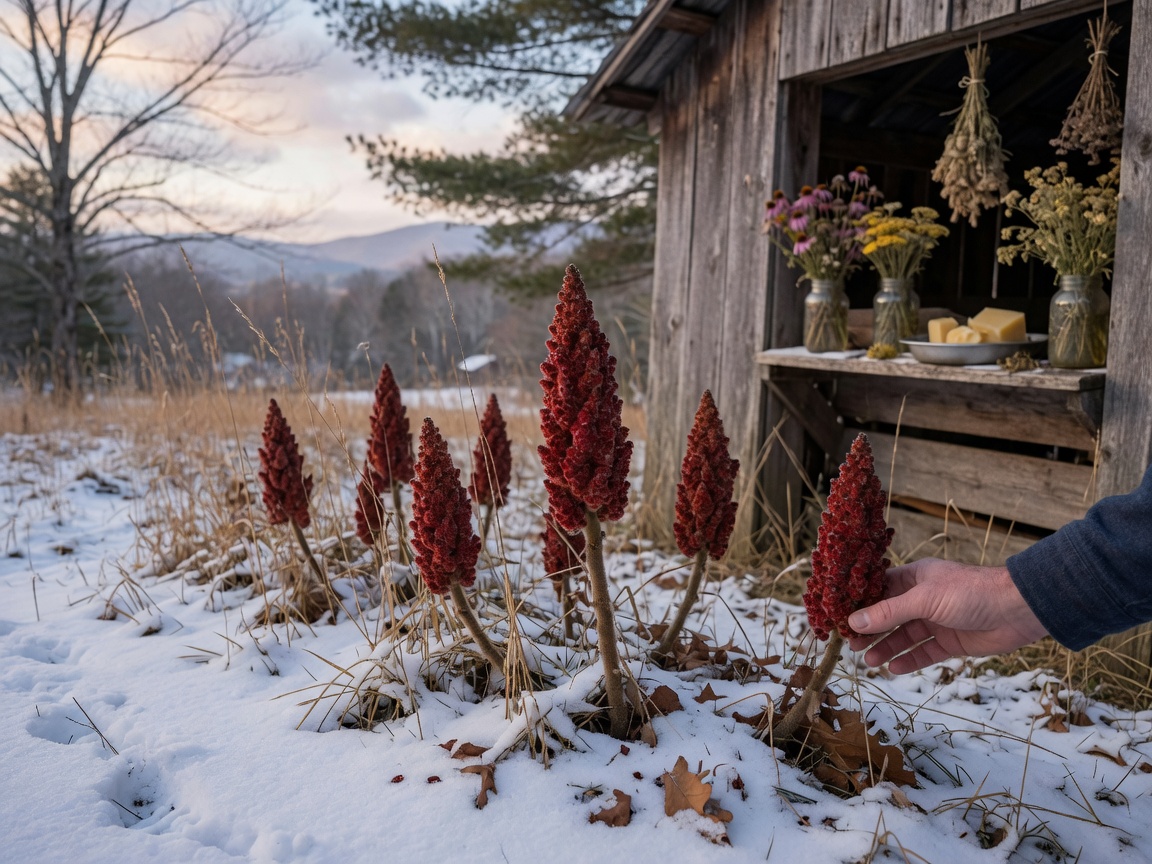
The last one carries the most important safety lesson of the winter, so read it close. Our staghorn and smooth sumacs (Rhus typhina and Rhus glabra) hold their fuzzy, dark-red, upright seed cones at the tips of their branches straight through winter, standing up above the snow along fencerows, old fields, and roadsides all over these mountains. Those tart red cones, steeped in cool water and strained, make the pink “sumac-ade” mountain children have always drunk.
Now the hard line. There is a plant called poison sumac (Toxicodendron vernix), kin to poison ivy, and it will blister you. But it tells on itself if you know one thing: poison sumac carries *white or pale gray berries that droop down in loose clusters, and it grows only in wet swamps and bogs, not the dry, sunny ground our good red sumac likes. Red cones standing up on dry ground: our sumac. White berries hanging down in a wet bog: leave it, and don’t touch it.* Learn that difference cold before you gather a single head. When two plants share a name and one of them hurts you, the identification is not a detail. It’s the whole job.
Bringing a winter’s gathering home
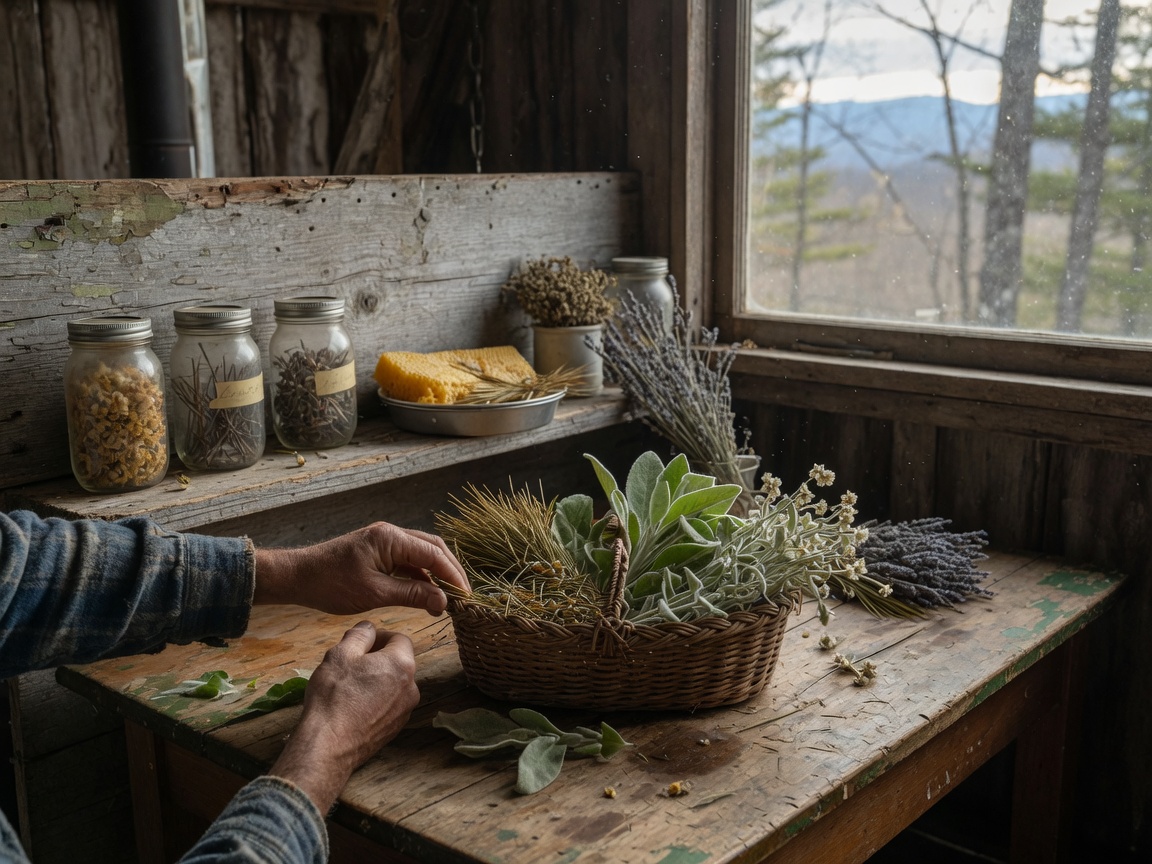
The finding is half of it. The other half is putting up the little a winter honestly offers so it’s still good come spring. Dry your mullein leaf, your rabbit-tobacco heads, and your sumac cones fully. Spread them in a single layer, out of direct heat, until they’re truly crisp, then store them in clean glass jars in the dark. Anything put away the least bit damp will mold instead of keep. I reuse canning jars I already have for this, so I won’t send you off to buy any.
For the mullein leaf and the resinous odds and ends, I go the salve route while the weather’s cold and I’m indoors anyway. Warm a jar of jojoba oil with the dried leaf infused in it, strain it clean through cheesecloth, melt in beeswax pellets at about an ounce of wax to a cup of oil, and pour it into two-ounce tins. Label every tin with the plant and the date. You will not remember by March; I have the drawer of unmarked tins to prove it.
Which plant, in which season, and every honest caution about the ones that mimic it: that’s the part that runs longer than a single post, and it’s the part I care about most. I put all of it into my book, Appalachian Medicinal Plants: how to know the plants of these mountains without guessing, when to gather each one, how the granny-women before me used them, and how to harvest the at-risk ones so there’s still some for the grandchildren. Winter is the season you learn the bones of a plant. The book is how you’re ready when the green comes back.
