Foraging Witch Hazel Bark for a Mountain Astringent
How to forage witch hazel bark in the Appalachian mountains and make a simple traditional astringent — where to cut it, how to prepare it, and how it's used.

Witch hazel is one of the few things worth cutting in these mountains once the leaves are down and most everything else has gone quiet for the year. It flowers in the late fall and into winter, little yellow ribbon-shaped blooms on bare branches when nothing else is blooming, which is how most people around here learn to spot it in the first place — you notice the one shrub still flowering in November and go looking closer. I’ve been cutting bark and twigs off the witch hazel on our place every fall for thirty years, and the astringent I make from it is one of the plainest, most useful things in my cabinet.
Hamamelis virginiana, common witch hazel, grows as an understory shrub or small tree through these coves and along the creek banks, usually in the dappled shade under bigger hardwoods. If you know it as the bottle on the drugstore shelf, this is where that comes from — the same plant, just made at home instead of in a plant.
Finding it and knowing it

Look for witch hazel where the ground is a little damp and the canopy is broken — the edge of a cove, along a branch or creek, the margin of an old field growing back up. The leaves, when they’re on, are lopsided at the base and wavy-toothed along the edge, easy to mistake for a hazelnut leaf if you’ve never handled both side by side. But the real tell, the one that makes an ID certain, is the bloom time. Witch hazel flowers in October and November here, after its own leaves have mostly dropped — thin, crinkled, pale-yellow petals that look almost like they got left out in the rain too long. Nothing else in these woods is blooming that late. If you find a shrub flowering in November, you’ve very likely found your plant, and the leaf shape and smooth gray bark confirm it.
The Cherokee, among other Appalachian and eastern peoples, used witch hazel bark and twigs medicinally long before it ever showed up in a drugstore — documented in Daniel Moerman’s Native American Ethnobotany, which credits specific nations’ plant knowledge rather than folding it all into one vague tradition. What’s sold in stores today is a direct descendant of that traditional use, adapted and commercialized. I’m passing along what I’ve learned from sourced material like that and from thirty years of making my own, not claiming it as knowledge that started with me.
Harvesting bark and twigs without hurting the shrub
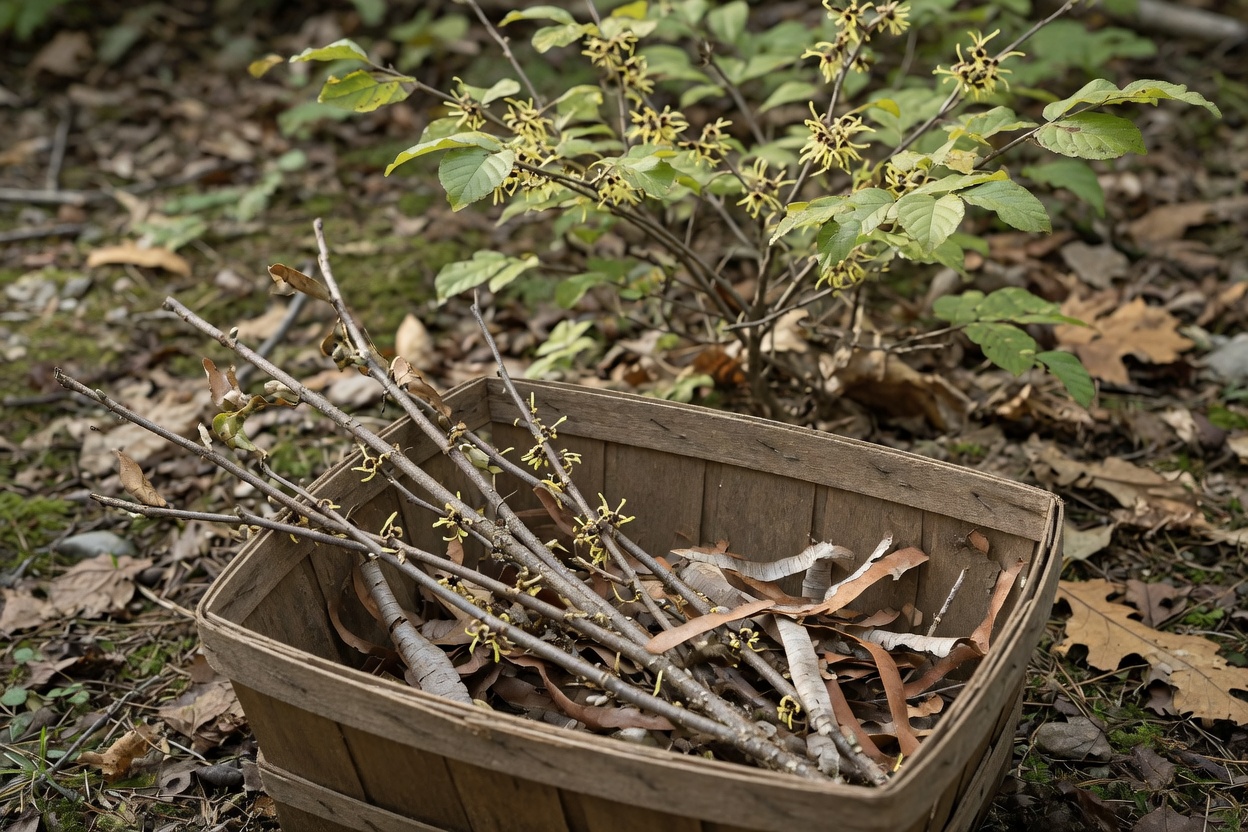
I take small twigs and short strips of bark from young growth, never from the main trunk of an established shrub, and never all from one plant. Witch hazel suckers and branches out readily, so a light harvest across several shrubs on the property does less damage than a heavy one off a single plant, and the shrub recovers fully by the next season either way if you’re not greedy about it.
Use the hori-hori to cut small twigs cleanly at a joint, and to take thin strips of bark from a young branch rather than girdling anything — a strip taken around the full circumference of a branch will kill everything above the cut, so I only ever take a partial strip lengthwise, leaving most of the bark intact. The inner bark and the twigs themselves both carry the tannins and volatile oils that make the astringent work; you don’t need much material for a batch that’ll last you the winter.
Making the astringent

This is a plain decoction, nothing fancier than what my grandmother did in her own kitchen. Chop the fresh bark and twigs into small pieces, cover them with water in a pot — I use roughly a cup of chopped plant material to three cups of water — and simmer gently for twenty to thirty minutes, not a hard boil. The water will darken and take on witch hazel’s faintly woody, slightly medicinal smell as the tannins release.
Strain the liquid through doubled cheesecloth into a bowl to catch every last bit of bark and twig, then pour the strained liquid into a clean wide-mouth mason jar. Because there’s no alcohol in this simple version, it won’t keep at room temperature the way the drugstore bottle does — I store mine in the refrigerator and use it up within a couple of weeks, making a fresh small batch as needed through the fall and winter rather than trying to put up a year’s supply at once.
How it’s traditionally used

Witch hazel’s traditional use is squarely topical and cosmetic — an astringent for the skin, applied to minor scrapes, insect bites, and irritated skin, and used as a simple face toner the same way the commercial bottle is used today. I keep a small jar by the sink through fall and winter and use it exactly the way you’d use the store-bought kind, dabbed on with a cotton pad.
I want to be plain about what this is and isn’t: it’s a traditional, topical skin preparation, not a treatment for any medical condition, and I’m not telling you it cures anything. If you have a wound that isn’t healing or skin trouble that’s more than minor irritation, that’s a matter for a doctor, not a jar of home-brewed witch hazel water.
A note on the plant itself, since it comes up: witch hazel isn’t on the at-risk list the way ginseng, goldenseal, and bloodroot are around here. It’s a common, fast-recovering shrub, and a light, spread-out harvest for personal use doesn’t put any real pressure on it — which makes it a good plant to start with if you’re new to cutting from the woods and want to practice good harvest habits on something forgiving before you ever go near the plants that do need real restraint.
There’s a lot more of this kind of plain mountain-apothecary practice — what to gather, when, and how to use it honestly — in Appalachian Medicinal Plants. This post is one shrub for one season. The book is the whole mountain year.
