How to Forage and Use Wild Violet, Leaf and Flower
Forage wild violet the honest way — how I tell a true Viola from its lookalikes, when to gather leaf and flower, and how I turn them into tea, oil, and syrup.
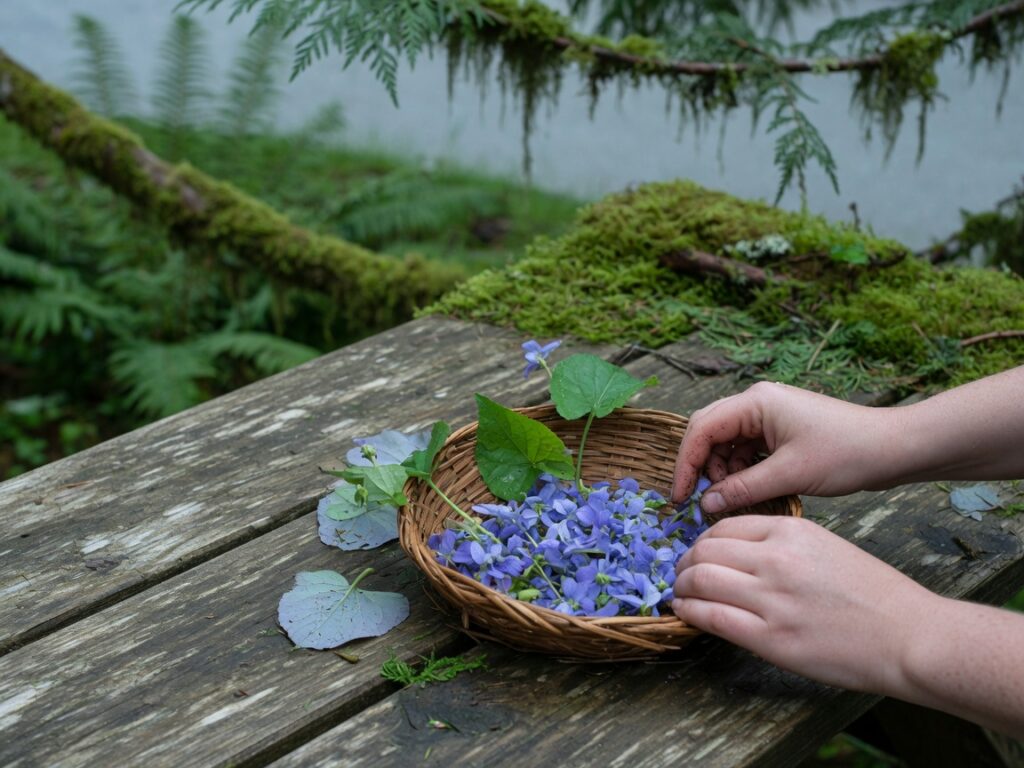
The violets come up early here, in that stretch of the year when the ground is still cold and everything else is holding back. Along the damp, half-shaded edge of my side garden outside Sequim, the little heart-shaped leaves show first, and then a scatter of deep blue-purple flowers close to the ground, each one nodding on its own thin stalk. I’ve watched them arrive in the same spot for close to thirty springs, and I still crouch down to gather a handful. Wild violet is one of the gentlest plants a beginner can start with — abundant, mild, and useful in both the kitchen and on the shelf.
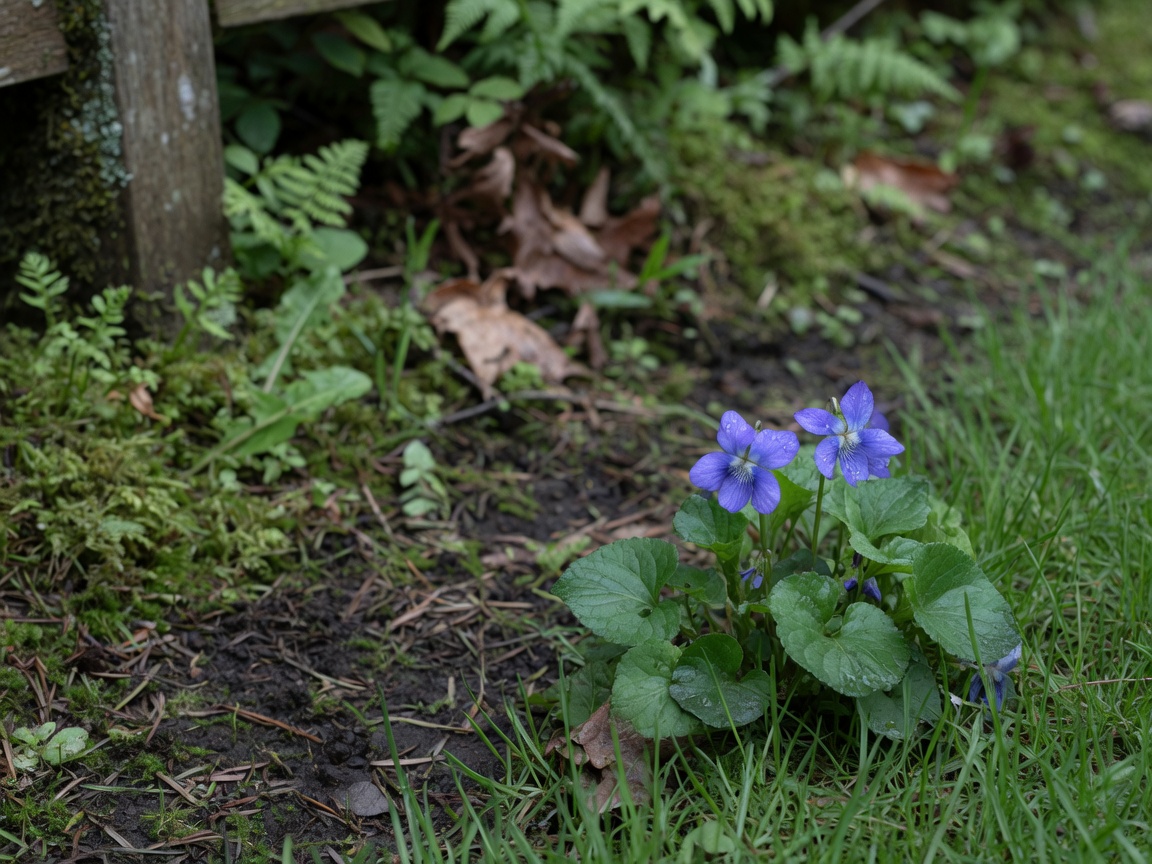
Wild violets belong to the genus Viola, and there are several worth knowing on this coast: the early blue violet (Viola adunca) native to our woods and meadows, the common blue violet (Viola sororia) that turns up in lawns and disturbed edges, and the sweet violet (Viola odorata) that escapes from old gardens. Their leaves and flowers have been gathered and used for generations, and unlike a lot of wild plants, the blue-and-white violets are forgiving ground for someone still building confidence.
Identify it before you trust it
Here is the rule I follow and won’t bend on: never eat or brew a wild plant you can’t name with certainty, confirmed against more than one reliable source and, when it matters, an experienced local forager. When in doubt, throw it out. Said once, plainly, and I’ll trust you to carry it like an adult.
A true violet gives you a clear set of tells. The leaves are heart-shaped to kidney-shaped, scalloped along the edge, and they grow straight up from the base of the plant, each on its own stem. The flower has five irregular petals — two standing up, two out to the sides, and a broader lower petal that makes a little landing pad, usually marked with fine darker lines running into the throat and a small spur pointing back behind the flower. Each flower sits alone on a leafless stalk that bends over at the top so the bloom nods toward the ground. Heart-shaped basal leaves, a five-petaled nodding flower with a spur: that combination is your confirmation, and you want the flower before you trust the plant.
That last point matters, because before violets bloom their leaves can be mistaken for other low, heart-leaved plants growing in the same cool damp ground. Lesser celandine (Ficaria verna) is the one I’d flag hardest — it favors the same shady, moist edges, its glossy leaves can read as violet-like at a glance, and it is not something you want on your plate raw. The violet flower settles the question every time, so wait for it. One more thing worth saying plainly: the African violet on your windowsill is Saintpaulia, not a Viola at all, and it is a houseplant, not food. Different plant, different family, despite the borrowed name.
When and where to gather leaf and flower
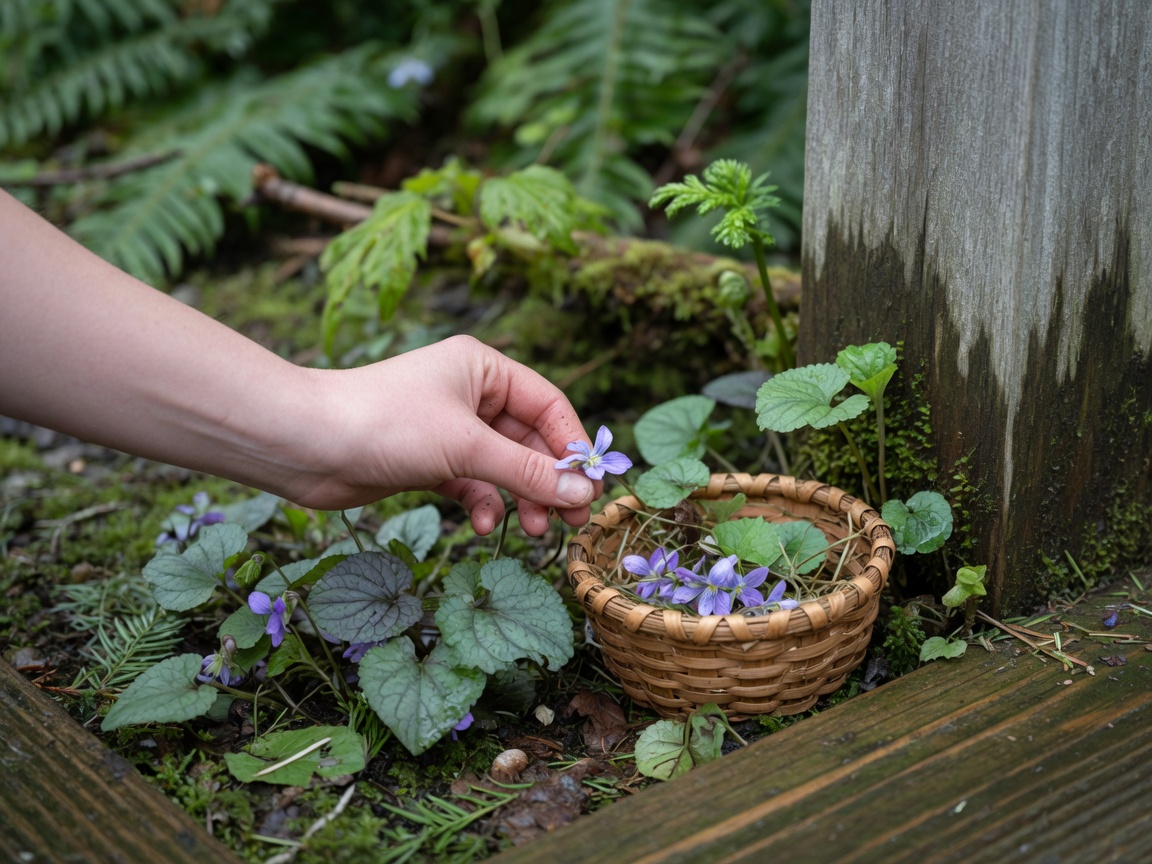
Violet is a spring plant, and the window is real. Leaves are best young and tender, from the first flush through the flowering weeks — gather them while they’re small and mild, before the summer heat toughens them. Flowers come with that same early stretch, blue and white ones opening low to the ground on any mild day. Pick them fully open and dry, mid-morning once the dew has burned off, and use them soon; a picked violet flower wilts fast.
I stick to the blue and white violets for the table. The yellow stream violet (Viola glabella) that lines our wet woodland seeps is a lovely thing to know, but I mostly leave it be — yellow violets have a reputation for being harsher on the stomach in any quantity, so I keep to the blue-flowered kinds I’ve gathered and used for decades.
Wherever you pick, pick clean. Skip roadsides, sprayed lawns, and the tidy strip of grass somebody keeps knocked back with a jug of weedkiller. Violets love exactly the kind of shady lawn edge where people spray, so this isn’t a small caution. I take mine from the untended margins of my own ground, where I know what has and hasn’t touched the soil. That rule matters more than any technique.
The leaf: a mild green and an easy tea
Violet leaves are mild, faintly sweet, and slightly mucilaginous — that soft, almost slippery quality is characteristic, and it’s part of why the leaf has been valued as a gentle spring green. A handful of young leaves torn into a salad disappears in with everything else; wilted briefly in a hot pan with a little fat, they behave like a mild cooked green. This is kitchen work more than foraging, so I’ll keep to my lane and let a good greens cook take you the rest of the way.
For the shelf, dry young leaves in a single layer somewhere warm and airy out of direct sun until they crumble cleanly, then store them dark and dry in a sealed tin. A rounded tablespoon of dried leaf steeped covered in just-off-the-boil water for ten minutes makes a mild, grassy, green tea. It’s an old, quiet spring drink — what it may do for you I’ll leave between you and a qualified practitioner, but as a plain seasonal cup it’s a pleasant one.
The flower: violet syrup and a simple oil
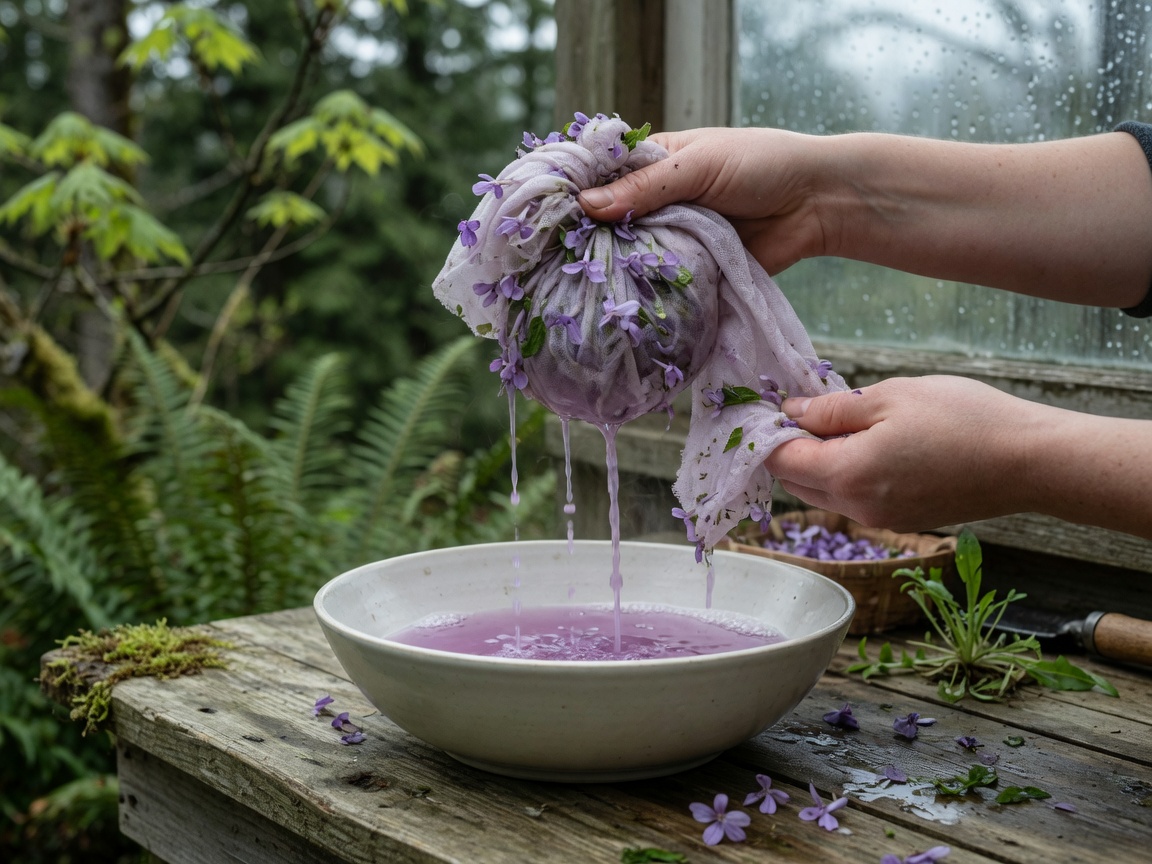
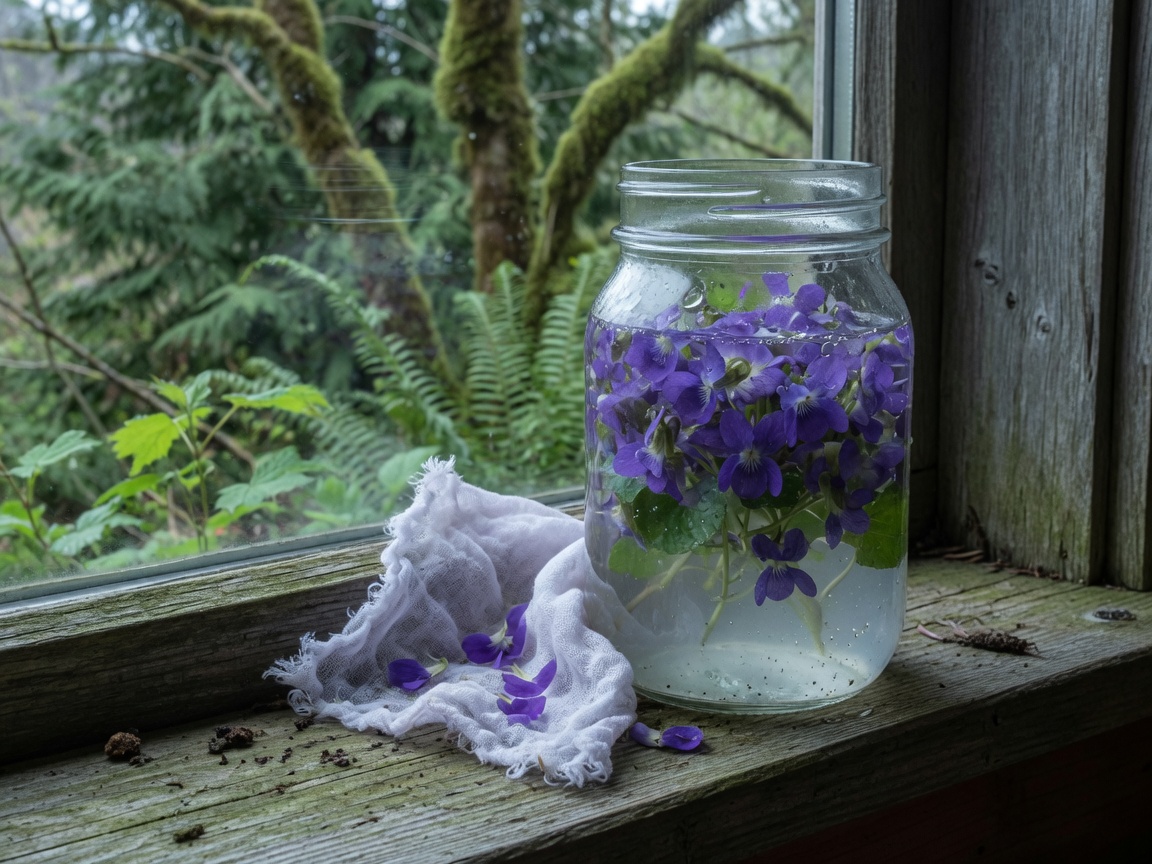
The flowers are my favorite part to put by, because a little handful turns into something that keeps its color and its charm for months. Violet syrup is the classic, and it’s genuinely hard to get wrong. Cover a jar of fresh flowers with just-boiled water and let them steep, covered, until the water pulls a soft blue from the petals — often overnight. Strain that infusion through a doubled layer of grade-90 cheesecloth, pressing gently, then warm it with an equal measure of sugar just until it dissolves, and bottle it. The color is the trick of the plant: a squeeze of lemon will swing that blue toward pink in the glass, which never stops being a small delight to show a grandchild.
If you’d rather make something for the skin, violet flowers infuse into oil the same way any beginner flower does. Let a jar of flowers wilt for a day first — this is the step people skip, and it matters, because fresh flowers carry water, and water in an oil infusion grows mold instead of medicine. Once wilted, pack them loosely in a clean dry jar and cover them completely with jojoba oil, which is shelf-stable and slow to turn. Set it warm and out of direct sun for a few weeks, strain it through cheesecloth, then warm the oil gently and melt in beeswax pellets — roughly one part wax to four parts oil, tested on a cold spoon until it sets the way you like. Pour it into small lidded tins. Keep the framing honest: this is a traditional flower salve people have made for generations, not a treatment for anything.
I’ve lost a batch or two over the years — one jar of flower oil went cloudy and musty on me because I packed the flowers still damp, and there was nothing to do but pour it out and begin again. Wilt the flowers. It’s the whole difference.
Learn one plant all the way through
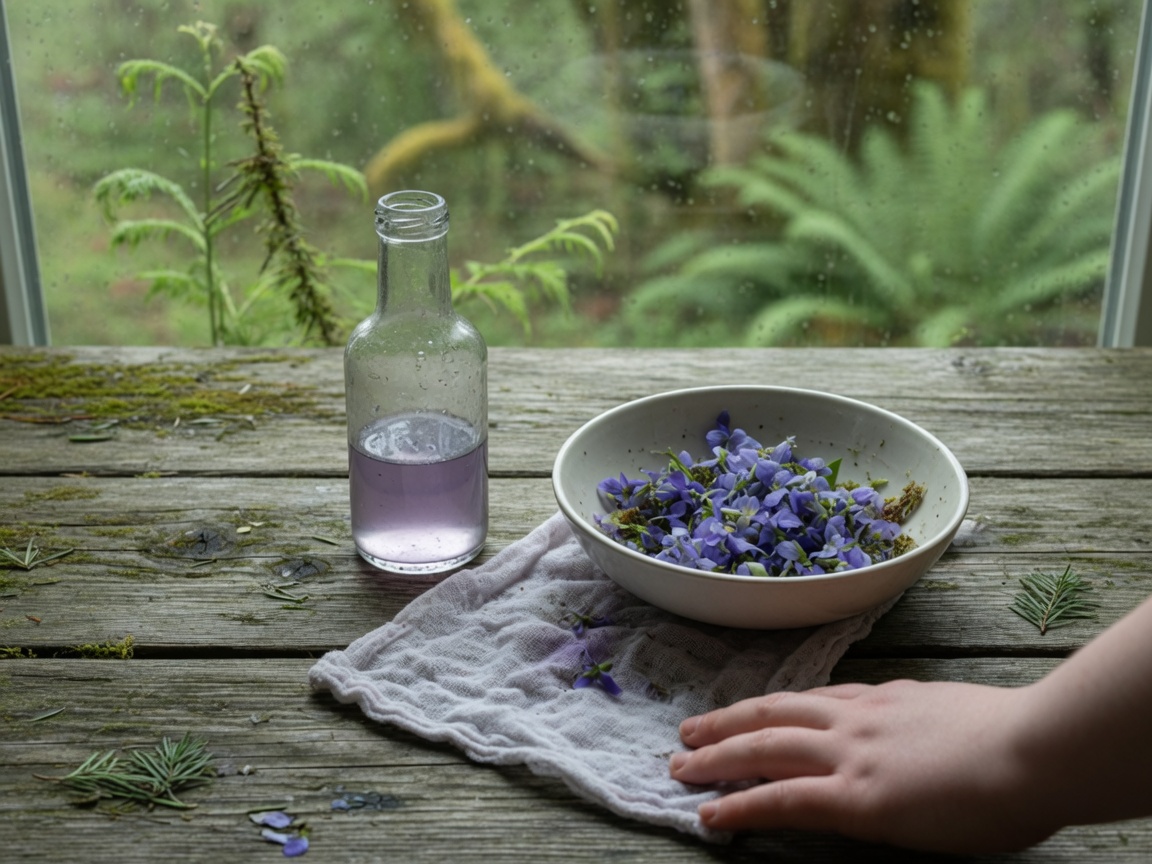
Wild violet is worth this attention precisely because it’s so ordinary and so early — it hands a beginner leaf and flower, fresh and dried, kitchen and shelf, in the first mild weeks of the year when there’s little else to gather. Learn to work one common plant completely and you’ve learned the shape of the whole practice. Everything after is a variation on what the violet just taught you.
If you want to go further, that’s most of what I put into my book, Pacific Northwest Medicinal Plants: 115 wild plants of this region, how to identify each one without guessing, when to gather it, and how the generations before us prepared it. The violet is an easy first door. The book is how you learn which doors to walk through next — and which ones to leave shut.
