How to Forage and Use Solomon’s Seal in Appalachia
Learn to forage Solomon's seal in Appalachia: how to know it from deadly look-alikes in spring, dig the rootstock with care, and prepare it the old way.
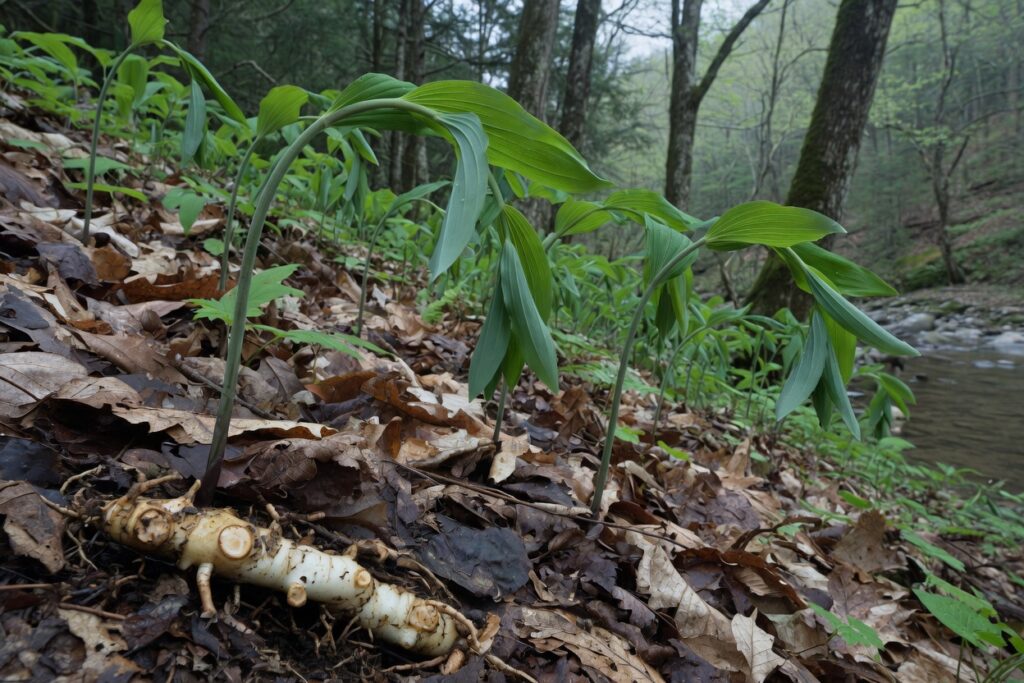
Late April in the coves below our place, the Solomon’s seal comes up in a way you can’t miss once you’ve seen it. A single green stalk pushes out of the leaf litter, bends over in a long arch like a shepherd’s crook, and slowly unfurls its leaves along the curve. My grandmother called it “the bowing plant” before she ever said its name to me. I was about eight, and I remember she made me stand and look at it for a good while before I was allowed to touch the ground.
That habit has served me better than any field guide. Solomon’s seal (Polygonatum biflorum) is a plant worth knowing, a root worth treating with respect, and a plant that sits near a very dangerous look-alike in the same spring woods. So we’ll take it slowly, the way she did.
Know it before you touch it

Never dig what you can’t name with certainty. This plant has a few features that all have to agree.
The stem. A single, unbranched, smooth stem, arching, usually one to three feet tall in our mountains, sometimes more in a rich cove. It bows over as it grows.
The leaves. Alternate along the stem, simple, with smooth edges and parallel veins, all pointing in the same direction like a row of oars. Not opposite, not whorled.
The flowers. Pale green-white bells that dangle in pairs from the underside of the stem at the leaf joints, hanging below the arch. Look under the stem. If the flowers hang there and the stem is otherwise bare, you’re likely looking at Solomon’s seal.
The berries. In late summer they turn blue-black. They’re not food. They can upset your stomach badly, so don’t eat them.
The root. This is the clincher. The rootstock is a thick, creamy rhizome that runs sideways just under the leaf litter. Along its length are round scars where the stalk of each past year died back. They look like little seals pressed into wax, and that’s the name’s origin. No scars, no Solomon’s seal.
Two plants worth keeping straight. False Solomon’s seal (Maianthemum racemosum) looks much like it, but the flowers cluster at the tip of the stem rather than hanging under it. And in the cool, moist coves of the high country, white hellebore, or false hellebore (Veratrum viride), pushes up in spring with big, pleated, ribbed leaves that can fool a hurried eye. Hellebore is poisonous. People have been badly hurt by mistaking it for ramps and other spring greens, and the same carelessness applies here. Pleated leaves, a stem with no arch, leaves wrapped around each other at the base: leave it alone. My notes on dangerous look-alikes of Appalachian medicinals cover this and more, and they’re worth reading before you go out.
And as always, never use a wild plant on the word of one book, one app, or one blog post, including this one. Confirm with several good guides and, if you can, someone who has dug it before. When in doubt, leave it.
Be an honest steward
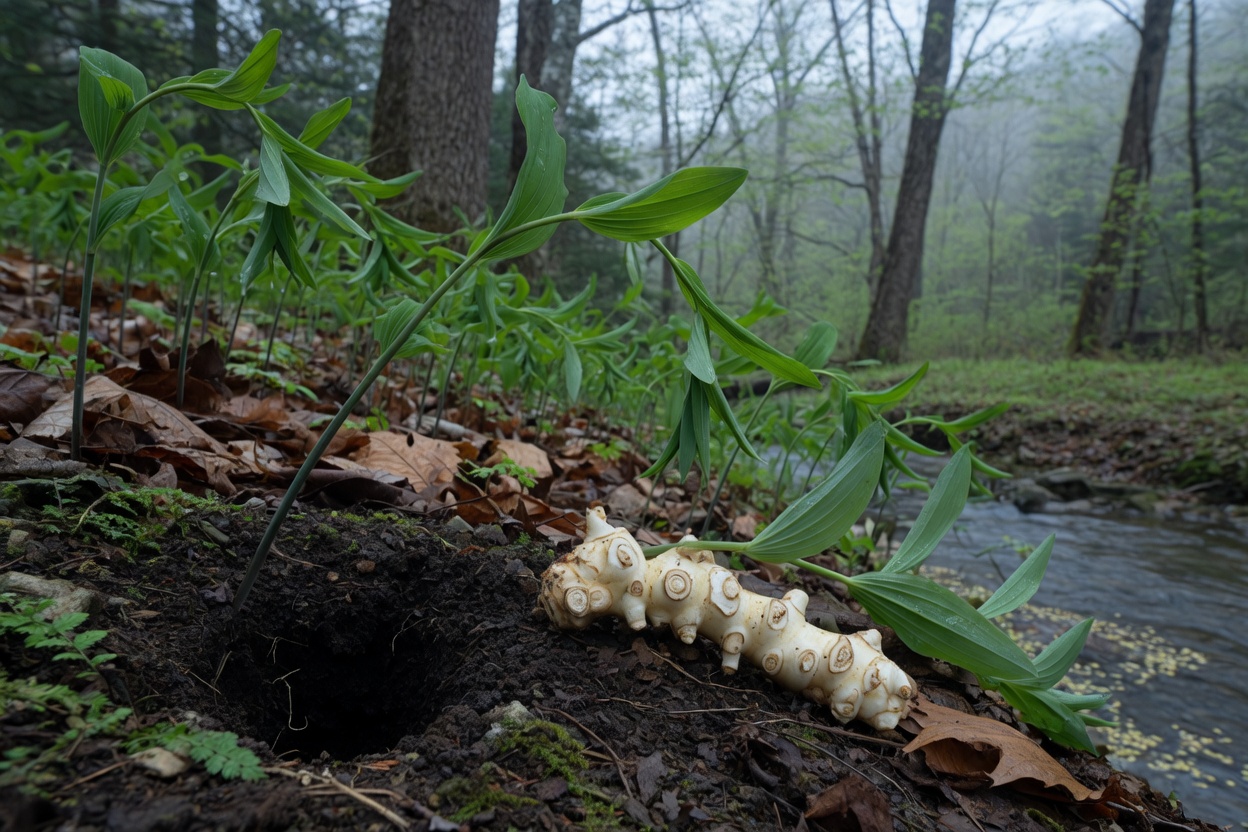
Solomon’s seal isn’t on the at-risk list the way ginseng or goldenseal is, but it grows slowly, and a colony takes years to build. The rule I follow is simple: dig only from a large, healthy colony, never a single plant or a thin patch, and take a small share. Dig the plant that has a long run of rootstock and cut off a piece with a few seal scars, then press the rest back into the ground with the growing tip pointing the way it was. A piece left in the soil will keep growing.
Take nothing from public parks, national forest land, or any property where you don’t have permission. Rules vary, and in much of our region gathering is restricted or prohibited on federal and state land. Check before you dig. A fence line on a friend’s land is a good place to start.
When to dig
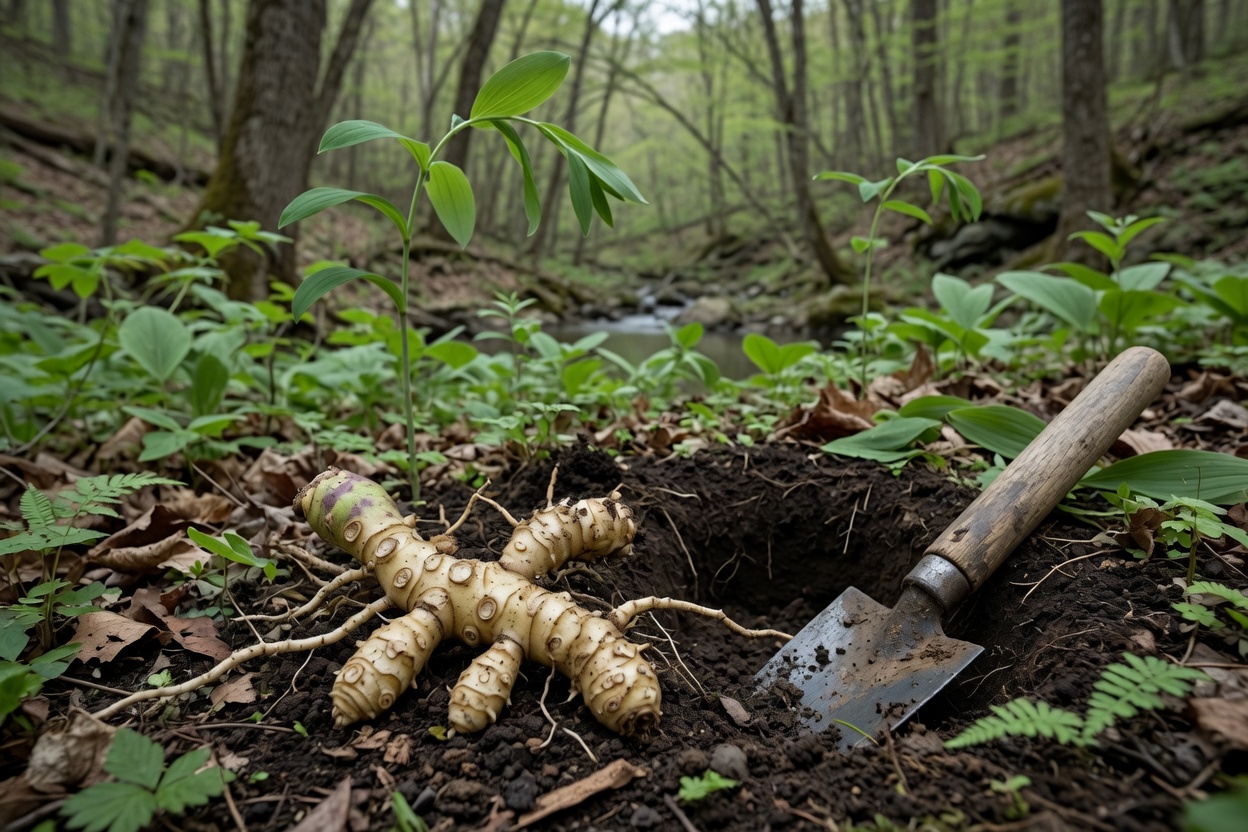
The best time for the rootstock is from late fall through early spring, when the plant has died back or hasn’t yet put up its stalk, and the energy sits in the root. The trouble is that in winter there’s no arching stem to tell you what you’re looking at. For that reason, I mark my patches in spring, when the plant is easy to read, and come back to dig months later. A bit of flagging tape or a stone cairn tied to a landmark does the job. It’s a habit I’d urge on every beginner.
The young spring shoots, the first few inches out of the ground, are also eaten in these mountains, cooked like asparagus. I’d rather you learn the plant a season before you eat any of it.
Cleaning and drying
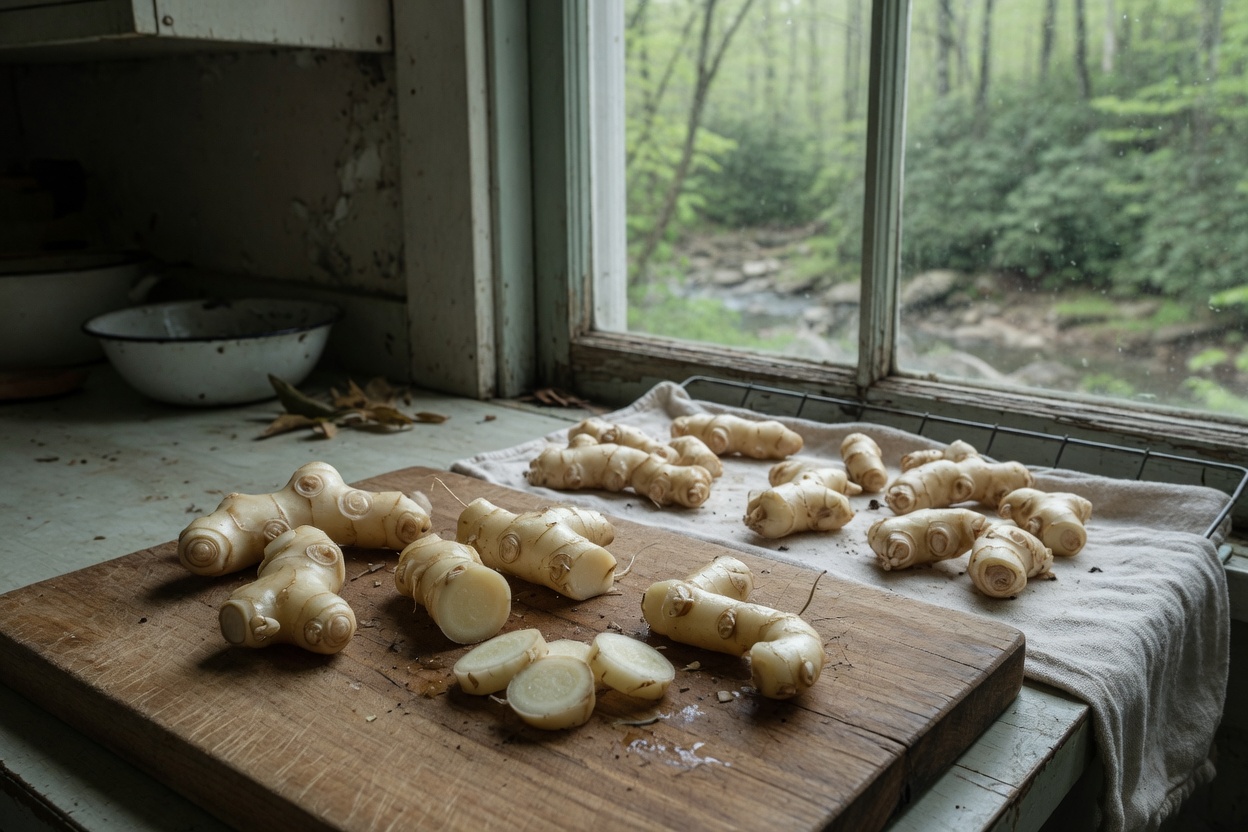
Scrub the rootstock well in cold water with a stiff brush. Don’t peel it. Cut it into thumb-sized pieces and split any thick ones so they dry evenly. Lay them on a screen in a dry, airy room out of the sun. Our humid winters are hard on stored roots, and a piece that isn’t fully dry will mold in the jar. Give it two to three weeks. It should snap, not bend. I wrote about this in how to store mountain herbs through a humid Appalachian winter, and the rules hold here.
Store the dry pieces in a mason jar, labeled with the plant and the date, in a cool, dark cupboard. It keeps about a year.
How it has traditionally been used
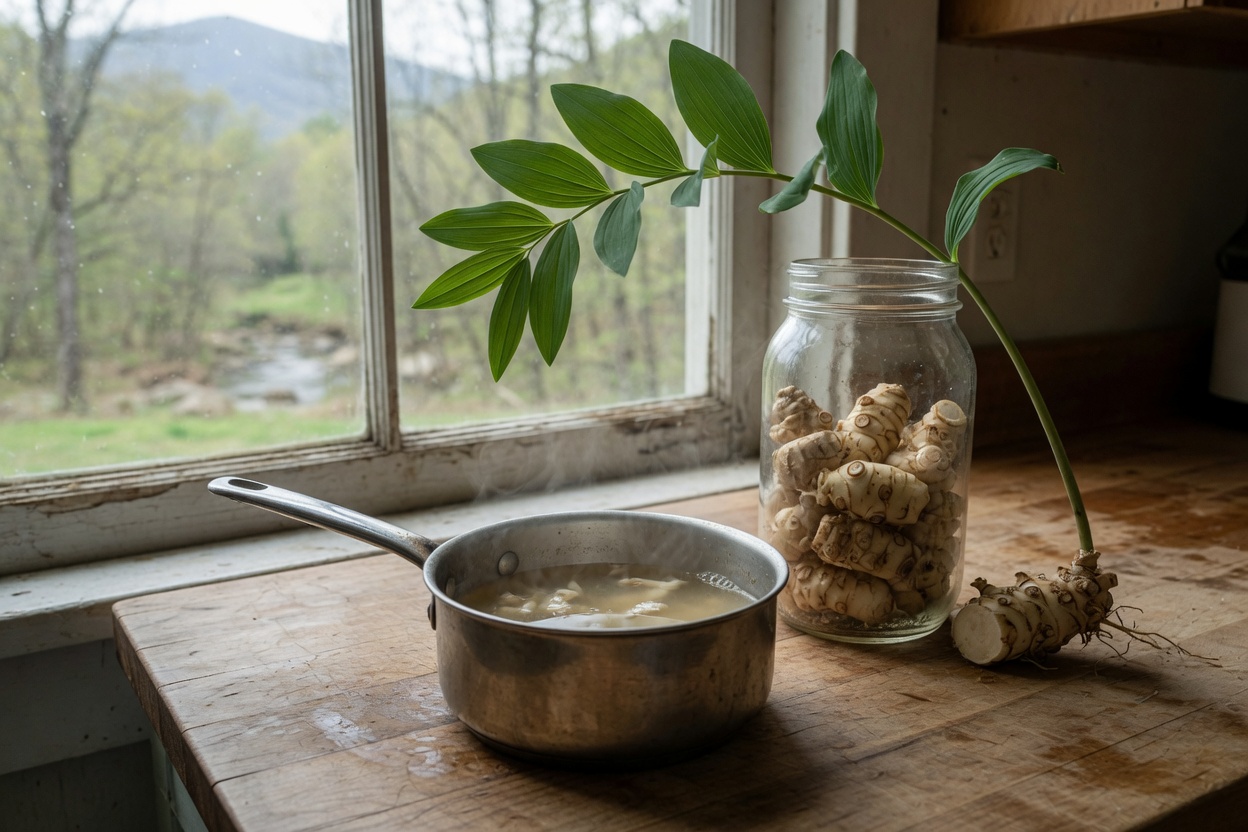
What follows is traditional-use information, how people in these mountains have handled this root and what I’ve seen in my own family. It is not medical advice, it isn’t a treatment claim, and I’m not giving doses. Anyone who is pregnant, nursing, or on prescription medication should talk with a qualified person first.
The Cherokee knew this plant long before settlers reached these coves, and their uses are in the ethnobotanical record. Rather than paraphrase from memory, I’d point you to Paul Hamel and Mary Chiltoski’s Cherokee Plants and Their Uses, and I credit them for what they documented. What I can speak to is what my own family did.
My grandmother kept a jar of dried rootstock on her shelf. She’d simmer a few pieces in water, covered, for twenty minutes or so, the way you’d make a decoction from any tough root, and strain it through cloth. The result is mild and a little sweet, with a slightly slick texture. Her older neighbors also grated fresh root and held it in a cloth against a bruise. I’ve done both. I can tell you what we did. I can’t tell you it works for you, and I won’t pretend to.
What I’d tell a beginner
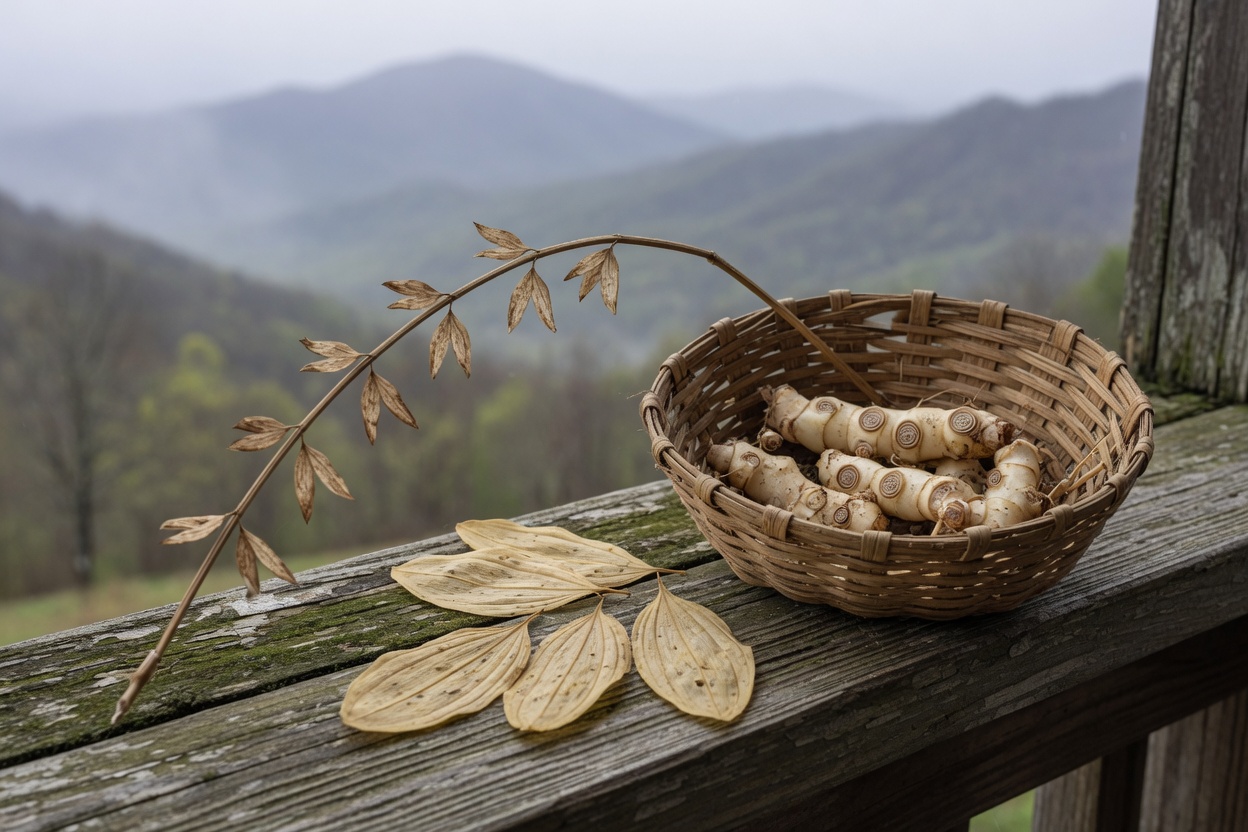
Learn this plant in spring and in the open leaf, standing in front of it, hand on the arched stem. Learn it next to its two look-alikes. Come back in the fall and in the winter to the same patch, and mark it. Dig a small piece once you’re certain, and replant the rest.
The knowing is the work, and it takes years. That’s what I put in my book, Appalachian Medicinal Plants: how to identify each plant without guessing, when to gather it, and what the mountain people before us did with it. Solomon’s seal is a gentle teacher. Let it be one of your first.
