How to Forage and Use Plantain, the Common Lawn Weed
How to forage and use plantain — the broad-leaved lawn weed you can identify without guessing, when to gather it, and the old folk ways I prepare it at home.
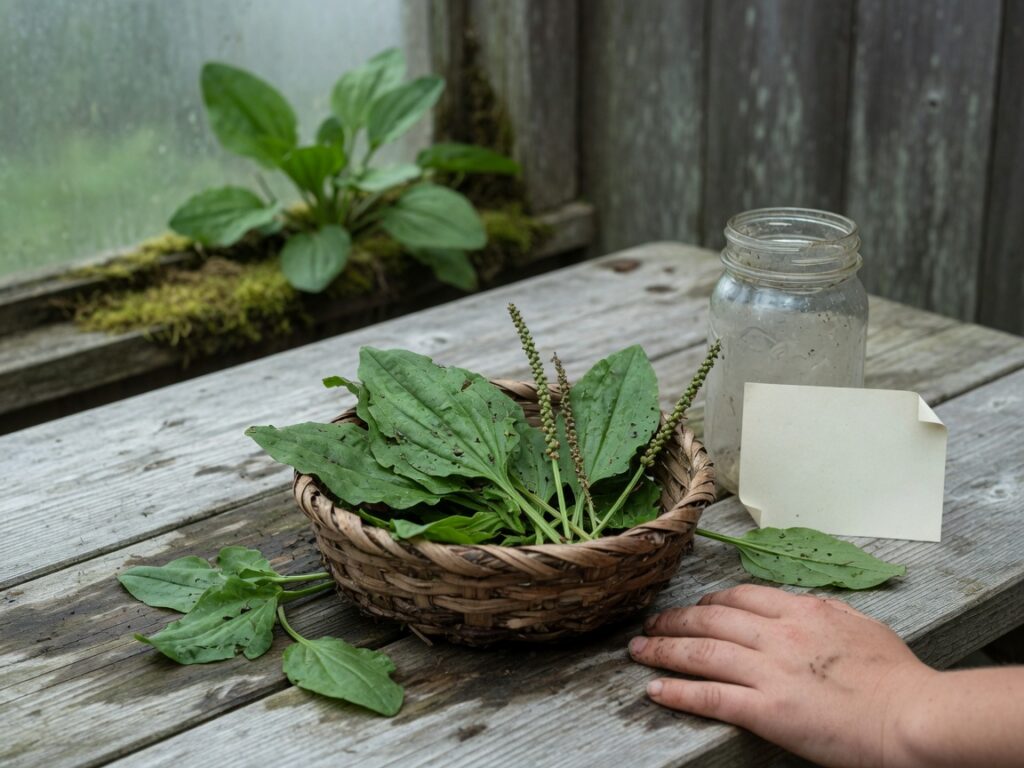
There is a plant growing in the cracks of your driveway right now that people have gathered and used for as long as anyone has kept track. Not up on some ridge you need a permit and a full day to reach — in the lawn, along the sidewalk, at the muddy edge of the trailhead parking lot. Plantain. Not the banana; the low, broad-leaved weed most people spend money to kill.
I have picked it out of my own gravel driveway outside Sequim for thirty years, and my father pointed it out to me on trail-crew weekends before that. It is, to my mind, the single best plant for a beginner to start with. It grows everywhere, it is nearly impossible to confuse with anything that will hurt you, and the ways it was traditionally used are simple enough to learn in an afternoon. Let me walk you through knowing it, gathering it, and putting it up the old folk way.
Know it before you pick it
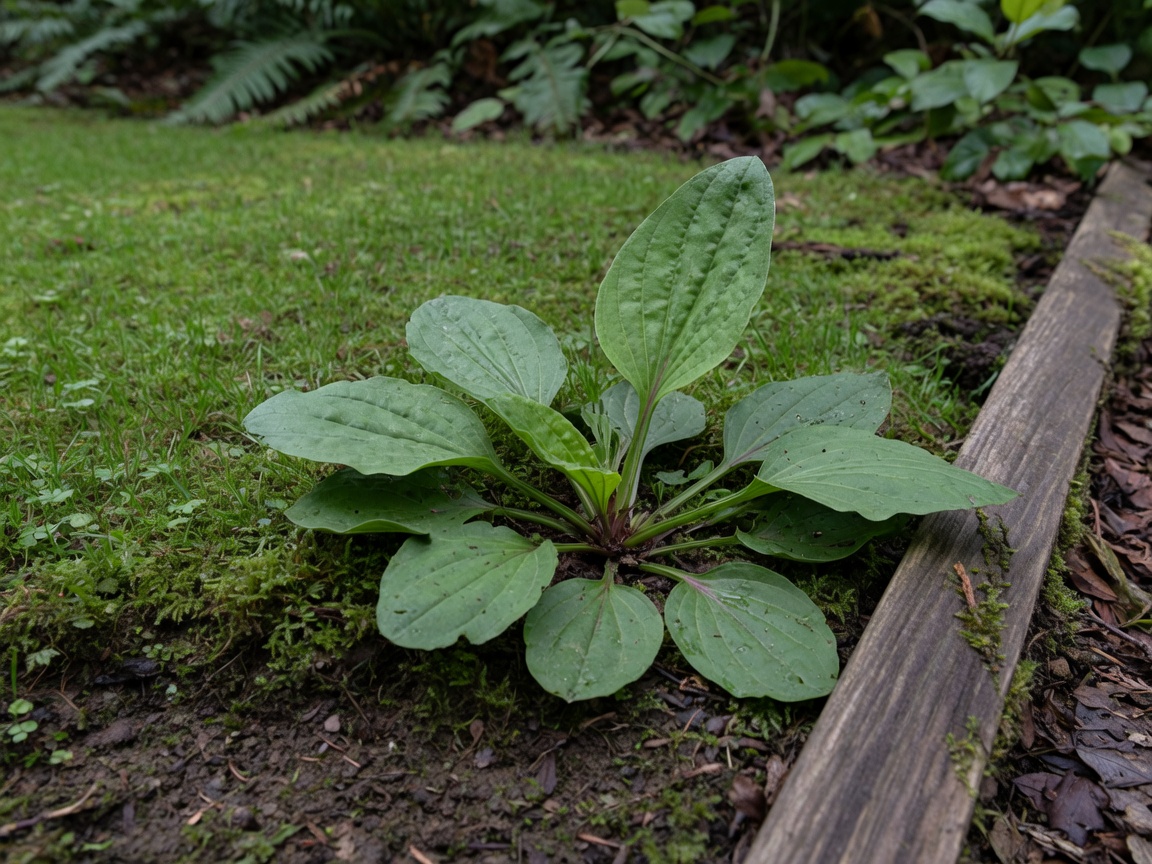
Two plantains grow across most of the country, and both are the ones you want. Broadleaf plantain (Plantago major) has wide, oval leaves that lie flat in a rosette against the ground, each with a short channel of a stem. Narrowleaf, or ribwort, plantain (Plantago lanceolata) has long, narrow, lance-shaped leaves standing more upright. Learn one feature and you’ll never mistake either: run your thumb along a leaf and it has strong parallel ribs running the whole length, and when you tear it gently, those ribs pull out from the torn edge like little threads or fine strings. Nothing dangerous in a North American lawn does that.
In summer each plant sends up a bare stalk topped with a slim green seed spike — a rat-tail on broadleaf, a stubbier cattail-shape on ribwort. That spike is a second confirmation, and later in the season it’s a harvest of its own.
Here is the one honest word on identification, said once, the way I’d say it to a neighbor and then trust her to be an adult about it: never eat any wild plant on the strength of one book, one app, or one blog post — mine included. Confirm it against more than one reputable source and, better, an experienced local before it goes anywhere near your mouth. When in doubt, throw it out. Plantain is about as forgiving a plant as this continent offers, and that rule still holds.
When and where to gather
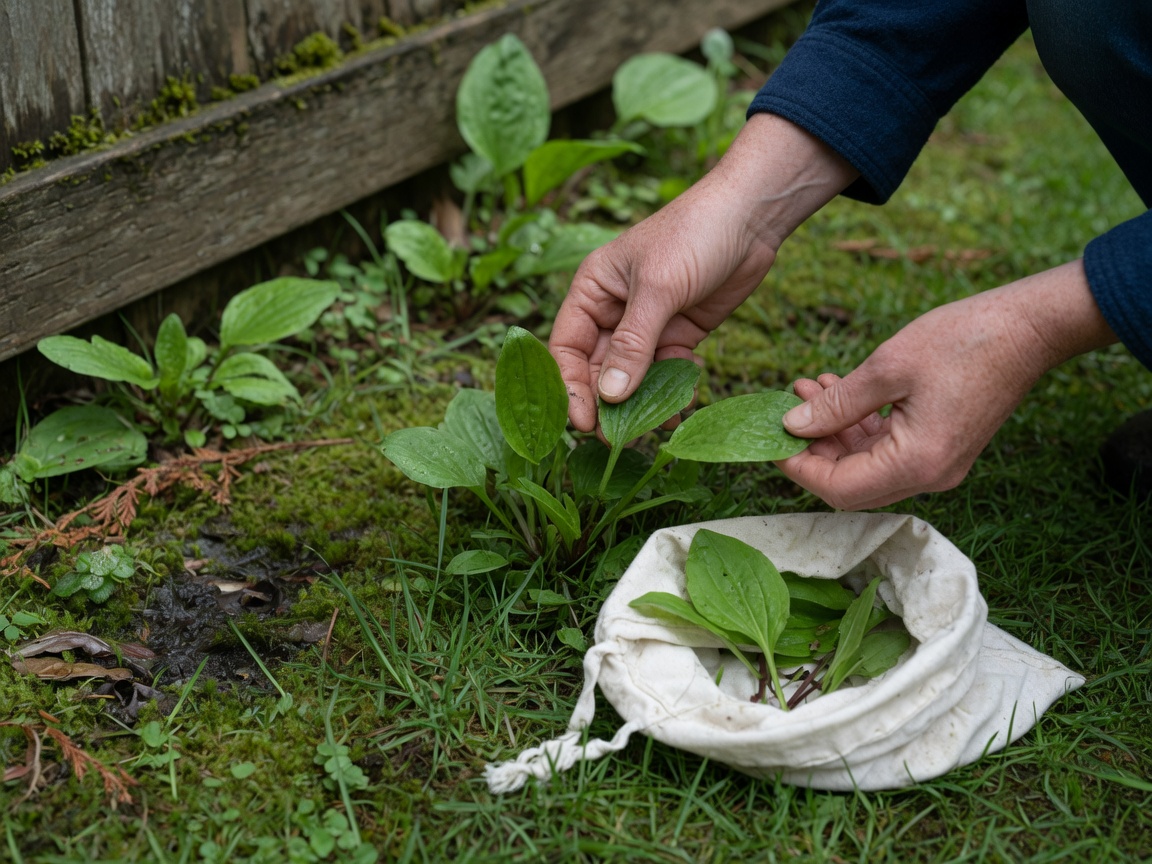
Plantain is generous — you can find leaf from spring right through fall. I like the young, tender leaves best, gathered in late spring and early summer before the plant puts its energy into those seed stalks. Older summer leaves get tougher and stringier, though they’re still fine dried. Come late summer and into fall, I strip the ripe seed off the stalks; it comes away between finger and thumb with a dry rustle.
Where you gather matters more than most beginners think. Plantain grows most eagerly in exactly the places you don’t want to harvest — the roadside, the dog-walked park strip, the lawn that gets sprayed. Skip all of those. Systemic herbicide doesn’t rinse off, and roadside soil carries what the traffic leaves behind. Pick from your own unsprayed yard, a friend’s, or clean ground you know well back from the road. I take a few leaves from each plant and leave the rest; a patch I tend gently gives me leaf all season for years.
Eat the young leaves
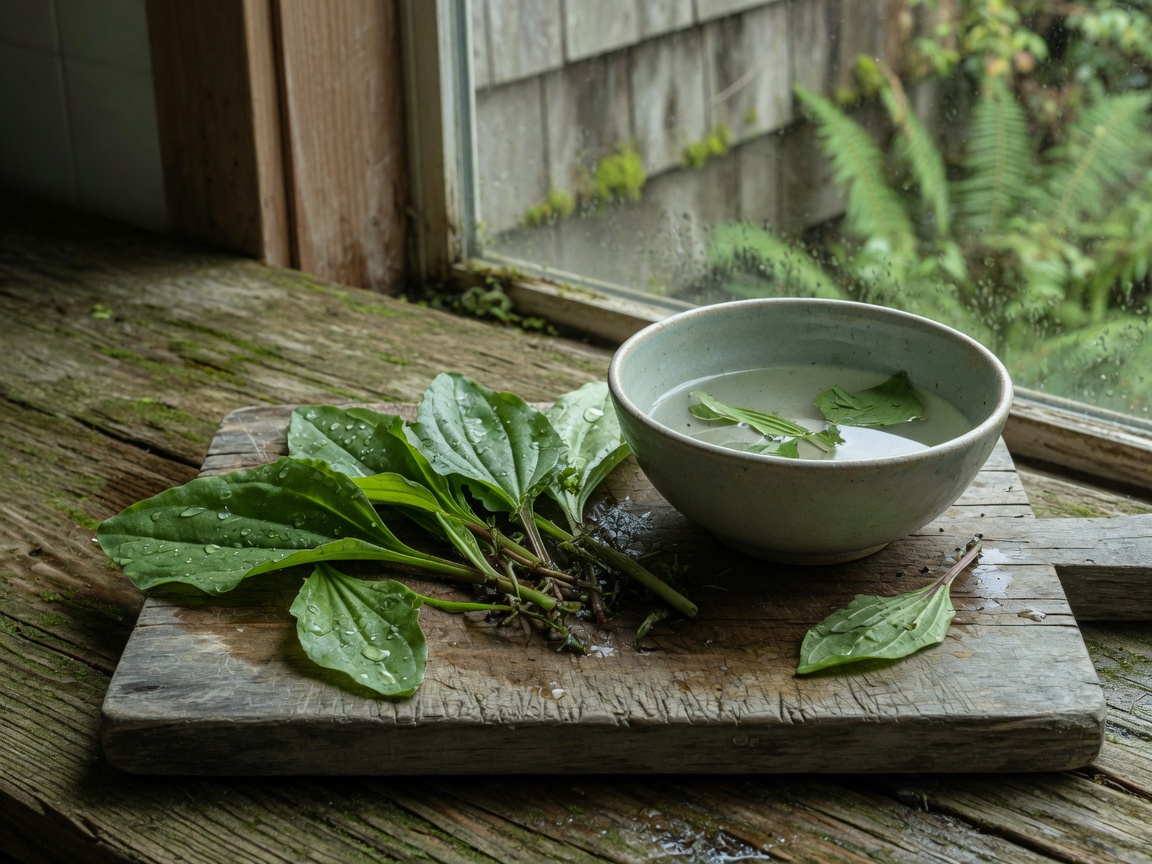
The simplest use is the plainest one: the young spring leaves are edible. Small and tender, they go into a salad with a mild, slightly earthy green flavor, a little like a firm lettuce with more backbone. Older leaves toughen and are better cooked — chopped into a pot of soup or wilted like any other pot-green, the way my grandmother used a handful of whatever was up in the yard. The stringy ribs are the giveaway that a leaf has gotten old; if it fights you when you tear it, cook it rather than eat it raw.
I go deeper on foraged greens and how I bring them into the kitchen in my post on making tea and simple preparations from foraged plants. Plantain is a fine one to start that habit on, because you can gather it fifteen steps from your door.
Dry it for the shelf
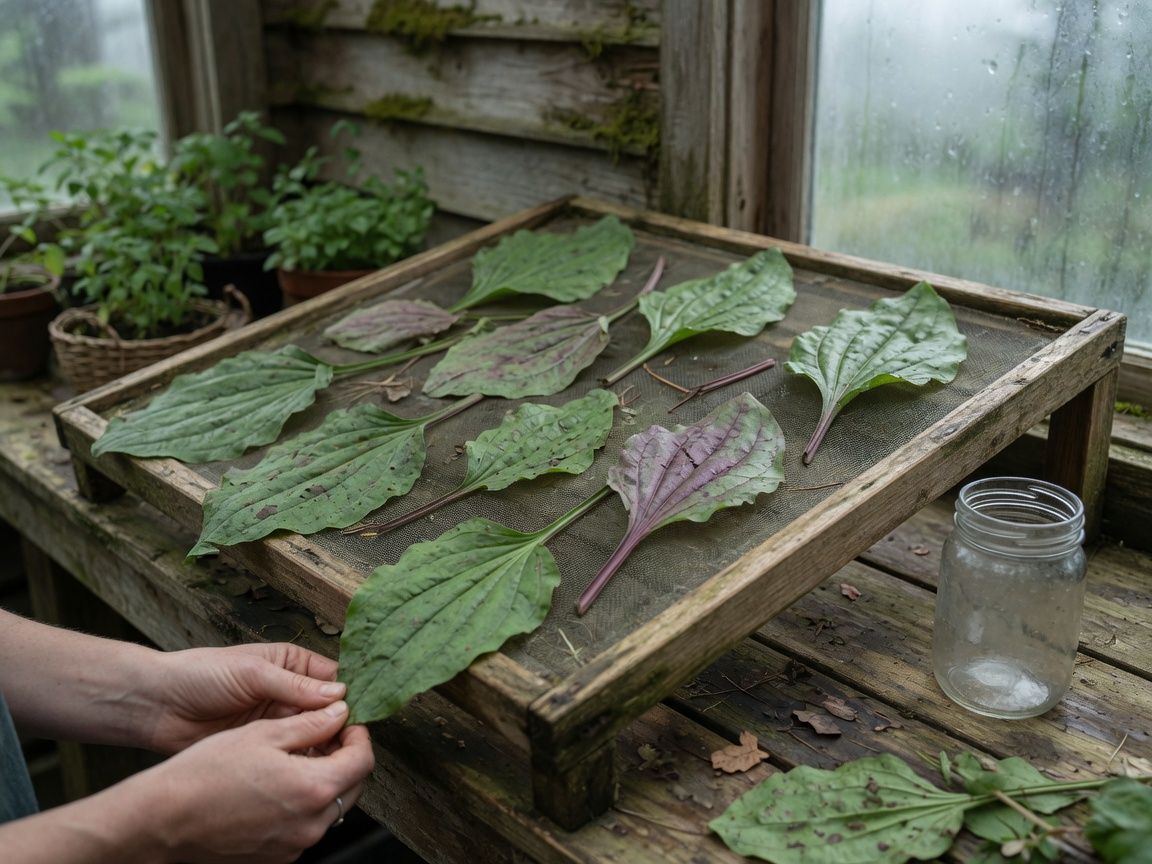
Whatever you don’t use fresh, dry for keeping. Lay the leaves in a single layer on a screen or a clean towel somewhere warm, dry, and out of direct sun, and give them a week or so — they’re ready when they crumble rather than bend. In our damp Peninsula air I sometimes finish them near the woodstove, because plantain that’s dried slow in humidity can mold before it’s done, and a molded batch is a wasted one. Store the dry leaf whole in a clean jar out of the light, and crumble it only when you go to use it. Kept that way it holds a year easily.
Dried plantain is also the leaf I reach for when I infuse an oil, which is the doorway to the preparation the old hands are best known for.
Put it up the folk way — an infused oil and a salve
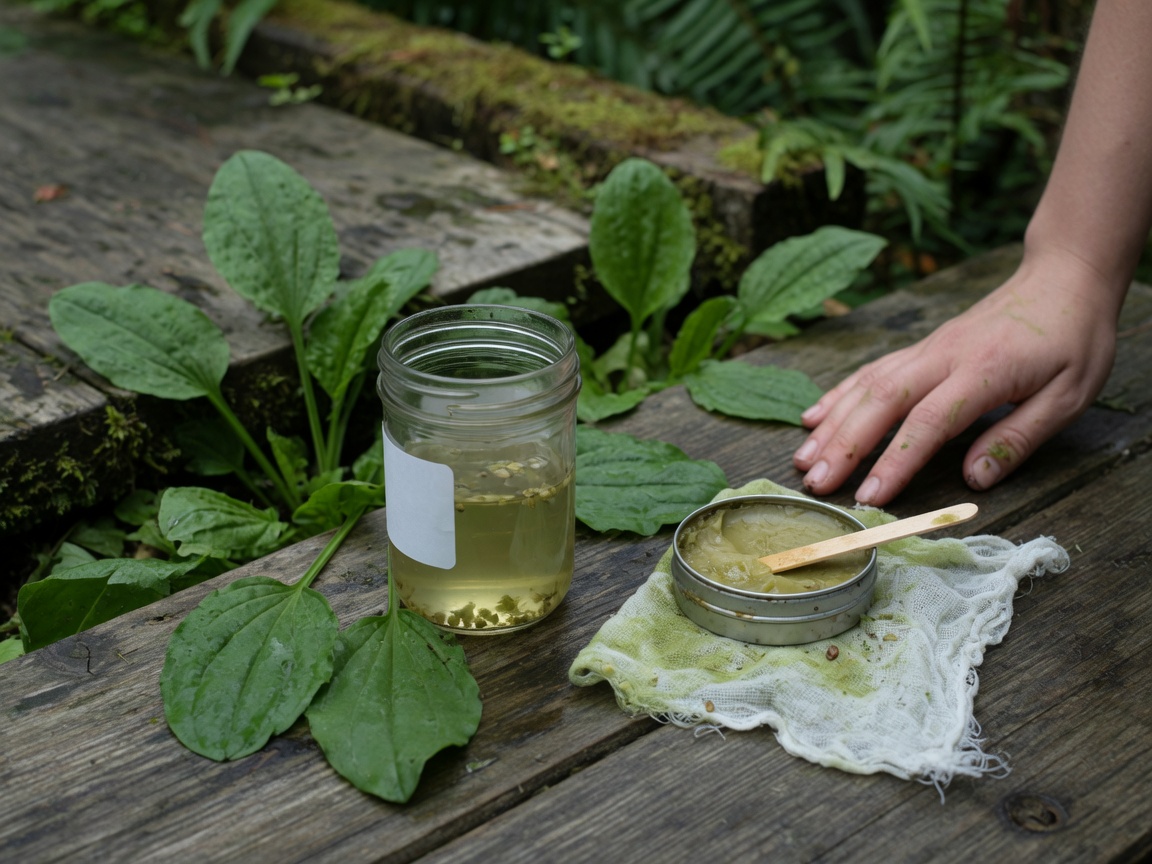
The traditional home preparation of plantain, going back further than anyone was writing it down, is a simple infused oil turned into a salve. This is folk practice, the way my grandmother kept a tin on every windowsill — I’m handing you the method, not a promise about what it will do.
Start with well-dried leaf; fresh leaf carries water, and water in your oil is what turns a batch rancid before its time. Pack a clean jar loosely with the dried plantain, cover it by an inch with jojoba or plain olive oil, and let it steep. The slow way is a warm windowsill for three to four weeks with a shake when you pass it. The quick way is the jar set uncapped in a pan of barely-simmering water for two or three hours, kept at a bare tremble so the oil never scorches. Either way, you’re done when the oil has taken on the green of the leaf.
Strain it through a doubled layer of grade-90 cheesecloth, wringing the last good oil out of the spent leaf. To turn that oil into a salve, warm it gently and stir in beeswax pellets until they melt clear — about one ounce of wax to one cup of oil for a salve soft enough to melt at a fingertip. Pour into two-ounce tins, let them set undisturbed, cap and label each with the plant and the date. I walk through every step of that salve method, with the cold-spoon firmness trick, in my full guide to making a first herbal salve, and the oil-infusing itself in how to make an herbal infused oil.
The plant is easy; the knowing takes longer
Plantain is where I send every beginner, and dandelion — which I cover here — is the second. Both grow underfoot, both are safe to learn on, and both reward the habit of looking down. The identification is a fifteen-minute lesson. Which plants are worth gathering, when each is at its best, how the generations before us prepared them and which ones have no business near you at all — that’s the longer study, and it’s the part I care most about.
Most of what I’ve learned about the wild plants of this coast is in my book, Pacific Northwest Medicinal Plants — 115 plants, how to identify each without guessing, when to gather it, and how it was traditionally used and prepared. Plantain is the easy first step. The book is how you learn the rest of what’s growing in the woods behind your house.
