How to Forage and Use Partridgeberry in Appalachia in Winter
Partridgeberry in Appalachia: how to know this evergreen ground cover, tell it from look-alikes, gather it lightly in winter, and how it has been used.
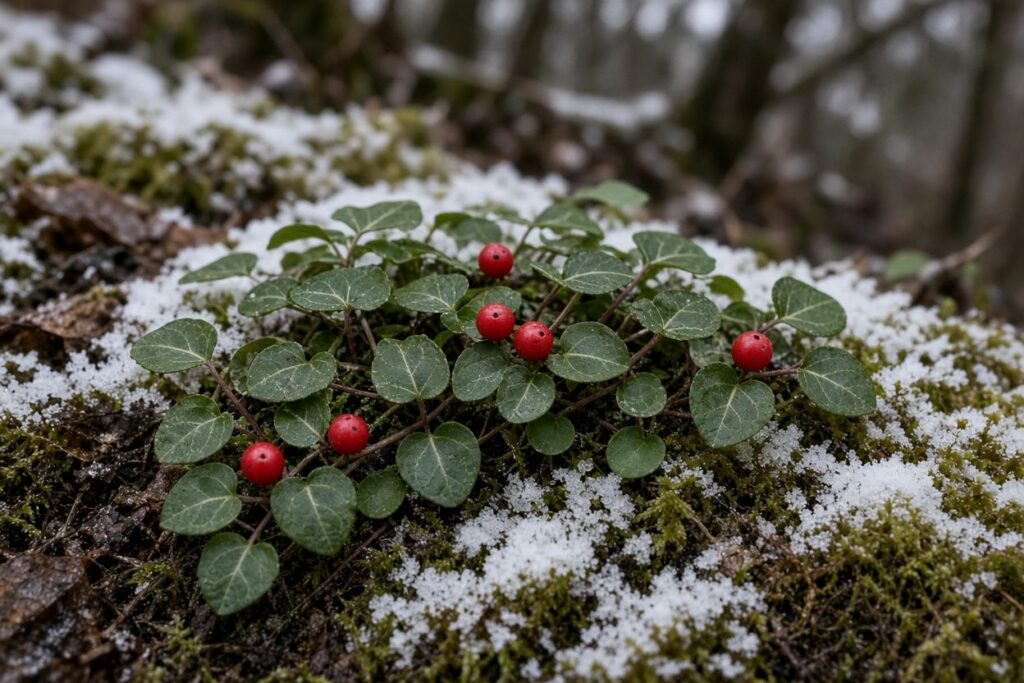
The first Christmas after my husband passed, my granddaughter and I walked up the hollow looking for something green to put on the table. We found partridgeberry running under the hemlocks, its red berries showing through a skiff of snow. She picked a handful of runners and laid them in a bowl, and that was our centerpiece. It was the best one we’ve ever had, and it cost us nothing but the walk.
Partridgeberry is Mitchella repens, a little trailing plant of the madder family, and it is one of the few things on the forest floor in these mountains that looks exactly the same in January as it did in August. That makes winter the easiest season to learn it. Here is how I find it, how I gather it without harming the mat, and how it has been used in my family and in the old books.
Beyond that, a small pair of sharp scissors and a paper sack will do. You do not dig this plant, so leave the trowel at home.
What partridgeberry looks like
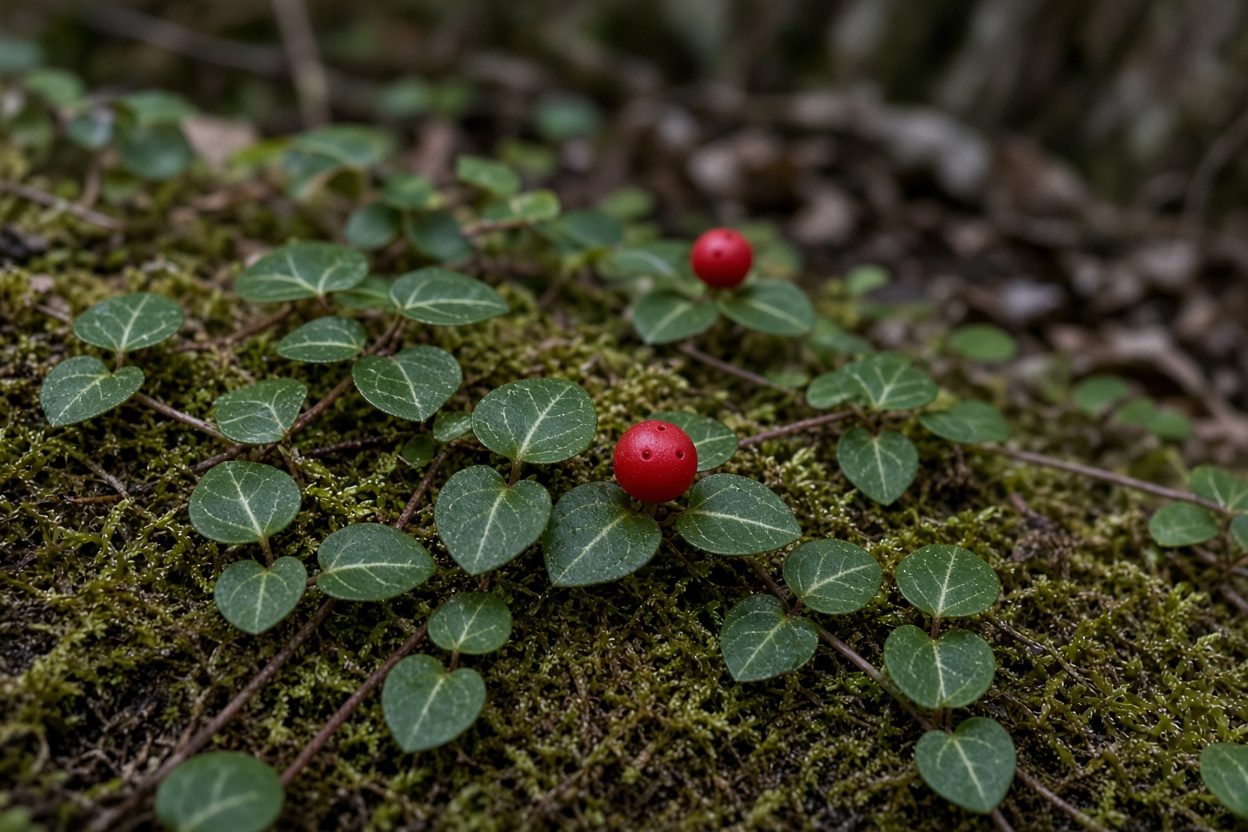
Look at your feet, under hemlock, rhododendron, and oak, on the mossy banks of a cove where the soil stays acid and damp. Partridgeberry grows flat to the ground in a loose mat, its thin stems creeping along and rooting wherever they touch down. A single runner might be a foot long, but it never rises more than an inch or two off the moss.
The leaves come in pairs, set opposite each other on the stem. Each one is small, about the size of your little fingernail, rounded or slightly heart-shaped, dark glossy green, with a pale line running down the middle. That pale midvein is one of the first things I teach the grandchildren to look for.
The berry is the real signature. It’s scarlet, about the size of a pea, and if you look closely you’ll see two small dimples on it, like a pair of eyes. That’s because partridgeberry flowers come in twos in June, white and fuzzy inside and sweet-smelling, and the two flowers share one ovary between them. Every berry is the child of two blossoms. Once you’ve seen those two little scars, you won’t mistake it.
The look-alikes, and my rule

Say this part with me, once. Never use any wild plant on the strength of a single book, app, or article, this one included. Check it against more than one reputable guide and with an experienced local forager, and when in doubt, leave it.
In these mountains there are three plants I’d hold up beside partridgeberry:
– Wintergreen (Gaultheria procumbens) grows in the same woods and also carries a red berry through winter. But its leaves are larger, leathery, and alternate rather than paired, the plant stands up a few inches instead of trailing, and a torn leaf smells like wintergreen candy. Its berry has no twin dimples. I wrote about it in how to forage and use wintergreen in Appalachia.
– Periwinkle (Vinca minor) is the one that worries me. It trails, it stays green all winter, and its leaves are opposite and glossy. It escaped from old homeplace yards and graveyards all over the southern mountains. But the leaves are longer and narrower, it flowers blue-violet in spring, and it bears no red berries. Periwinkle is not for using in any way, and if you find a green trailing mat near an old chimney or a family cemetery, assume periwinkle until you’ve proven otherwise.
– Small cranberry shows up in a few high bogs and seeps. It has alternate, pointed leaves and a larger berry without the paired scars, and it lives in wetter ground than partridgeberry likes.
My post on dangerous look-alikes of Appalachian medicinals goes further into the habit of checking more than one feature before you trust a plant.
Where and when to gather

I find the best mats on north-facing banks below hemlocks and in rhododendron thickets along the creeks, from the river bottoms up past 4,000 feet. It’s never in a hurry. A mat the size of a bath towel may have taken many years to spread that far.
November through February is when I gather, mostly because the plant is easy to see once the leaves have dropped and the forest floor opens up. The berries hang on through winter unless the birds get them first. Ask permission on private land, and on national forest or park ground, call the district and ask about their gathering rules before you put anything in a sack.
Harvest lightly, and leave the berries
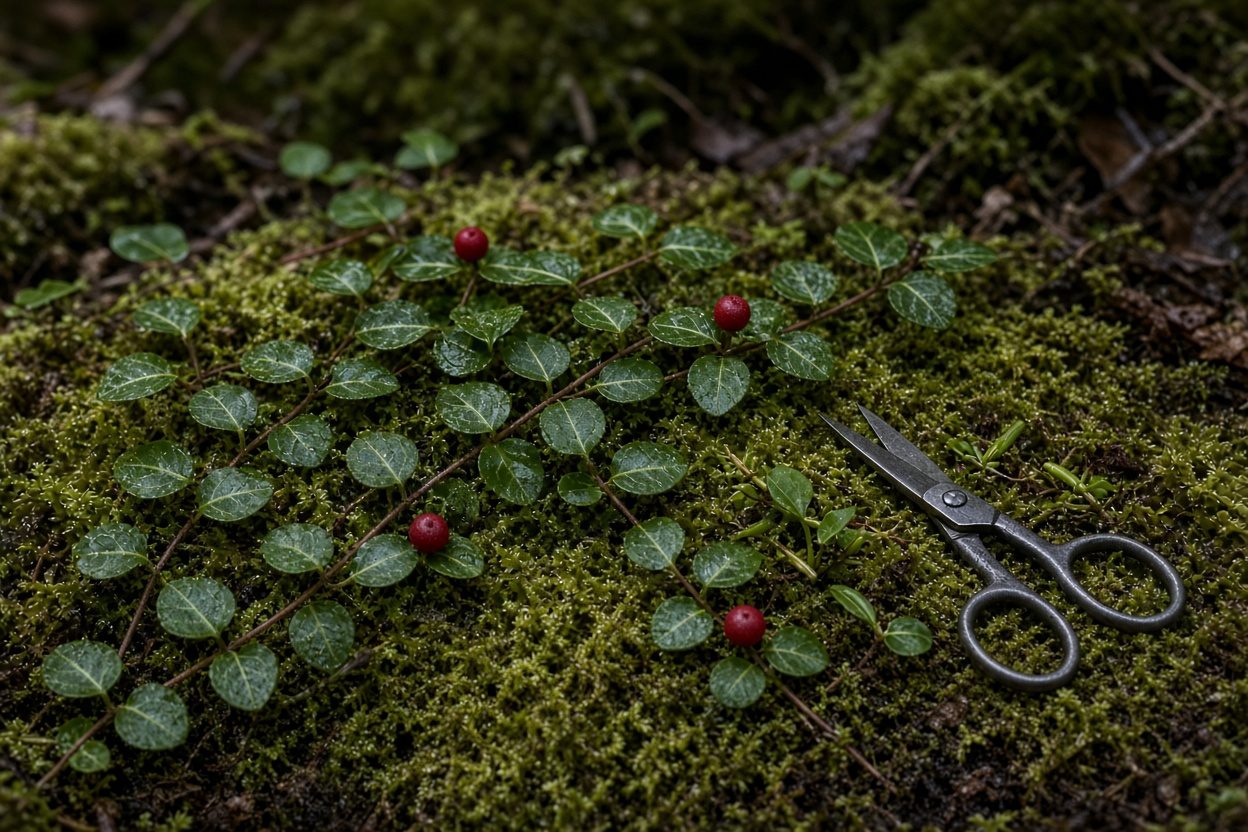
This is the part I care about most. Never pull up a mat. The runners are rooted all along their length, and yanking tears up roots and moss together and leaves a scar that takes years to close. Instead, take your scissors and snip a few inches from the growing tips of runners at the outer edge of a large, healthy mat.
The rule I follow is to take no more than a small handful from any one patch, never from a small or struggling one, and to leave most of the berries where they are. The plant’s name didn’t come from nowhere. Grouse, turkey, and quail eat those berries in the lean part of winter. I don’t need them nearly as much as they do. I’ll eat two or three as I walk and leave the rest.
Drying and keeping it

At home I rinse the runners quickly in cold water and shake them off, then lay them in a single layer on a clean cloth or a screen. A warm room with moving air, out of direct sun, dries them in about a week. They’re done when the leaves crumble between your fingers but still hold their color.
Strip the leaves, or keep the runners whole. Pack them loosely in a mason jar, label it with the plant, the place, and the date, and store it in a dark cupboard. Dried partridgeberry keeps well for about a year. After that it tastes like dust, and I compost what’s left.
How it has been used

I’ll be plain about what follows. This is traditional-use information, how mountain families and the old herbals described the plant. It is not medical advice, and nothing here treats or cures anything. I don’t give amounts or schedules for taking it, and I won’t.
The Cherokee used partridgeberry long before my people came into these mountains, and their use of it is recorded in Hamel and Chiltoskey’s Cherokee Plants and Their Uses. I send readers to that book for what the Cherokee themselves recorded rather than paraphrase it here. They knew it first, and I credit them.
The settler herbals of the 1800s tied partridgeberry closely to women’s health, and to late pregnancy in particular. I mention that as history, because you’ll run into it in every old book. In my house the rule is the opposite: it’s one plant I tell anyone who is expecting, nursing, or on medication to leave entirely alone. You’ll also see it under an older common name that is an ugly word, and I won’t repeat it.
What my family actually did with it was simple. My grandmother kept a jar of dried leaf and put a pinch into a pot of mixed winter tea along with whatever else was in the cupboard. To make it the way she did, pour hot water over a small spoonful of crumbled dried leaf in a cup, cover it, and let it steep about ten minutes. Strain through cheesecloth and you’ll have a mild, faintly green, slightly astringent tea, nothing dramatic. I go over the rest of that blend in a winter herbal tea from mountain plants.
The berries are edible, and I’ll tell you honestly they’re not worth much as food. They’re dry, seedy, and taste of almost nothing, a little like a mealy cranberry with the sour taken out. Children like them for the two little eyes.
Honest pros and cons
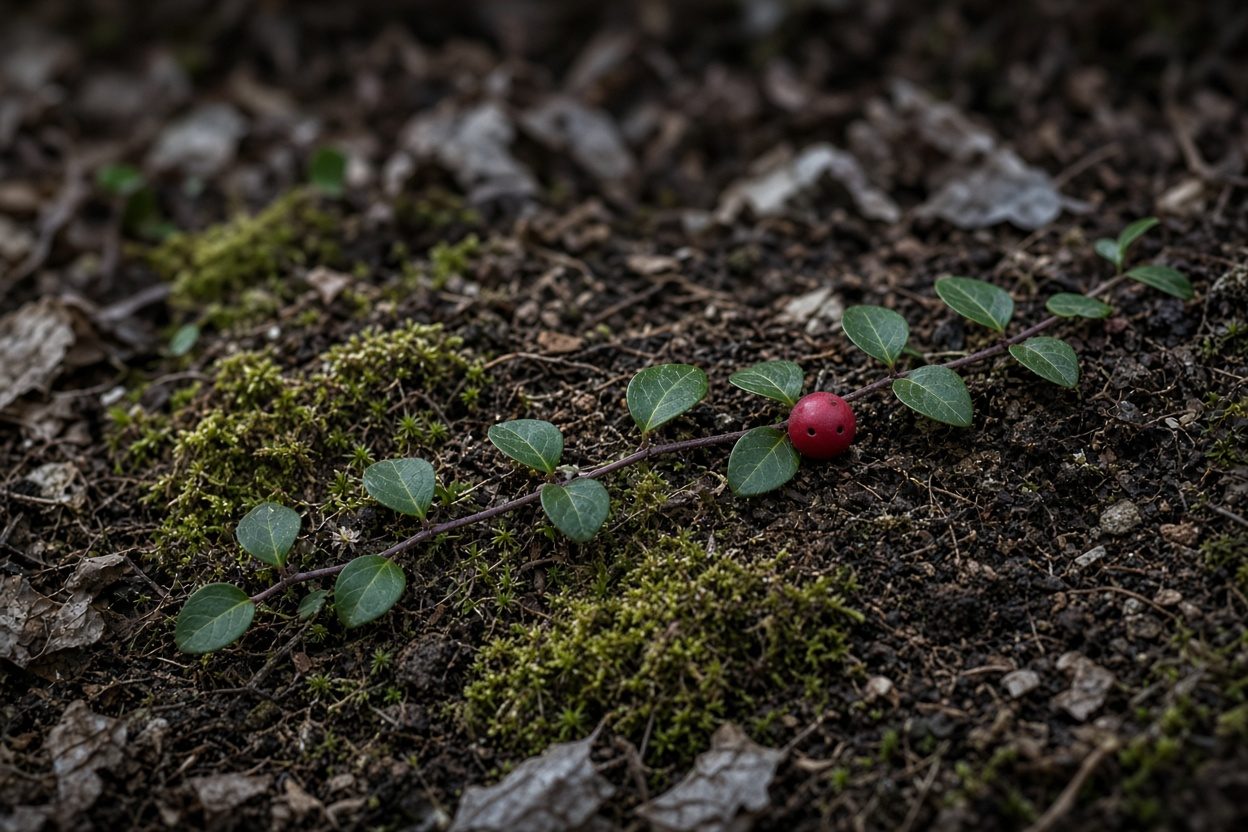
The good of partridgeberry is that it’s evergreen, it’s easy to see in winter, and once you know the paired leaf and the two-dimpled berry, it’s a hard plant to get wrong. It asks for no special tools. A handful of runners in a bowl makes the prettiest winter table in the county.
The drawbacks are real, too. It grows slowly, so you can’t gather much of it in good conscience. Its traditional uses are narrow, and its main historical one is a use I’d tell most readers to steer clear of. And periwinkle sits close enough in the winter woods that a careless eye can mistake one for the other. If you only want one evergreen to get to know this winter, partridgeberry is a fine choice. Just don’t expect it to fill your cupboard.
Where to go from here

Walk a mossy bank under the hemlocks this week and look for the paired leaves and the two-eyed berries. Learn it in the snow, and you’ll know it in every season after. If you want the rest of the mountain plants laid out one at a time, with how to tell each from its kin and how to gather so the next person still finds it, that’s what I put into Appalachian Medicinal Plants. And for the other evergreens worth learning this time of year, my notes on how to forage and use pipsissewa and identifying Appalachian medicinal plants in winter are good next stops.
