How to Forage and Use Sheep Sorrel in Appalachia, Safely
How to find sheep sorrel (lamb sorrel, sour grass) in Appalachia: how to tell it from look-alikes, when to gather, how to dry it, and its traditional uses.
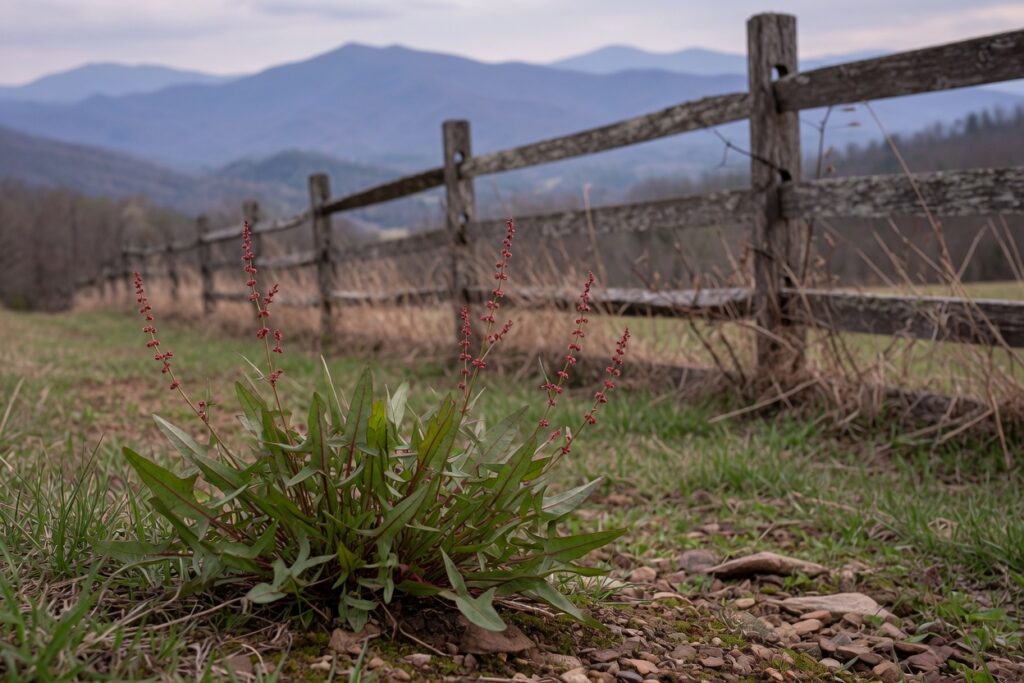
My grandmother called it sour grass, and she nipped a leaf from the edge of the garden every spring before she’d answer a single question I asked her. She never said why. I took it to be a kind of punctuation, a small sharp thing to clear her head. Later I learned it has a good many names, and the one in the books is sheep sorrel, Rumex acetosella, though plenty of folks around here say lamb sorrel or just sorrel.
It’s a humble plant. It grows in the poor, acid, picked-over soil that most things won’t have, along old fence rows and in the thin grass of a hayfield gone tired. It stays green in the winter when a good deal else is brown. That makes it one of the easiest mountain plants to get to know, and this is a fine time of year to start, with the rosettes small and red-tinged in the cold ground and the spring flush only a few months off.
What it looks like

Look low. Sheep sorrel is a small plant, often only four to eight inches tall in the leaf, and a rosette of leaves sitting at the ground. The thing that marks it is the leaf shape. Each leaf is shaped like a small arrowhead or a spear point, with two little lobes flaring out at the base like barbs, held on a slender stalk. The leaf is smooth, a bit fleshy, and often a dusty green with a flush of red in cold weather.
The stem is jointed. At each joint there’s a thin, papery sleeve around the stem, which is a feature of the whole dock and sorrel family. In May and June the plant sends up a spike of tiny reddish-green flowers that turn rust-colored as the seed ripens. A hayfield in early summer can look washed in red from a distance, and that’s sorrel gone to seed.
The taste is how you confirm it, and I’ll say that carefully, since taste alone is never the whole of an identification. A leaf nibbled from a plant that you’ve already matched on shape, size, and stem is bright and sour, like lemon peel. If a leaf looks like sorrel and doesn’t taste sour, it isn’t sorrel. Spit it out.
Look-alikes, and the line I give everybody

Here is my rule, and I don’t bend it: never use a wild plant on a book, an app, or a single source alone. Match it against more than one good guide, and then against someone local who knows it by sight. When in doubt, leave it.
Sorrel has a few look-alikes worth knowing in these mountains:
– Arrow arum and other arum-family plants in wet ground have larger, arrow-shaped leaves with no jointed stem and no sour taste. Plants in this family can burn the mouth badly and are not for eating. Sheep sorrel grows in dry, sour ground, not in a seep or a boggy edge.
– Curly and broadleaf dock are cousins in the same genus, with much larger leaves and the same papery sleeve at the joints. They’re the plants I describe in how to forage and use yellow dock root. Different job, same family.
– Wood sorrel, an Oxalis, has three heart-shaped leaflets like a clover and yellow flowers. It’s sour as well, but it’s not the same plant, and it’s a different gathering.
If you have any of these in mind and you can’t tell, my post on dangerous look-alikes of Appalachian medicinals is the page to keep open.
Where and when to gather

I look in dry, sunny, acid places: the edge of a pasture, an old homesite yard, a gravel verge well back from the road, a fence row nobody’s mowed. Avoid roadsides that get sprayed or mowed with a lot of traffic, power-line cuts where herbicide goes down, and anywhere you don’t know the history. Ask permission on private land. On national forest ground, check the district’s rules on gathering before you carry anything out.
In the southern mountains the first good flush is in March and April, when the rosettes push up fresh and tender, long before the flower stalks. The leaf is best before the plant bolts, since it gets more bitter and tough once it flowers. A second, smaller flush comes in fall after the first cool rains, and sometimes there’s a green leaf on a warm January day. Right now, in late October, is the best time to find the patches and note where they grow, while the rest of the field has gone gold.
Pick the leaves, not the whole plant. Take a few from each rosette, and leave the roots. Sorrel spreads by root and seed, and a patch will give you leaf for years if you don’t uproot it. The hori-hori helps in hard sod, where you can slide the blade down beside a rosette and lift it gently, but it’s not a necessity. Scissors and a basket do just as well, and for most gathering I’d skip the purchase.
Drying and keeping it
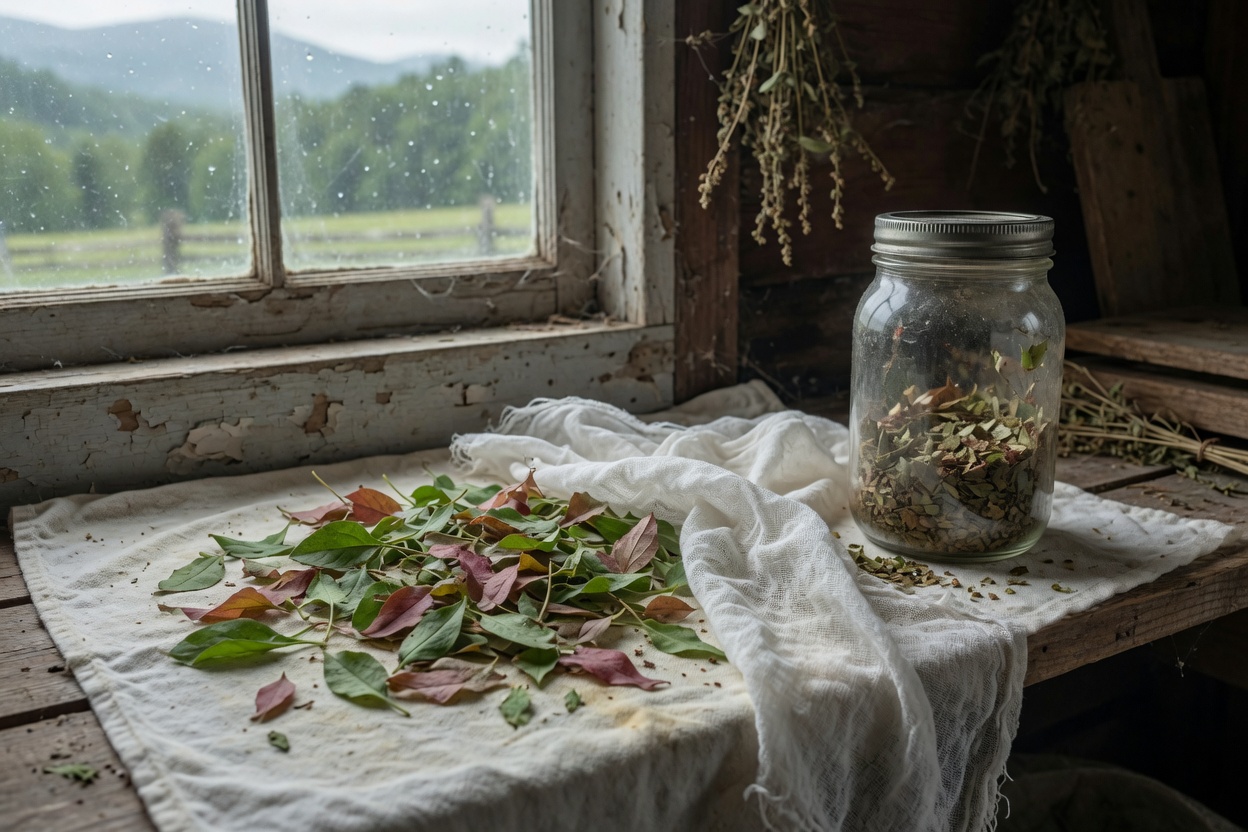
Wash the leaves quickly in cold water, if you must, and shake them dry. Then spread them in a single layer on a clean cloth or a screen, and lay cheesecloth loosely across to keep dust and flies off. Out of the sun, in a room with moving air, they’ll dry in a few days. In my drying shed that’s about three. They’re done when they crumble.
Store the dry leaf whole, in a mason jar, with the date and plant written on a label. Keep it in a cupboard, away from light. It keeps its flavor best for a year or so. Sorrel is a plant that fades, and the color goes from green to a dull brown-olive. That’s normal.
How it has been used

Sheep sorrel is one of the old mountain greens, and its traditional uses are modest. Folks ate the fresh leaf as a trail nibble for its sourness, chopped it into spring salads and soups for a lemony bite, and made a cooling, sour drink from it in warm weather. My grandmother steeped a handful of fresh leaf in cold water overnight, then strained it, and called it sour water. We drank it on hot days and it tasted like a very mild lemonade.
To make the drink, put a loose handful of fresh leaves, or a tablespoon of dried, into a mason jar of cold water, cover it, and leave it overnight in the refrigerator. Strain through cheesecloth in the morning. It’s tart and light.
I make no claim about what it does for the body, and I’d distrust any page that does. What I can tell you is how my family has used it. I should say, too, that I’m sharing a settler-mountain use of the plant, handed down in my own family. Other peoples in these mountains, the Cherokee among them, knew these plants long before us, and where I draw on published Cherokee sources I will name them. I won’t claim that knowledge as mine.
A caution about oxalic acid

The sour taste comes from oxalic acid, which is also in spinach, rhubarb, and wood sorrel. A little as a nibble or a few leaves in a salad is common food. But a lot of it, regularly, isn’t wise, and anyone with kidney stones, gout, or a kidney condition should leave it alone or ask a doctor first. Same for anyone pregnant, nursing, or on medication. This is traditional use, not a recommendation, and I’m not a doctor.
Where to go from here
Walk a dry field edge this week and see if you can find the little arrowhead rosettes in the grass. Learn the shape in the cold, and you’ll know the plant on sight when March comes. If you want the mountain plants laid out one at a time, with how to tell each one apart from its kin, that’s what I put into Appalachian Medicinal Plants, and you can find it here: Appalachian Medicinal Plants. And for what to look for in the other seasons, my notes on what to forage in Appalachia in spring are a good place to go next.
