How to Forage and Use Horsetail in the Pacific Northwest
How to forage horsetail in the Pacific Northwest: telling field horsetail from its toxic cousins, when to cut, how to dry it, and how it has been used.
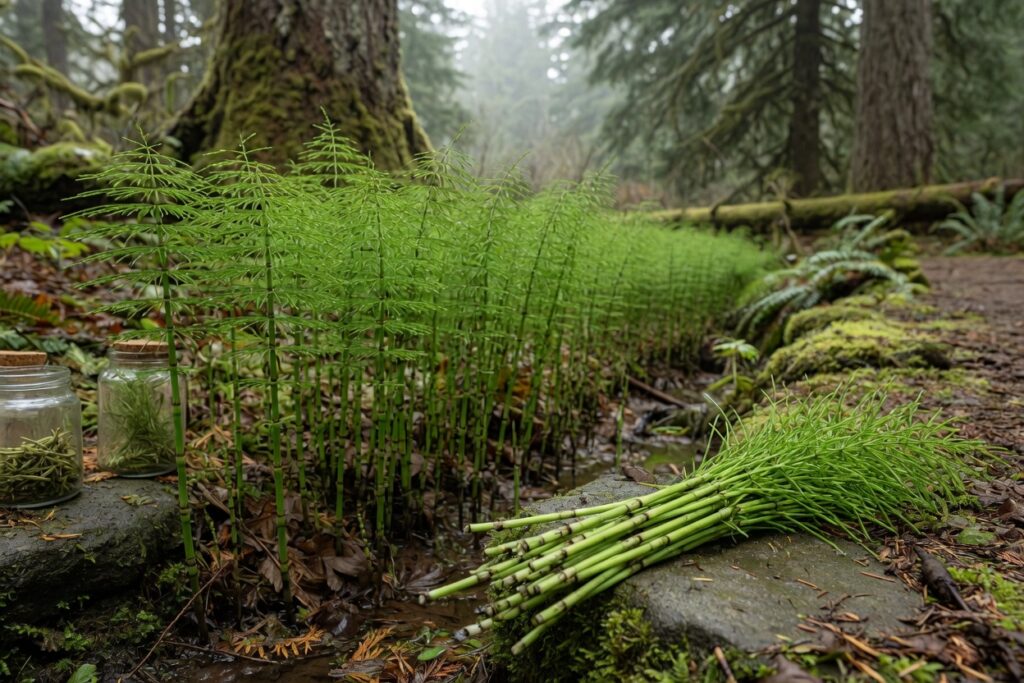
My mother kept a bundle of dried horsetail stalks by the kitchen sink to scour her cast-iron pans, and I thought of it as a cleaning tool long before I thought of it as a plant. I still reach for the same rough green stems when a pot needs it. The plant grows in a ditch two hundred yards from my door, and it has been there since before the road was paved.
Horsetail is a spring plant, and spring is five months off. I’m writing it up now because the ground is bare and the patches are easy to find, and because horsetail is the one plant in this series where identification matters more than technique. A wrong guess here has consequences. So we start with the looking.
What you are looking at
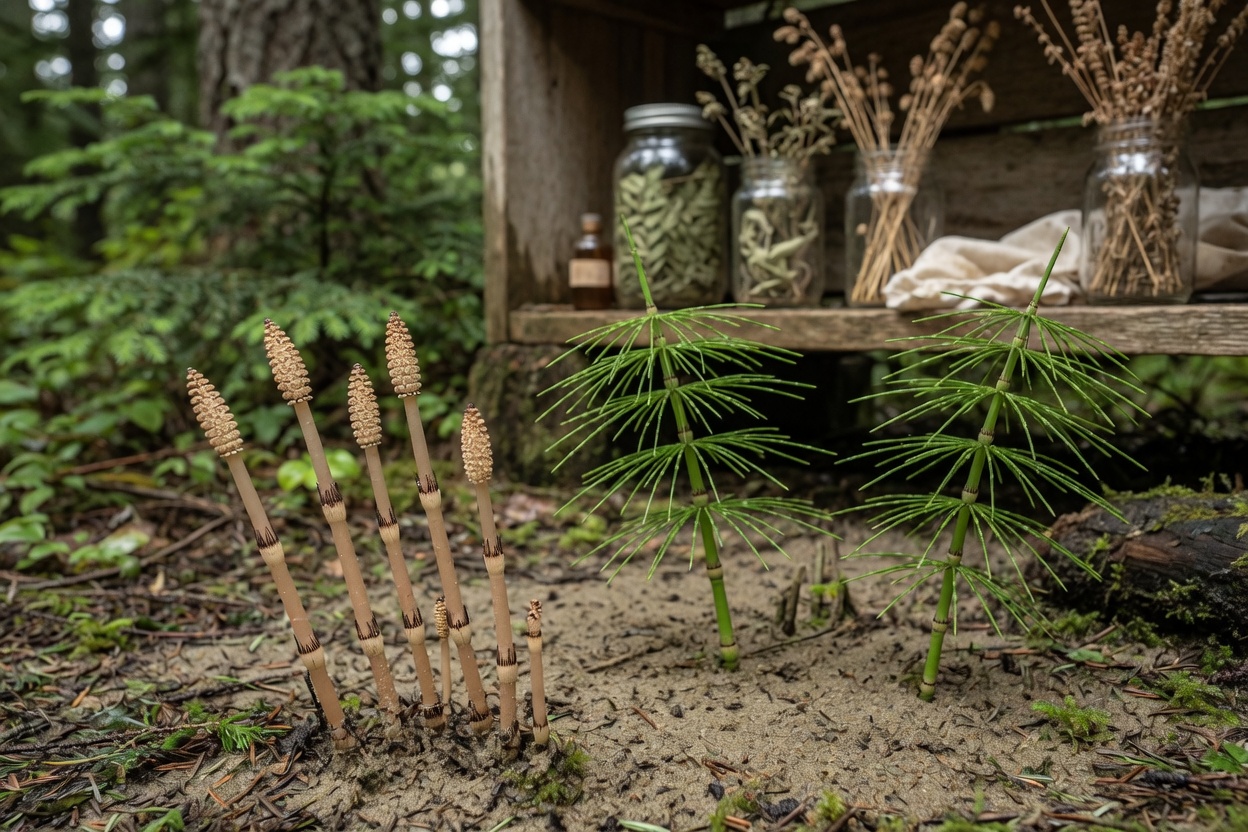
The horsetail most Pacific Northwest foragers mean is field horsetail, Equisetum arvense. It shows up twice a year in two different costumes, and that is the first thing that trips people.
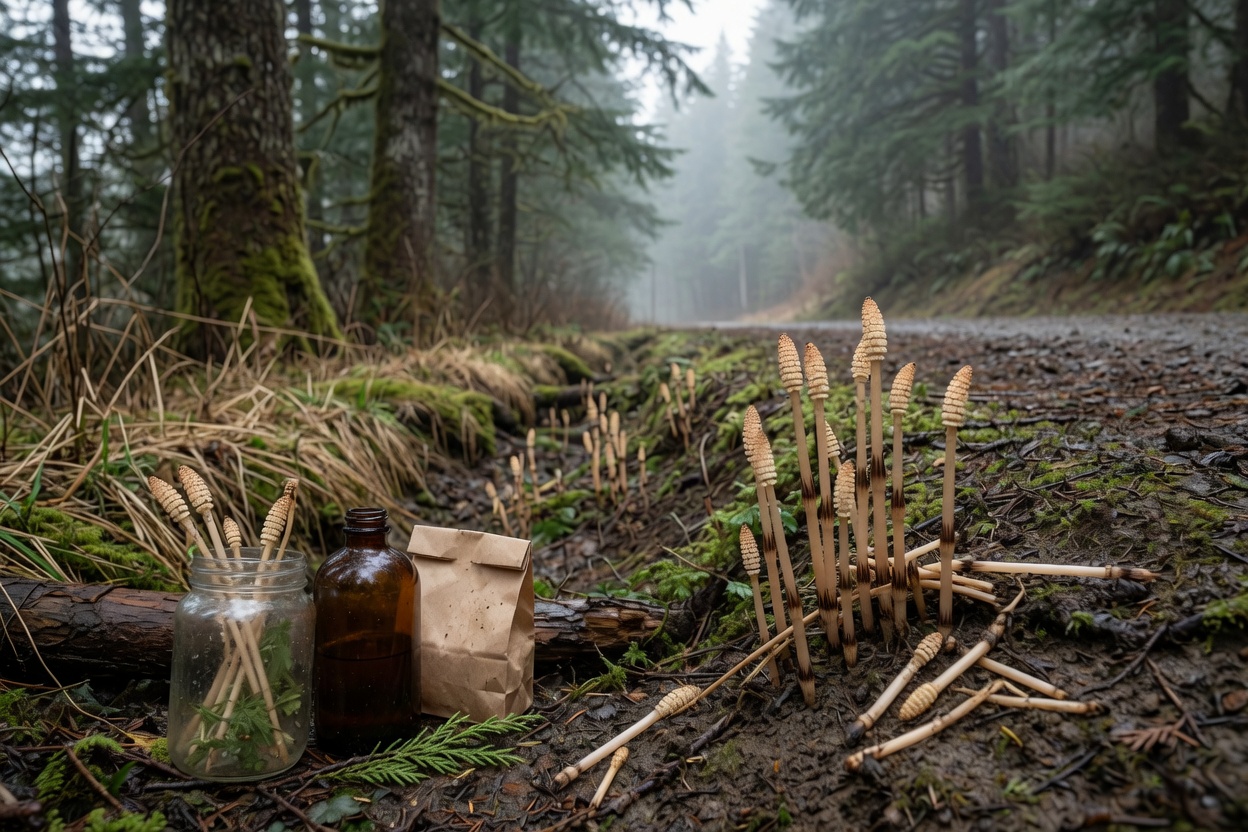
In March and April, usually the first warm week after the soil loosens, you’ll see pale tan, fleshy spikes about the height of your hand, each topped with a little cone. They look like asparagus that went to seed. Those are the fertile stems, and they wither within a few weeks. Then the green plant comes up: hollow, jointed stems with whorls of thin, bristly branches at each joint, like a bottle brush or a small fir tree. The joints pull apart with a faint pop, and the whole stem feels gritty when you run a thumbnail along it. That grit is silica, which is why my mother scoured pans with it.
Never gather a wild plant on one source alone. Check your identification against at least two good guides, and then against someone who knows the plants of your county. If you aren’t sure, leave it and come back in a month.
The cousin you do not want
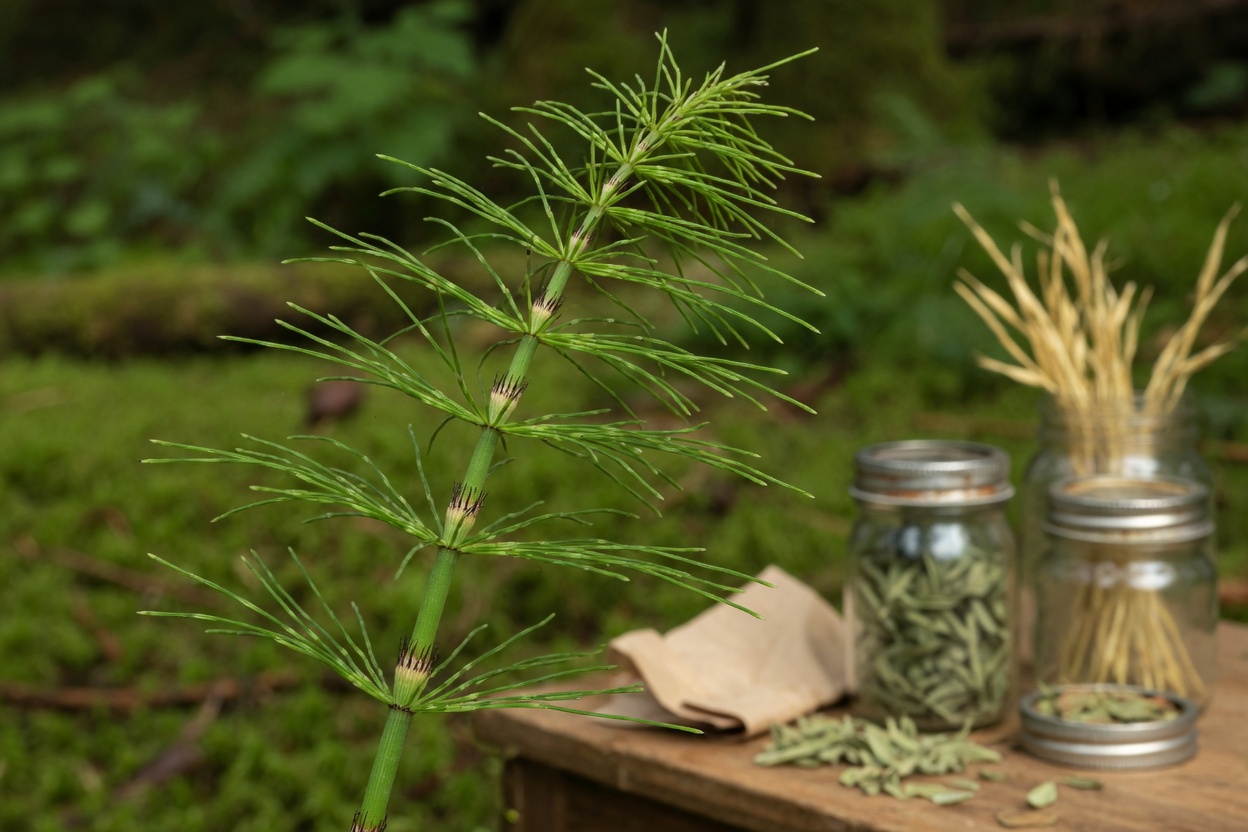
Here is the warning I give once, and mean. Horsetail has relatives, and not all of them are safe. Marsh horsetail, Equisetum palustre, grows in wetter ground and is documented as toxic to grazing livestock. Several species look close enough to the field plant that a casual glance won’t separate them. Field horsetail’s branches are simple, meaning they don’t branch again, and they tend to arch a little. Anything that deviates from that, or that stands in wetter ground than the rest of the patch, is a reason to stop and check a regional guide before you cut.
Horsetail also carries an enzyme that breaks down thiamine, which is part of why the older herbals say the plant isn’t for steady, daily use, and why I treat it as an occasional plant at most. If you want a longer look at the dangerous doubles in this region, how to identify common poisonous plant lookalikes walks through what to check before you pick anything.
Where it grows, and why to look now
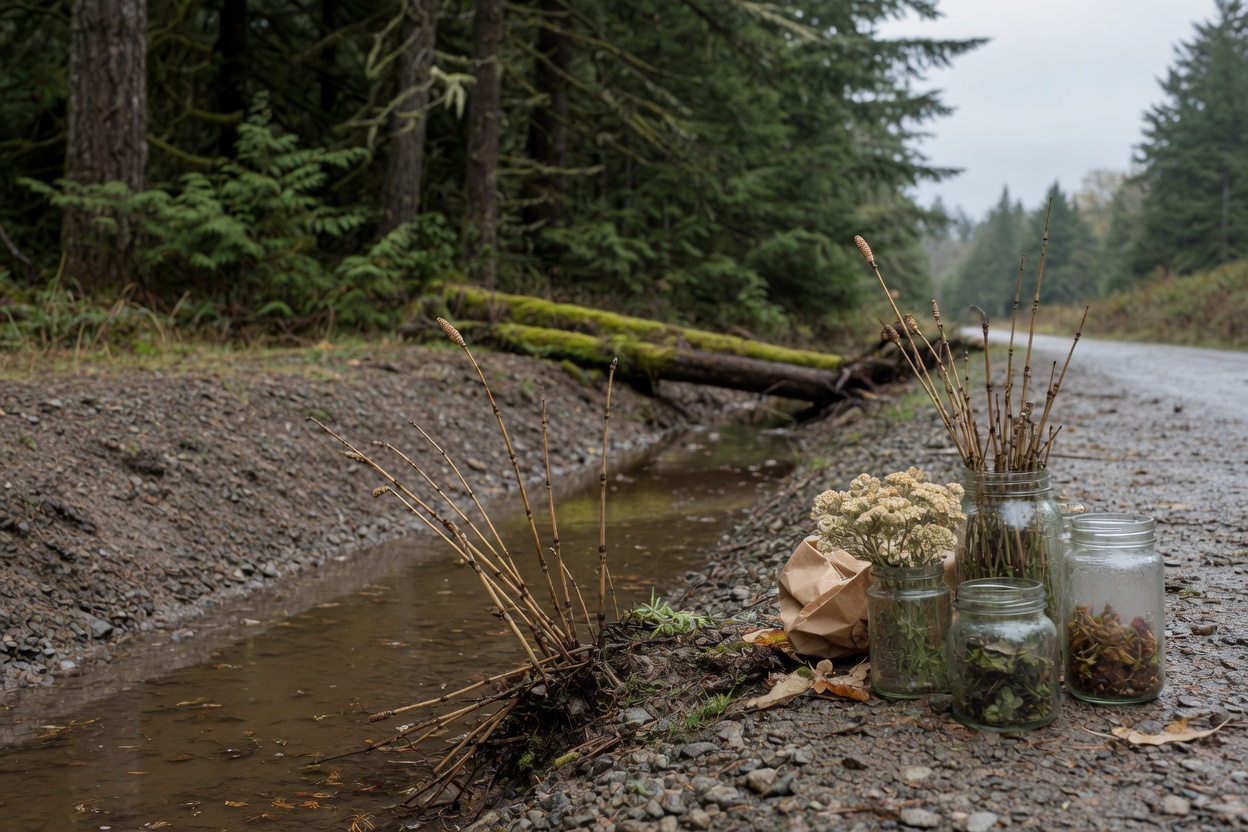
Horsetail likes wet, disturbed, compacted ground: roadside ditches, the edge of an old logging spur, the bank of a seasonal creek, a gravel shoulder where water stands in March. Around Sequim I find it from sea level up to about 1,500 feet, always where something has been scraped or graded in living memory.
This is the reason I’m writing in October. The patches are invisible by now, but you can learn the ground. Walk the ditches you’d gather from and note where water collects and the soil is packed. Pin it on your phone. In April you’ll come back to a place you already know.
Mind the land, too. Ditches are sprayed. Railroad right-of-ways are sprayed. Horsetail pulls minerals out of the soil it stands in, and I won’t gather from anywhere I can’t vouch for. Ask a landowner before you cut, or ask your local ranger district about the rules on public land.
When and how to cut
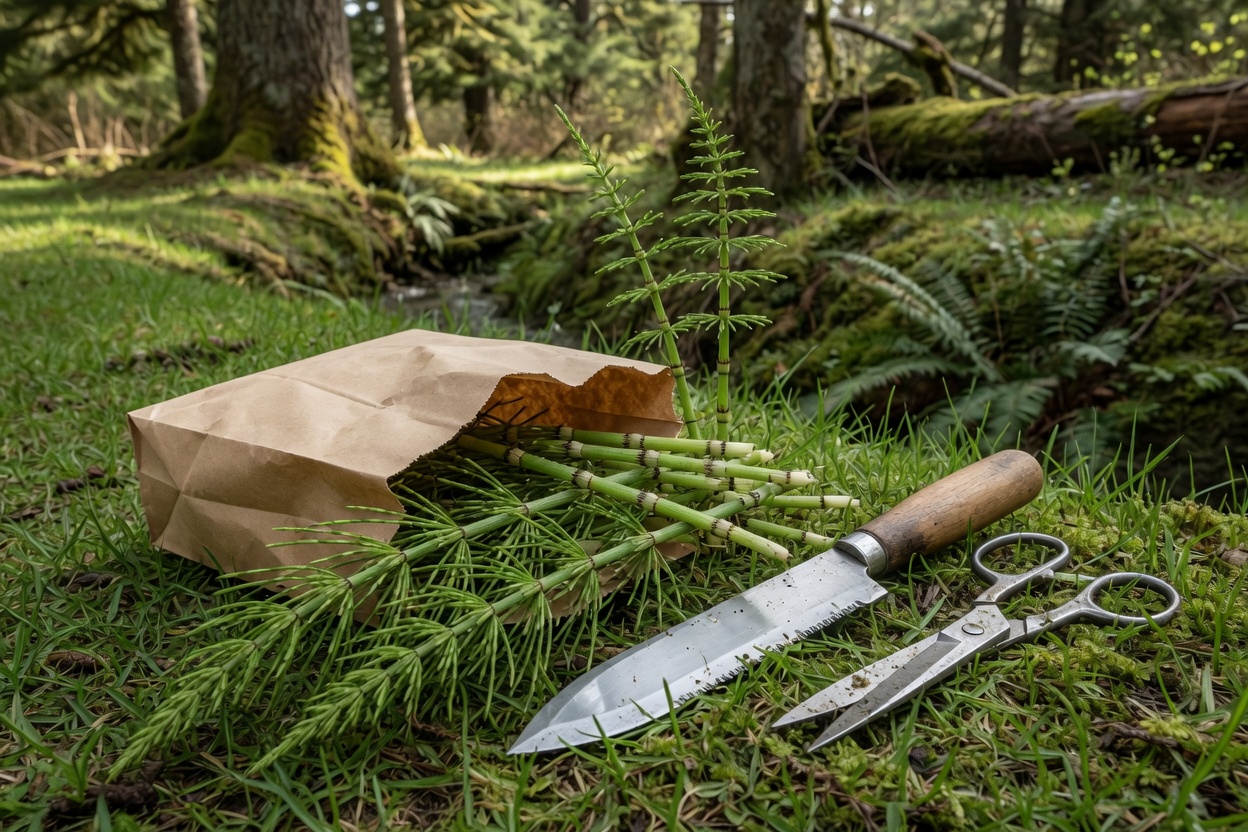
I cut the green, sterile stems in late spring, usually May on my side of the Olympics, once the whorls have fully spread and before the stems turn wiry and pale in high summer. A good stem is bright green, firm, and clean. Skip anything yellowing or sitting in standing water.
Use scissors or a hori-hori and cut a few inches above the ground, leaving the base so the stand regrows. Take no more than a third of a patch. Put the stems in a paper bag, not plastic, which sweats them in ten minutes.
Drying it
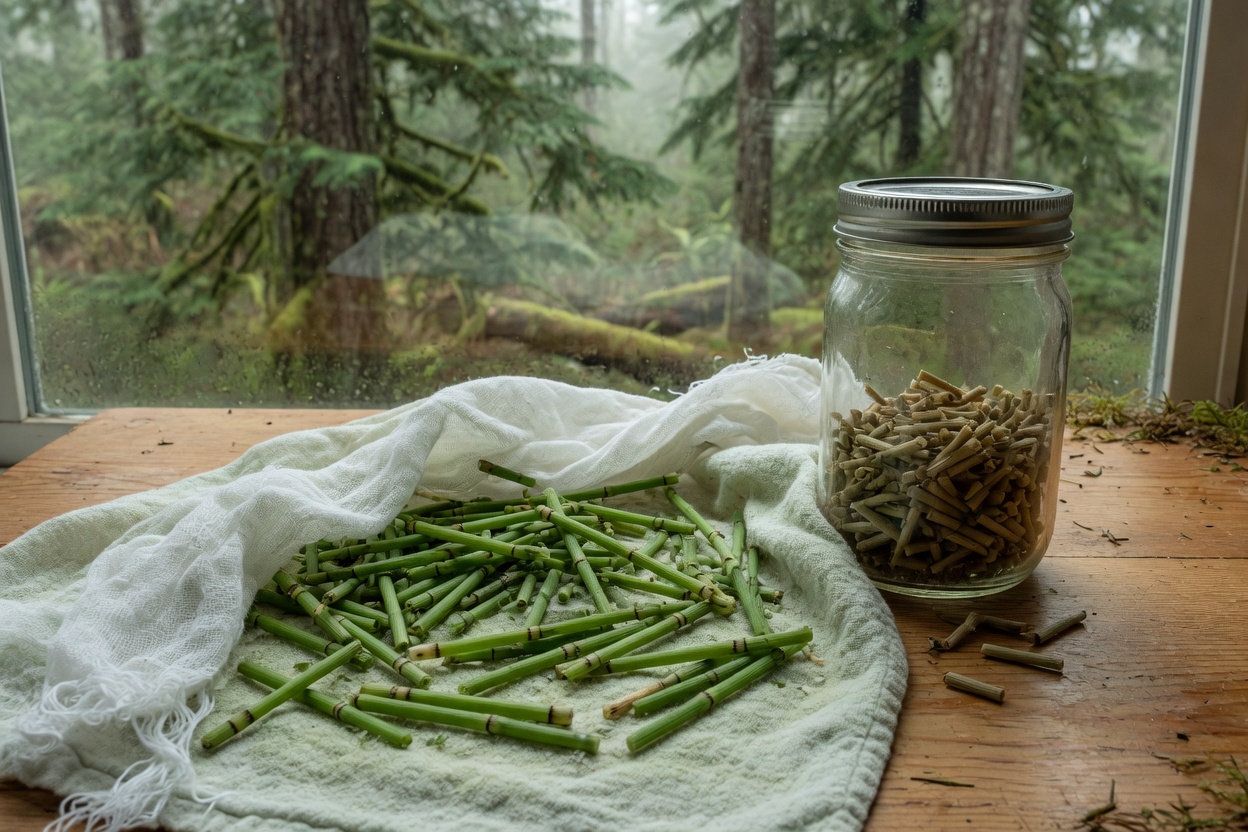
Cut the stems into short lengths, an inch or two, and spread them in a single layer on a clean cotton towel or screen. Cover loosely with cheesecloth to keep dust and flies off while air still moves through. Keep it out of direct sun.
In dry weather they snap in four to six days. On a wet week I give them a few hours in an oven set as low as it goes, door cracked. Horsetail is dry when a piece snaps clean rather than bending, and a stem that bends will mold in a jar.
Pack it loosely in a mason jar, label it with the plant and the date, and put it in a dark cupboard. I wrote more about the habit in how to store dried herbs so they last. The short version is dry, dark, and sealed, and a jar stays good for about a year.
How it has been used
Horsetail has a long record across North America and Europe, and in this region Nancy Turner’s Food Plants of Coastal First Peoples documents the plant among coastal nations, and I credit that work and the people it records for what is known there. What I can offer is my own household’s use, which is modest.
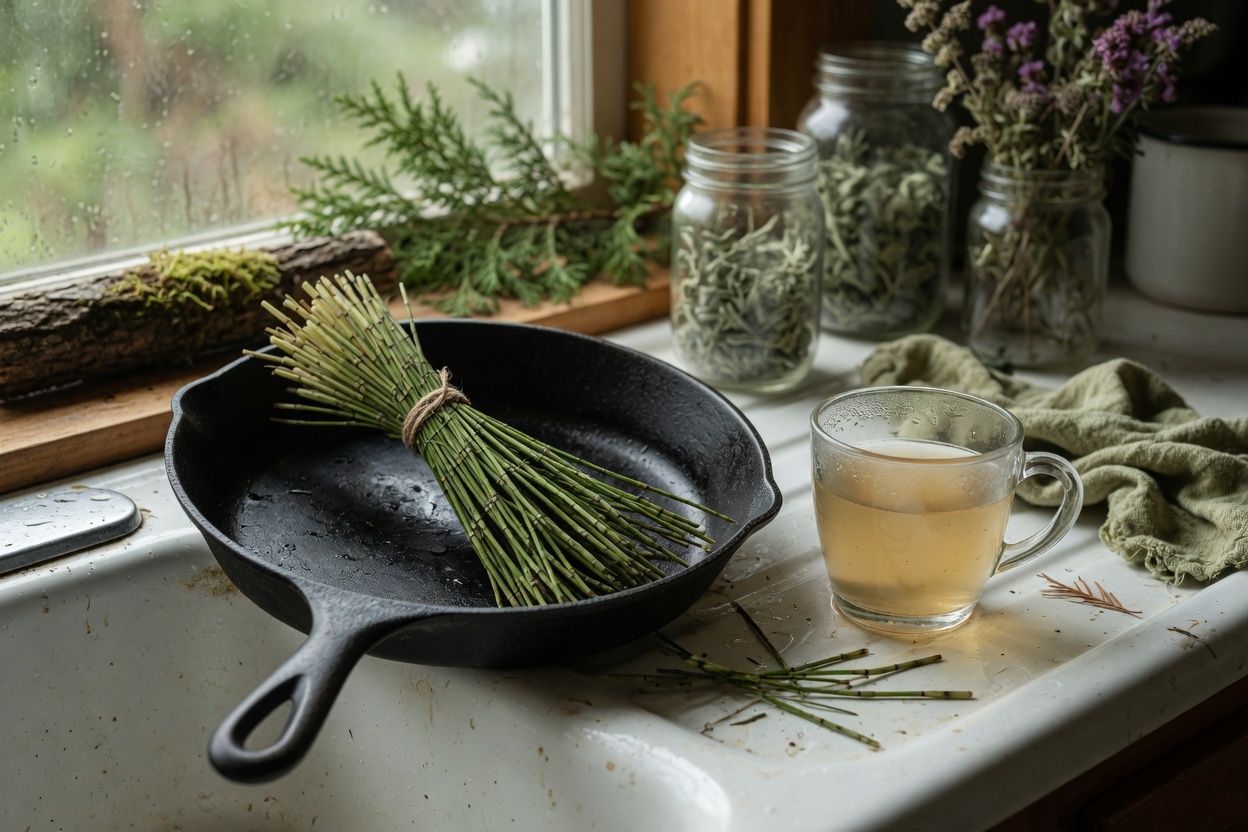
The most dependable use is the one my mother taught me: the dried stems scour pots, pewter, and a stubborn cutting board, because of the silica. Folk herbals have also described horsetail as a drying, astringent plant, steeped in tea and used in rinses, and a few older sources mention it in poultices. That is the tradition, not a promise.
If I make tea, it’s a pinch of the dried stem steeped covered for ten minutes and strained through cheesecloth, because the fine silica grit gets into everything. The taste is grassy and a little flat, like hay water. I don’t drink it often, and I don’t tell anyone what it will do for them. If you’re pregnant, nursing, on medication, or treating a health condition, ask a qualified practitioner before you add any herbal tea to your routine. This is traditional use, not advice. My ratios for plain teas are in how to make herbal tea from foraged plants.
Honest notes on the gear
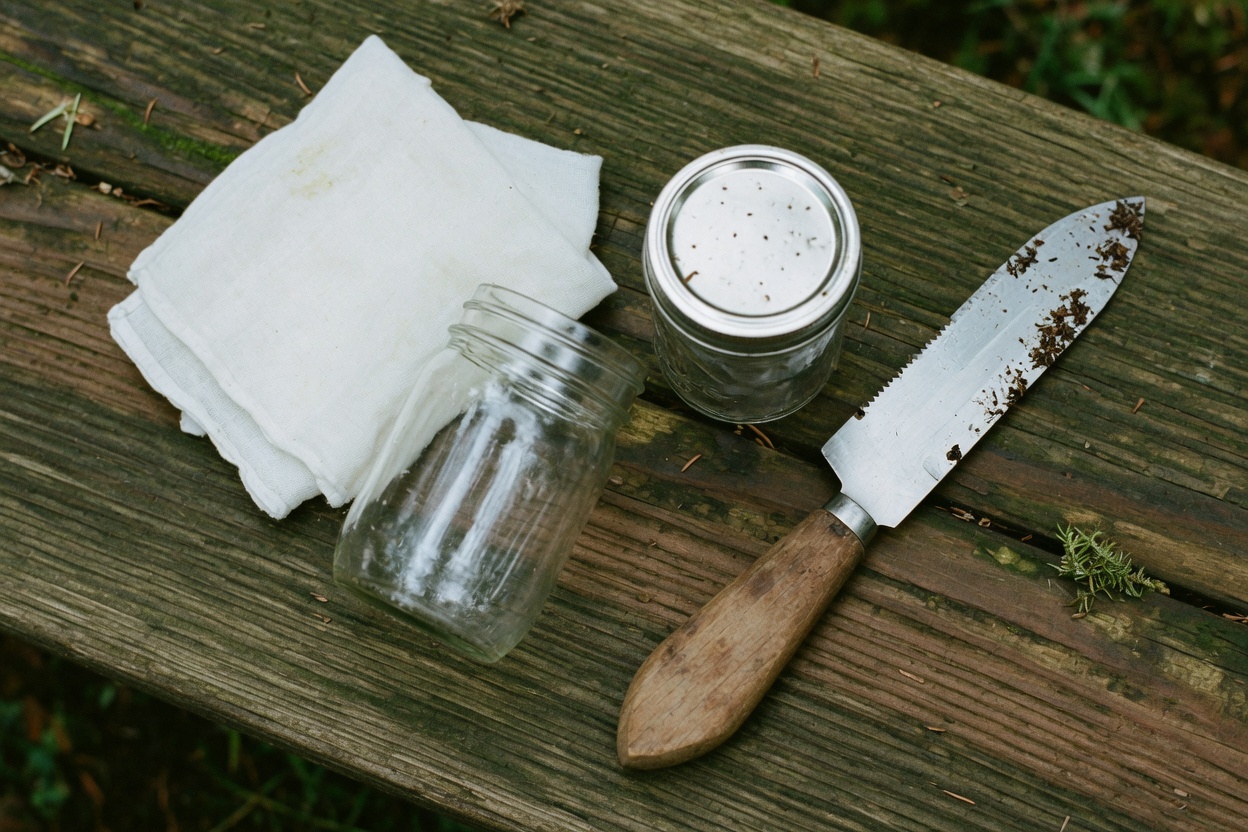
You don’t need much. The cheesecloth and jars earn their keep on every plant you dry this year, so that is where I’d spend. The hori-hori is the optional piece here. It cuts a stand cleanly and it’s useful if horsetail has invaded a bed of yours, because the rhizomes run deep and a trowel won’t do it. But if you only plan to cut a few stems from a ditch, scissors will do and I’d skip the purchase for that reason alone.
Where to go from here
Walk your local ditches this month, note where the ground stays wet, and get comfortable with the shape of the plant in photographs. In April, return to the spot you marked and identify before you cut. The identification features, the harvest windows, and the look-alikes are laid out in Pacific Northwest Medicinal Plants, the book I wrote so that people aren’t guessing at the roadside. If you want it in your pack for spring: Pacific Northwest Medicinal Plants.
