How to Forage Henbit in Appalachia and Tell It From Dead Nettle
How to forage henbit in Appalachia: tell it from purple dead nettle and ground ivy, gather it clean, dry it, and make a simple traditional tea and spring green.
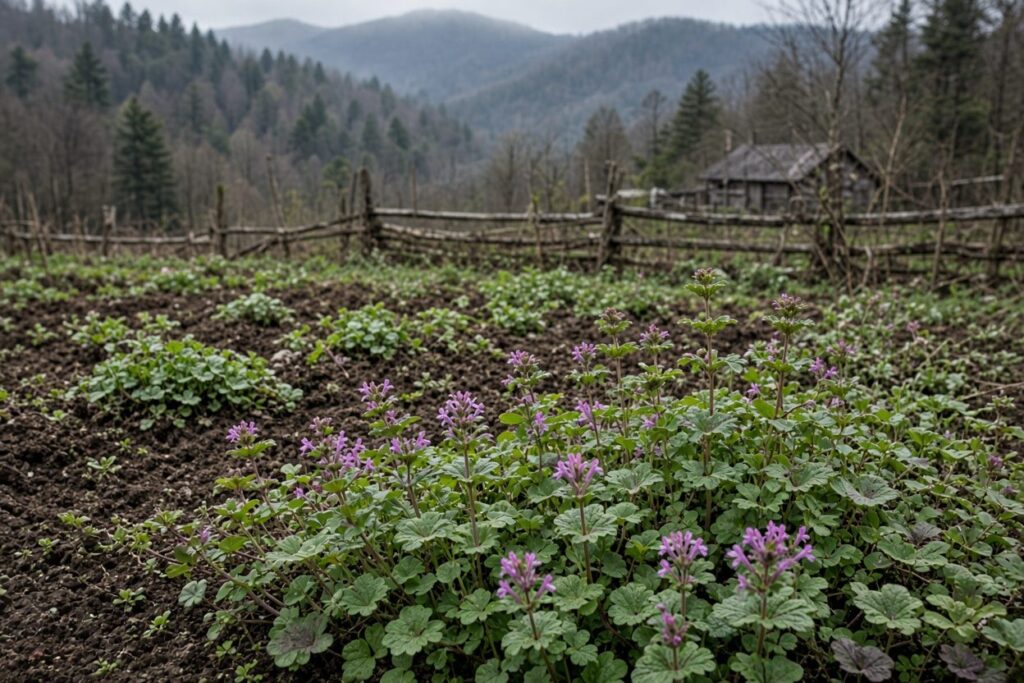
Last February my granddaughter came up from the bottom garden with a fistful of what she called purple dead nettle, and I sat her down at the kitchen table and sorted it into two piles. About half of it was henbit, and she hadn’t known there was a difference. Most people don’t. The two grow side by side in the same bare beds, bloom the same pinkish purple in the same weeks, and get pulled and thrown on the same compost pile.
They are close cousins, but they are not the same plant, and if you’re going to gather one you ought to know which one is in your basket. Henbit, Lamium amplexicaule, is the one I want to talk about here. Right now, in mid-November, the first little seedlings are already coming up in the empty garden rows outside Marshall, which makes this a good time to learn them before the spring flush.
The leaf that hugs the stem
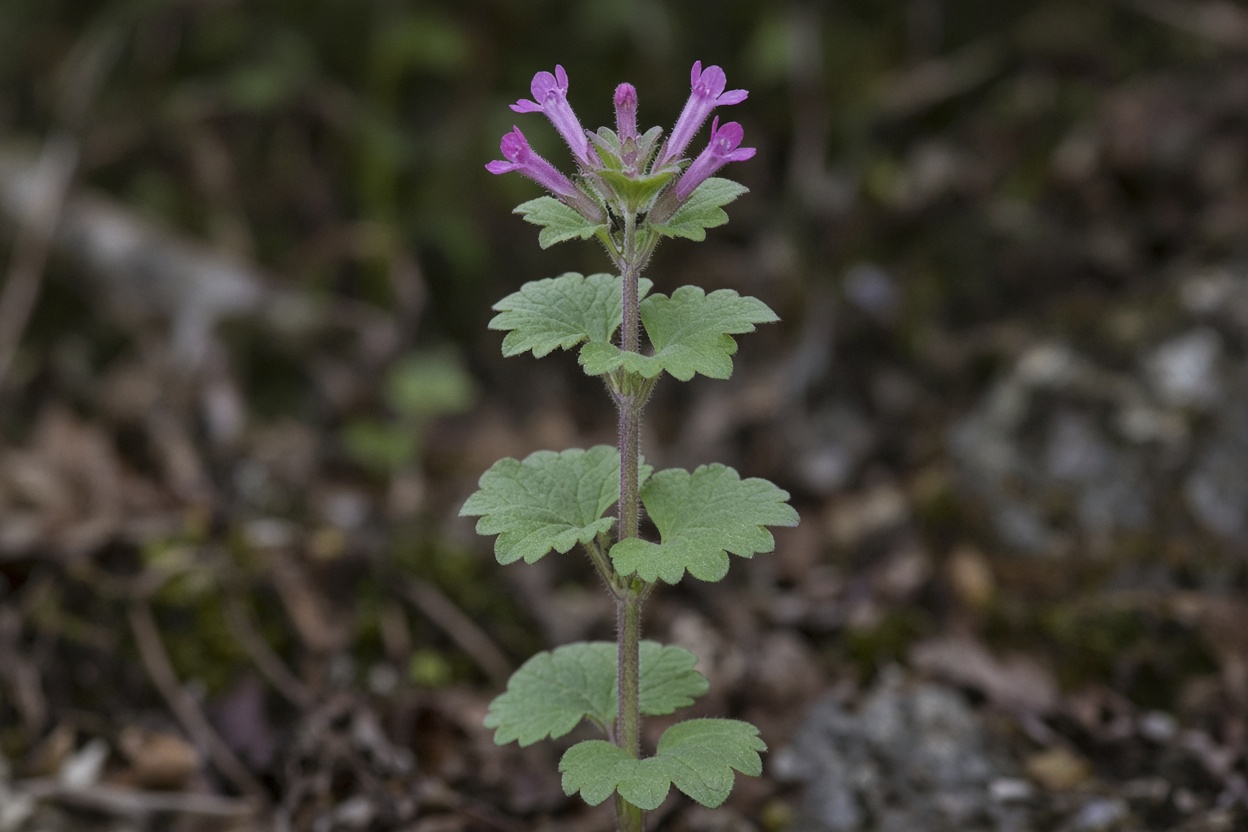
The Latin name tells you the main thing. Amplexicaule means “stem-clasping,” and that is exactly what the upper leaves do. They have no stalk at all. Each pair wraps partway around the square stem, the way a hand cups around a broom handle, and the pairs are stacked up the stem in tiers with bare stem showing between them.
The leaves themselves are round to kidney-shaped, with a scalloped edge like a row of little half-moons, and they are a plain mid-green, faintly hairy. The lowest leaves near the ground do have short stalks, so look at the top half of the plant when you’re checking. The flowers are slender pink-to-purple tubes, nearly an inch long, poking up out of those leaf tiers, with darker spots on the lower lip. You’ll also see small closed buds that never seem to open. Some henbit flowers set seed without ever opening.
The stem is square, as with all the mint family, and the plant sprawls low, usually four to ten inches, branching from the base. The old name comes from hens pecking at it in the yard, and it’s about that humble.
Henbit or purple dead nettle?
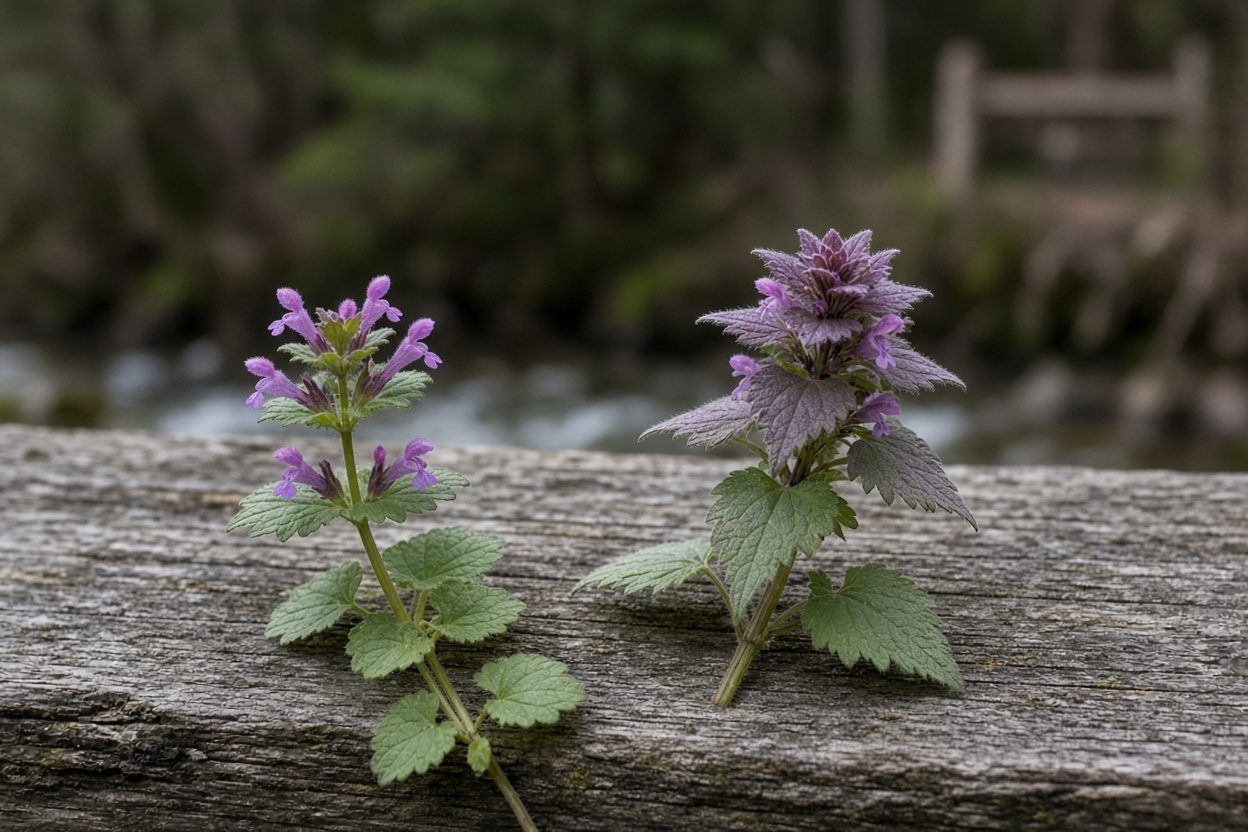
Here’s how I showed my granddaughter. Purple dead nettle, Lamium purpureum, has leaves that are triangular or heart-shaped and every one of them sits on a stalk, even at the top. Those top leaves crowd together into a tight, overlapping, purple-tinged hood, so the whole plant looks like a little pagoda with a roof on it. Henbit has no roof. Its top is open, with round scalloped leaves clasping the stem in separate tiers and the flowers standing up between them.
If you hold one of each side by side, you’ll never confuse them again. Purple dead nettle is the fuzzier, more pointed, more purple of the two. Henbit is greener, rounder, and more open. They are traditionally used in much the same ways, and I’ve written up the cousin in how to forage and use purple dead nettle, but it’s good practice to keep them in separate jars and know which is which.
Ground ivy and other look-alikes
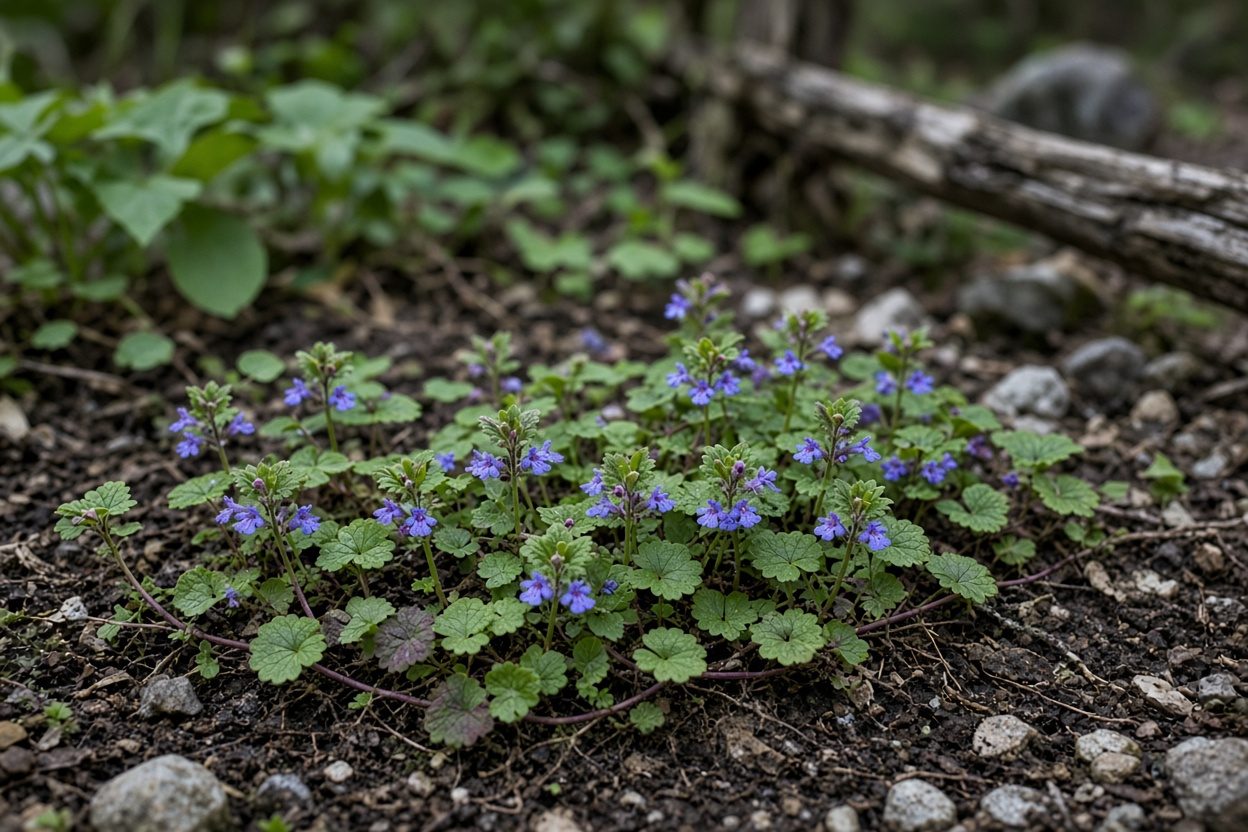
Ground ivy, Glechoma hederacea, which some of the older folks call gill-over-the-ground, is the other one that fools people. It also has round, scalloped leaves and purple tubular flowers in spring. But ground ivy creeps. It runs flat across the ground and puts down roots where the stem touches soil, making a mat, and every leaf sits on a long stalk. Crush it and it smells sharp and strong, somewhere between mint and skunk. Henbit stands up in little branching clumps, doesn’t root along the stem, and barely smells at all. I go through ground ivy on its own in how to forage and use ground ivy.
Now the rule I give everybody, and I’ll say it once. Never use any wild plant on a book, an app, or a single source alone, this page included. Confirm it with more than one reputable guide and an experienced local forager, and when in doubt, leave it. Henbit’s family has no deadly look-alikes in a garden bed, but a beginner’s basket can pick up anything that’s growing low and green in March. My page on dangerous look-alikes of Appalachian medicinals is worth keeping open your first season.
Where to gather, and where not to
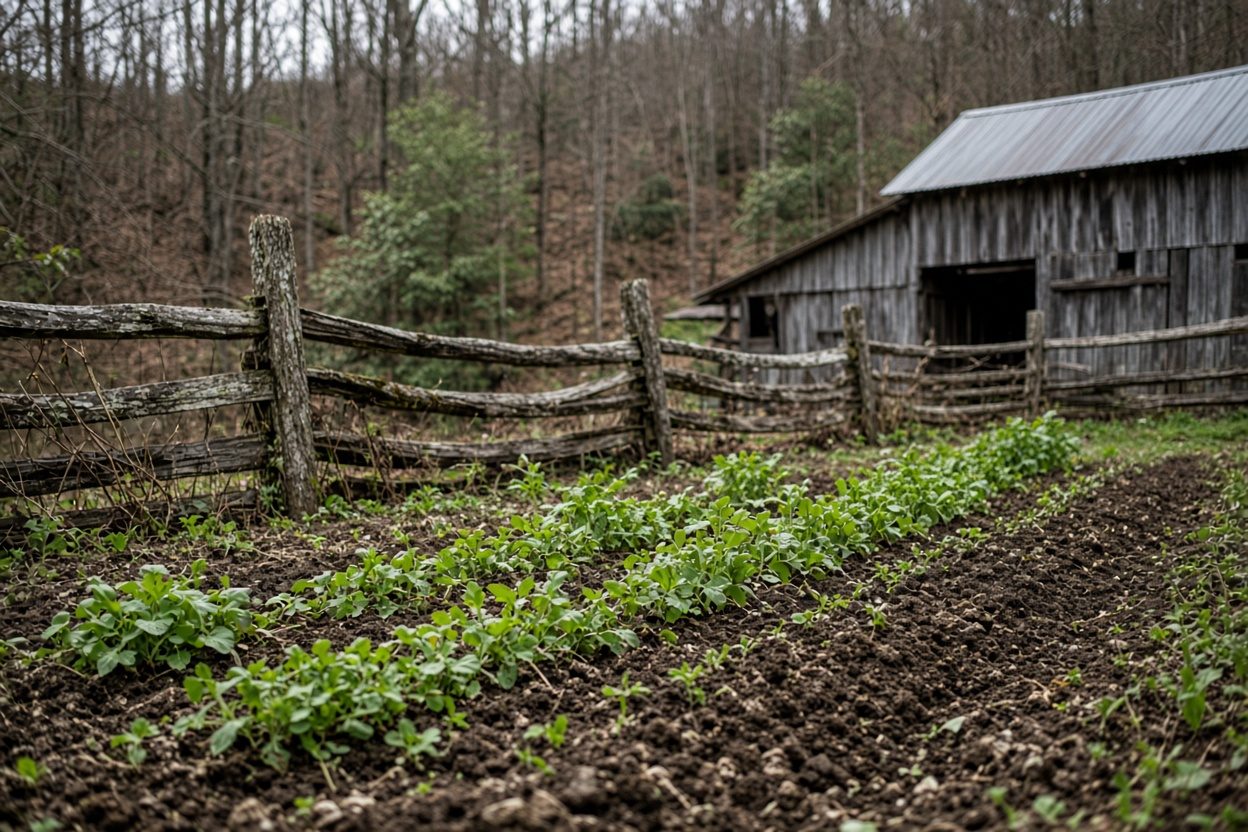
Henbit came over from Europe in seed and soil, and it follows people. It wants turned ground: garden beds, plowed bottomland, the edges of a tobacco field gone fallow, a yard that doesn’t get much attention. That habit is the trouble with it. The same places it loves are the places that get sprayed.
I won’t gather it from roadsides, where the state crews spray and the traffic leaves its own residue. I won’t take it from a crop field unless I know the farmer and know what went down that spring, because a lot of fields get a burndown spray in late winter right when henbit is at its best. Lawns are the same story if anybody’s put down a weed-and-feed. In practice, most of mine comes from my own vegetable garden, which I know hasn’t seen a spray in forty years, and from a neighbor’s hayfield edge where I’ve asked and been told. Ask permission on private land, and check the rules before carrying anything off public ground.
When to gather

In Madison County the seed sprouts in fall, the plants sit small through the cold, and they take off in February. The best gathering is late February through March, when the tops are tender and the first flowers are up. By April the plants get stringy and start dropping seed, and once the heat comes in May they’re gone.
I snip the top three or four inches with scissors, leaves, flowers, and soft stem together, and leave the base. There’s no worry about overharvest with henbit; it is a garden weed with more seed than you’ll ever see the end of. When I’m clearing a bed for peas in March I’ll lift whole clumps with the hori-hori, knock the dirt off the roots, and keep the tops. I’ll be honest that for gathering alone you don’t need a hori-hori. It earns its keep because I’m weeding anyway, and it’s the same knife I use for roots all year.
Drying it

Rinse the tops quickly in cold water and shake them hard, or spin them in a towel. Spread them in a single layer on a screen or a clean cloth, out of the sun, in a room with moving air, and lay a piece of cheesecloth over them to keep the dust and flies off. In my drying shed in March they take four or five days. They’re done when a leaf crumbles between your fingers instead of bending.
Pack it loosely in a wide-mouth jar with the plant, the place, and the date written on a strip of masking tape, and keep it in a dark cupboard. Here’s the honest part. Dried henbit is mild to begin with and it fades fast, so it’s best within the year. I lost a whole jar one wet spring because I packed it before it was truly dry, and it went musty in a week. My notes on storing mountain herbs through a humid Appalachian winter are how I keep that from happening now.
A simple tea and a fresh green
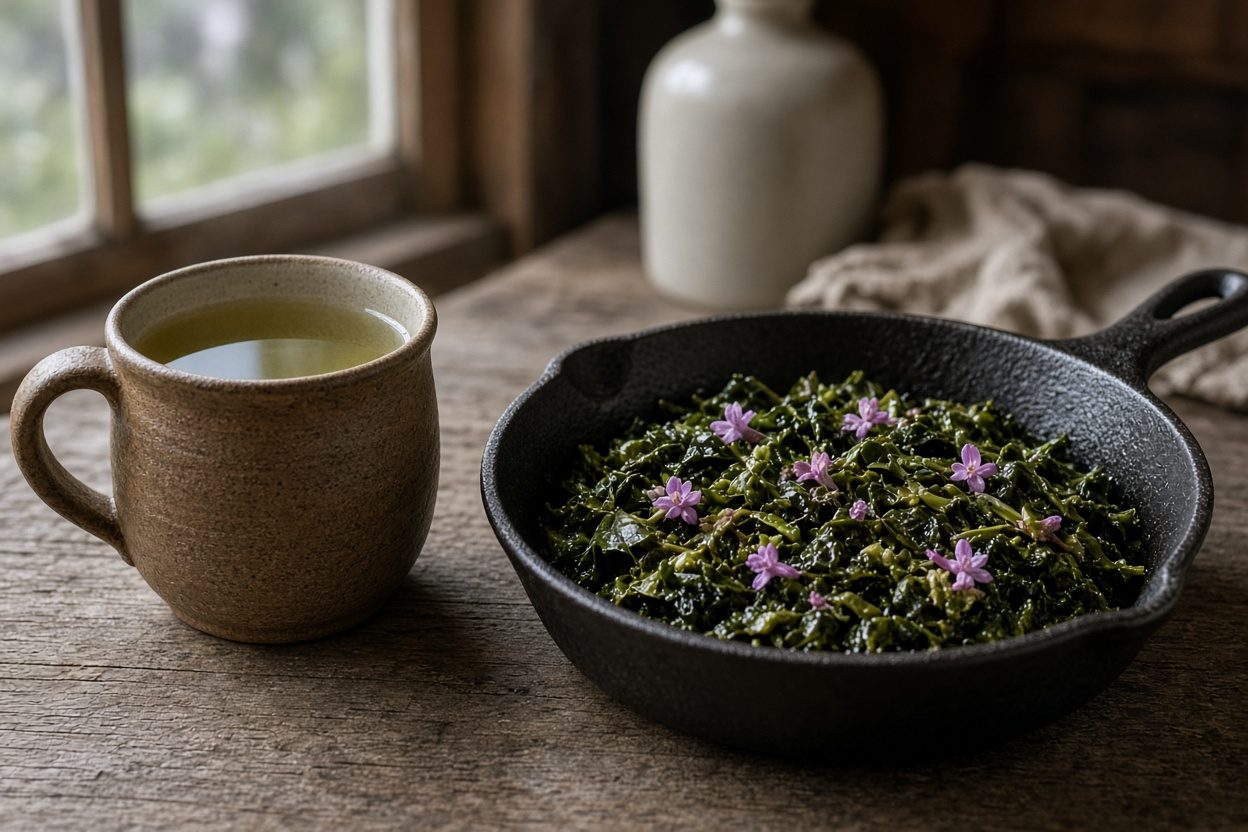
I’ll describe how henbit has traditionally been used in my family, and I’ll be plain about it: this is folk practice, not medical advice. Henbit has a long history as a spring green and a plain tea, and I make no claim about what it does for the body. Anyone pregnant, nursing, or on medication should ask a doctor before trying any wild plant.
For the tea, put a small pinch of dried henbit in a mug or a small pot, pour hot water over it, cover it, and let it steep about ten minutes. Strain it through cheesecloth. It’s a light, grassy, faintly sweet cup, nothing dramatic. My grandmother made it in March when the first of it came up, mostly, I think, because it was the first green thing she could put in a cup.
Fresh is where henbit really shines. The tops are mild and a little earthy, and I chop a handful into a skillet of spring greens or creasy greens right at the end, or stir it into scrambled eggs. Small plants go raw into a salad, flowers and all. Eat it as food, in food amounts. Livestock that graze a field of nothing else have been known to get sick on it, and that’s reason enough for me to treat it as one green among several, not a meal on its own.
Go learn it in the bare rows
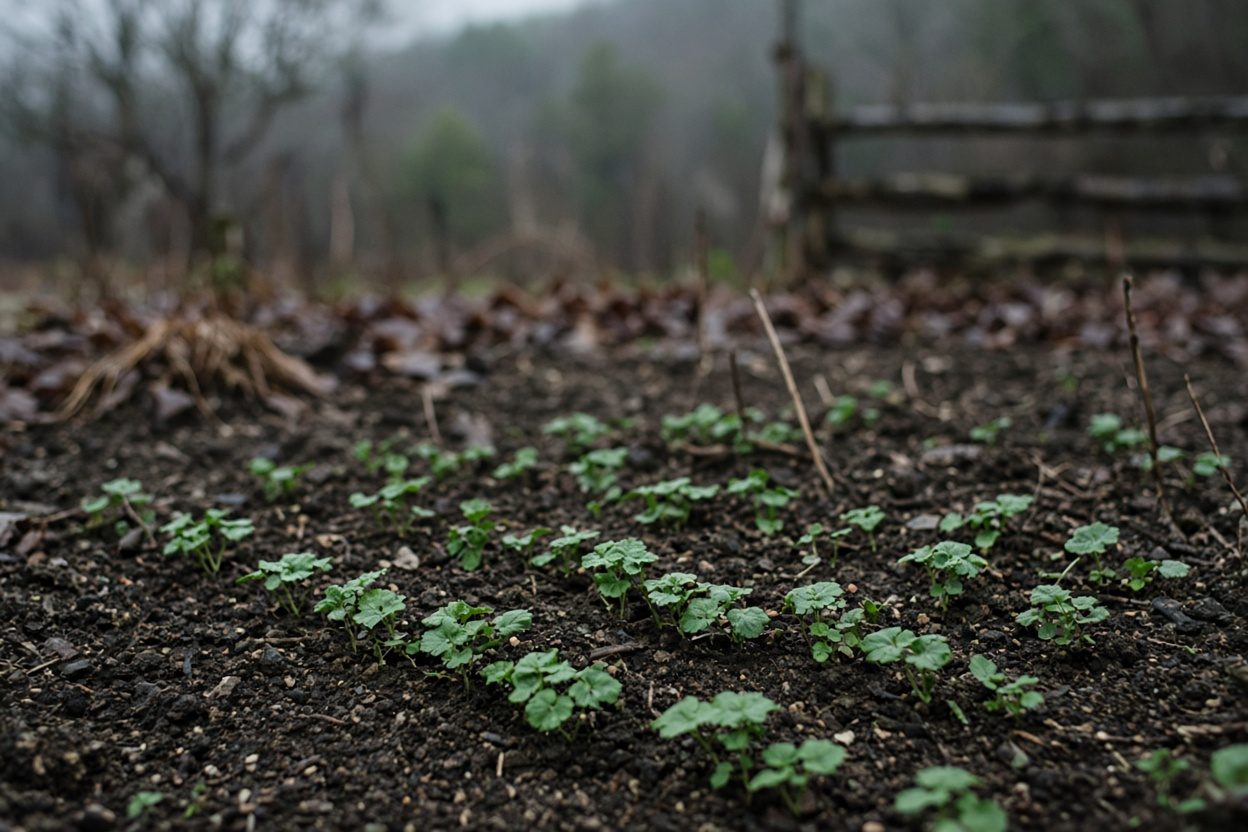
Walk your garden this week and look down between the rows. Those little round scalloped seedlings are henbit, and by February you’ll know them on sight. If you want the rest of the early list, my starter notes on what to forage in Appalachia in spring pick up where this leaves off.
I go through the mountain plants one at a time in my book, Appalachian Medicinal Plants: how to tell each one from its kin, when to gather it, and how to put it up so it keeps. It’s the book I’d hand my granddaughter, and I did.
