How to Forage and Use Ground Ivy in the Southern Mountains
Learn to identify, harvest, and brew ground ivy (Glechoma hederacea) the mountain way, how it differs from English ivy and poison ivy, and who should skip it.
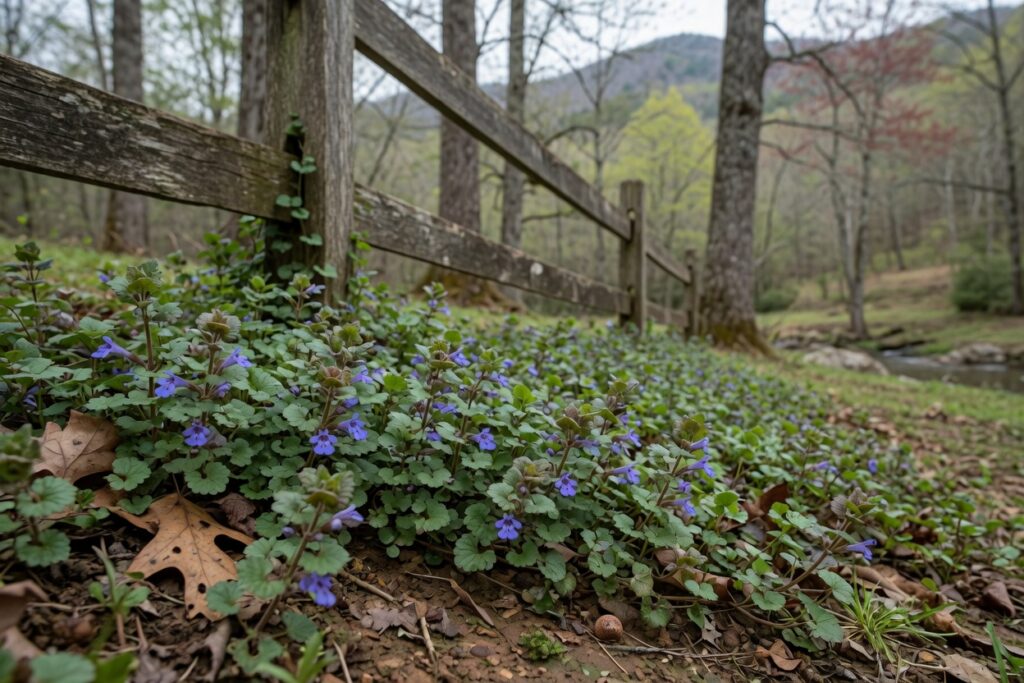
The first green thing that comes back up my hollow every year isn’t a ramp or a violet. It’s ground ivy, creeping low along the edge of the yard, never quite having gone away. My grandmother called it gill-over-the-ground, and my mother called it creeping Charlie, and I’ve spent most of my life telling folks it is neither of the plants they think it is.
It stays green much of the winter in the mountains, which makes January a fine time to learn it. If you can find it now, you’ll know exactly where it is when the purple flowers open in April. Here’s how I identify it, gather it, and make a plain mountain tea from it.
You’ll also want a paper bag and a pair of scissors.
Know it before you pick it

Ground ivy is Glechoma hederacea, a low creeping plant in the mint family. Mint family means a square stem. Roll the stem between your fingers and you’ll feel four distinct edges. That’s the first check, and I never skip it.
The leaves are small, rounded to kidney-shaped, with scalloped edges and a soft hairiness. They grow in opposite pairs along trailing stems that root at the joints, which is how a patch spreads across a yard. Crush a leaf and it smells sharp and minty, a bit like a rough oregano. In April the plant sends up small blue-purple flowers shaped like little lipped trumpets.
Think of it as a creeper, not a climber. It runs along the ground and doesn’t go up a tree.
What it isn’t

English ivy (Hedera helix) is a woody climbing vine with glossy, lobed, evergreen leaves. It’s toxic. It has nothing to do with ground ivy except the name, and you’ll know it by the climbing habit and the leathery leaves.
Poison ivy has leaves in groups of three and grows as a vine or a low shrub. It has no square stem and no mint smell. Everyone in the mountains learns it young, and I’ll assume you have too.
Henbit and purple deadnettle are close relatives that grow in the same disturbed ground. They share the square stem, but their leaves are rounder and upright, and the top leaves are often tinged purple. They aren’t the plant I’m writing about here, so if the plant stands up instead of creeping, I’d set it aside.
Never use any wild plant on a book, app, or single source alone. Confirm with multiple reputable guides and an experienced local forager, and when in doubt, leave it.
Where and when to gather

I find it in shady, damp places: the edge of a yard, a fence row, the bank by the spring. It likes disturbed ground. Gather from places you know have not been sprayed with weed killer, and stay away from roadsides, where the plants collect whatever washes off the pavement.
The best leaf is the young, tender growth from early spring up to the flowering in April and May. Pinch or snip the top few inches of the stems, leaving the root and the lower growth in place. A patch is generous, and it grows back fast. Take what you need, and leave the rest.
A word for people with horses

Ground ivy has a reputation among horse people. Eaten in quantity, especially in hay, it has been linked to poisoning in horses. If you keep horses or ponies, don’t pick it where they graze, and don’t cut hay from a field with a lot of it. It’s another reason to know your ground.
The plain way to use it

Mountain folk used this plant as a spring tea long before there were herb shops, and it’s still known in the old books as a traditional tea. I’m telling you how my family made it. I’m not telling you what it will do for your body, and I won’t claim anything of the kind.
Fresh leaf tea. Put a small handful of fresh, rinsed leaves in a pint jar, pour just-boiled water over them, cover, and steep for ten minutes. Strain through cheesecloth. The taste is green and a little bitter, with that mint edge. Folks used to sweeten it with honey. It was also a brewing herb in the old days, called alehoof, before hops took over.
Dried leaf. Spread the cut stems on a screen or hang small bundles in a warm, airy place until the leaves crumble. Strip the leaves, pack them in a clean jar, and label it with the date. Dried ground ivy keeps its flavor best in the first year. If your winters are damp, my post on how to store mountain herbs through a humid Appalachian winter will help you keep it from molding.
I’d start with a single cup and see how you like it. Plants affect people differently. If you’re pregnant, nursing, on medication, or managing a health condition, talk to a doctor before you drink any herb you haven’t had before.
Bring a start home

If you would rather have a patch by the kitchen door than walk the fence row, lift a small piece with its roots. A hori-hori slides under the creeping stem without tearing it. Set the piece in a pot of ordinary garden soil in part shade and keep it watered. It needs no coaxing. Keep the pot away from the garden beds, because it runs, and that is the reason most folks have it in the first place.
Learn it in winter

Walk the edges of your yard and your fence rows in January with your eyes on the ground. Look for the creeping, scalloped, green leaves, and roll a stem between your fingers. The plant is often more obvious in winter, with the grass and weeds gone brown around it.
For more on what to look for when the garden is quiet, I wrote about how to identify Appalachian medicinal plants in winter. And before you gather anything, how to identify dangerous look-alikes of Appalachian medicinals is worth reading all the way through.
If you want to know what else is coming up the hollow in spring, what to forage in Appalachia in spring is the place to start.
I cover identification, safe harvest, and the traditions behind these plants in my book, Appalachian Medicinal Plants.
