How to Forage and Use Fireweed: Spring Shoots and Summer Tea
Learn how to forage fireweed in the Pacific Northwest: tell spring shoots from look-alikes, dry the leaves for tea, and store a winter's supply properly.
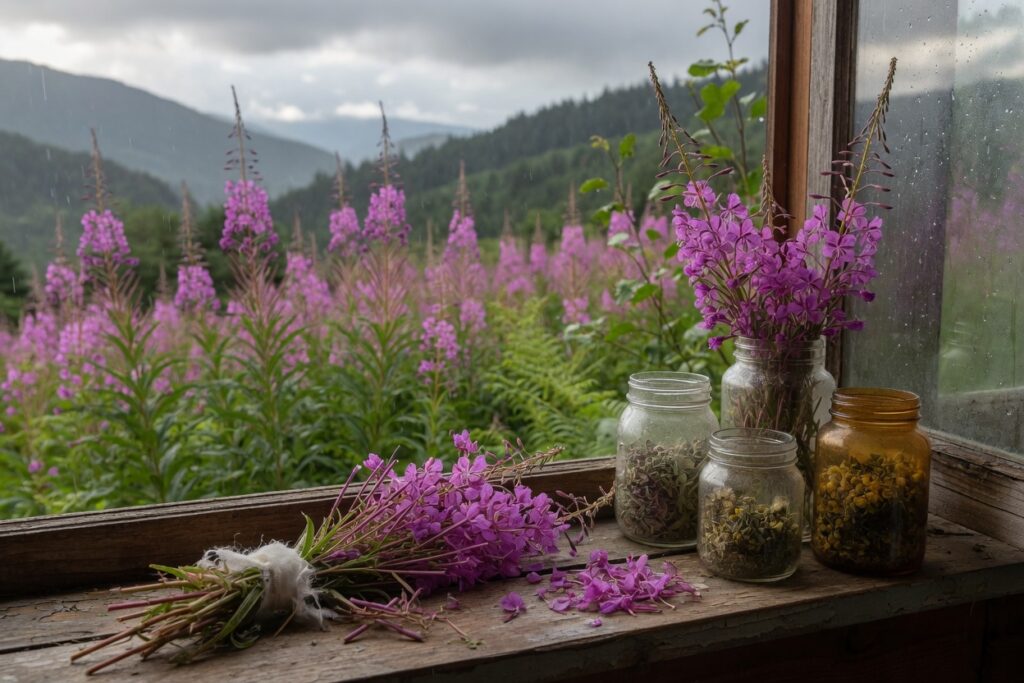
Fireweed is the plant that moves in after the fire, the logging crew, or the bulldozer, and it does it with a flourish. Come July, the old clearcuts above the Dungeness are streaked magenta from the road to the ridgeline, tall spikes of flowers that open from the bottom up, a few at a time, all summer long. Chamaenerion angustifolium, which older guides still list as Epilobium, is one of the first wild plants I teach a beginner, because you can find it from a moving car and learn its leaf in an afternoon.
I’ve gathered fireweed on the Peninsula for the better part of thirty years, shoots in April, leaves through the summer, and I’ll walk you through the season in that order. One note up front: this is a spring-ahead post. The shoots are what you’ll be looking for in a few months, but the leaf for tea is a summer job, and a winter evening with a map and a field guide is the right time to plan both.
Know it before you cut it
Before anything else: never eat or prepare a wild plant on the word of one book, one app, or one article, this one included. Confirm it against more than one reputable guide and, better, with an experienced local forager. When there is real doubt, leave it standing.
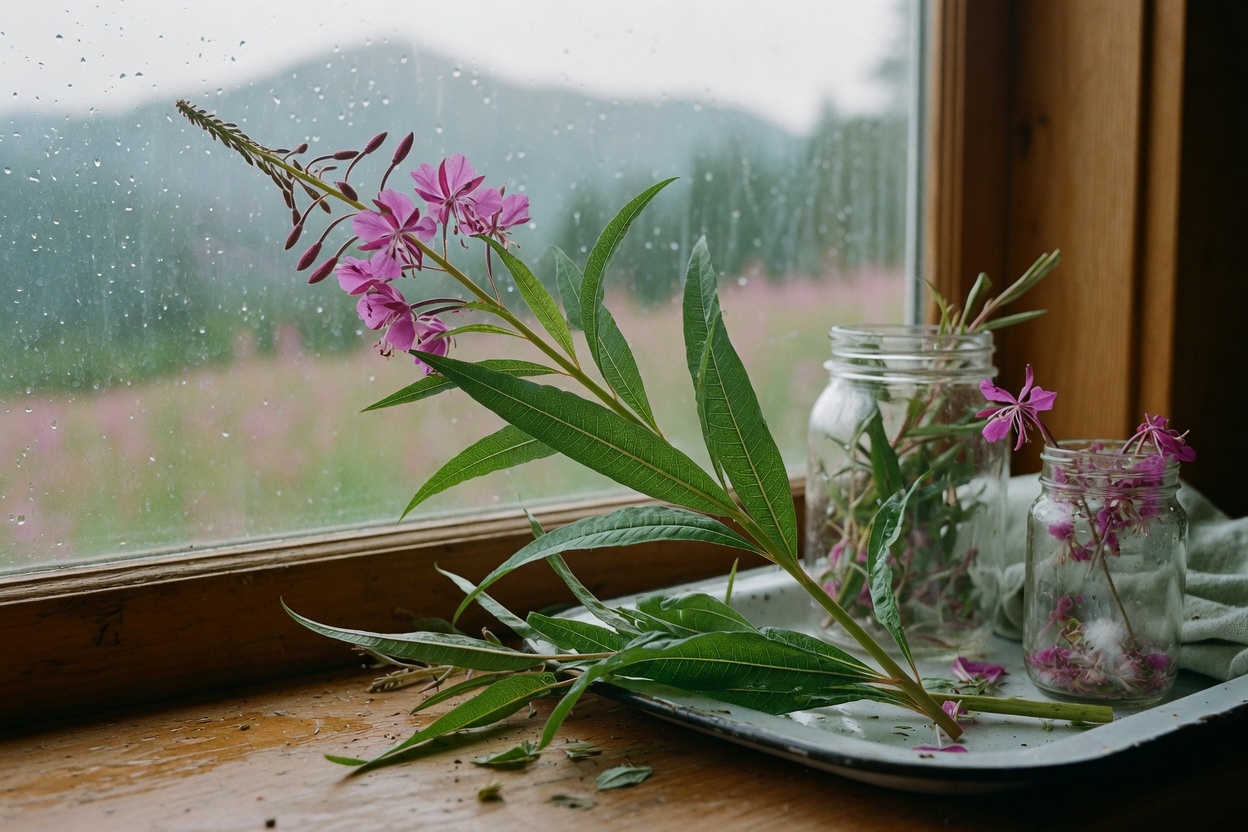
In spring, fireweed comes up as a cluster of reddish-green shoots in the open ground where it grew last year, often with the dry brown stalk of last year’s plant still beside it. The leaves are lance-shaped, smooth along the edge, and arranged in a spiral up the stem. Here is the identifier that settles it for me. Look at the veins on a mature leaf: the side veins curve and join up before they reach the margin, forming a faint continuous line just inside the leaf edge. Almost nothing else has that. You can see it from a foot away once you know to look.
That matters because young fireweed shoots can be mistaken in wet ground for false hellebore (Veratrum), which is seriously toxic. Hellebore leaves are pleated like a fan, with deep parallel creases and fuzzy undersides, and they grow in thick clumps. Fireweed leaves are flat and smooth. If the leaf is pleated, put your knife away. I cover this and the other dangerous pairings in Poisonous Plant Look-Alikes Every Forager Should Know, and I’d read that one before you go out in April.
The shoots, in April and early May
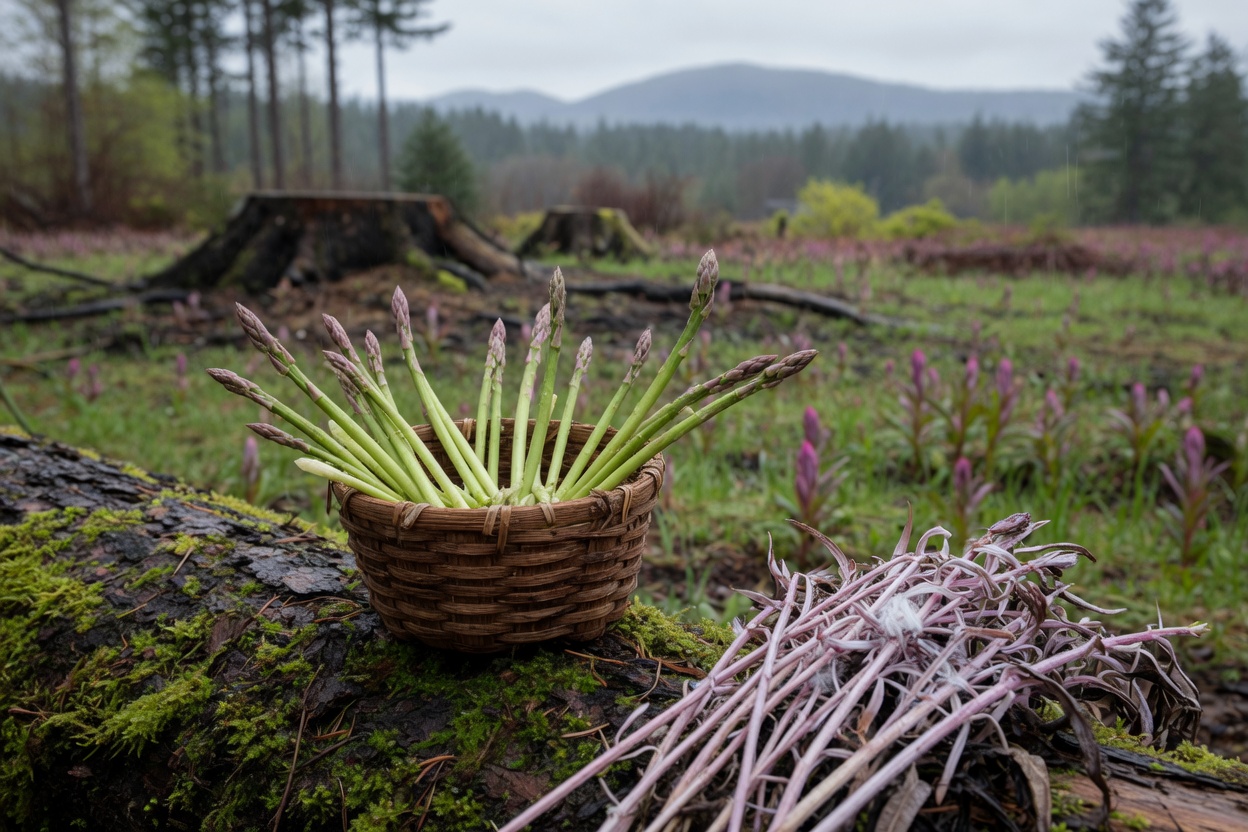
Gather the young shoots when they’re under a foot tall and the leaves are still tight against the stem and tinged red. Past that point they turn tough and bitter. Cut them at ground level with the hori-hori and take only a few from any one patch, because the plant spreads by underground runners and you want those runners to keep sending up shoots next year.
If you’re not certain of a patch, this is where I use the knife for its other job. Fireweed shoots in a stand are connected by a shallow rhizome, a pale horizontal root, and tracing one shoot to its neighbors with a gentle scrape of soil is a good confirmation that you’re in a fireweed colony and not a scatter of unrelated seedlings. Firm the soil back when you’re done.
The shoots are eaten cooked, simply: a few minutes in boiling water, then butter and salt, the way you would treat thin asparagus. They taste mild and a little green, with a faint sweetness. Nancy Turner’s Food Plants of Coastal First Peoples documents the shoots and the peeled summer stems as food on this coast, and I’d send you to her work for who ate them and how, rather than rely on my paraphrase. The knowledge belongs to the people who kept it.
The leaves, for tea, through the summer
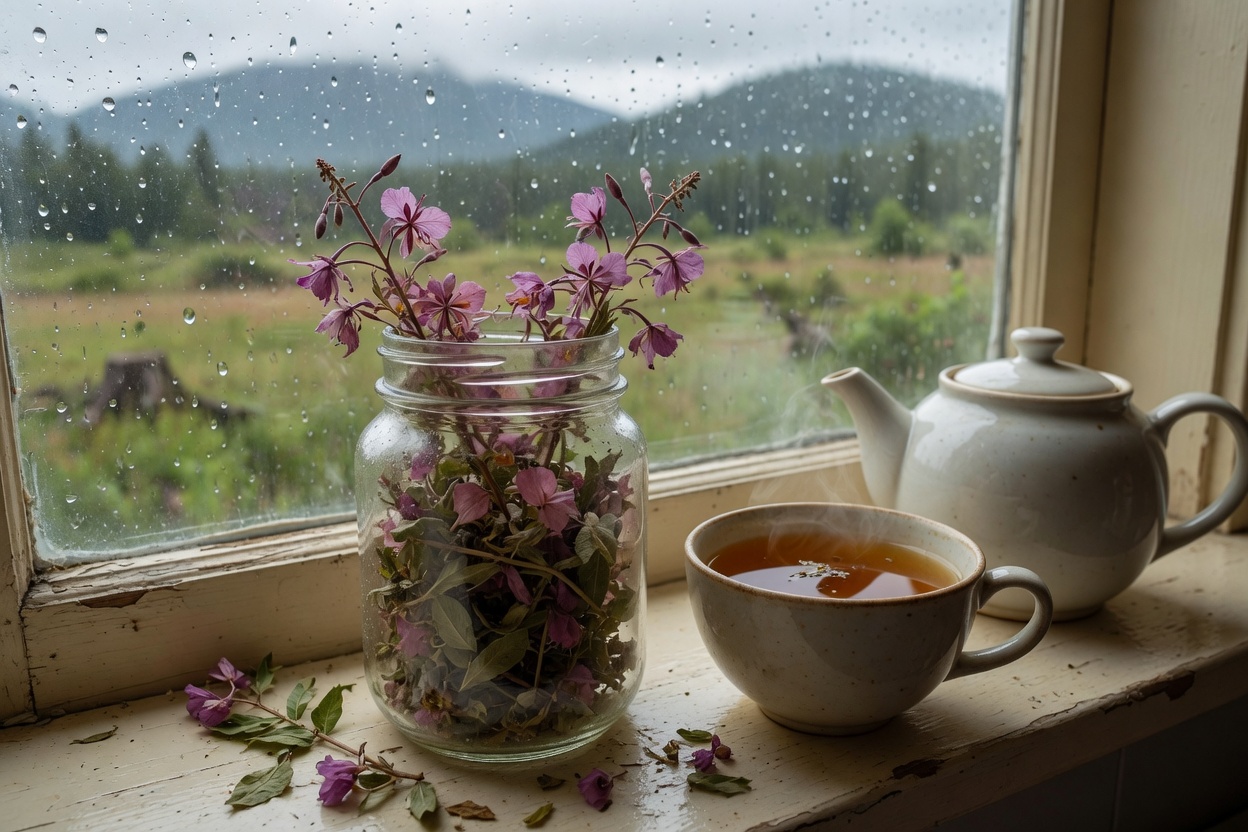
Fireweed leaf makes a mild, slightly malty tea, and it’s the use I come back to every year. Pick the upper leaves of the plant from late June through July, before the flowers are far along, and take them from stalks growing well away from the road and any roadside spray. I look for clearcut and ridge-line stands, not ditches.
You can simply dry the leaves. Spread them in a single layer on a screen in a dry, shaded room until they crumble, and then rub them into pieces. Some people bruise and ferment the leaf first, letting it wilt and darken before drying; that is the old Russian way, where it’s called Ivan chai, and it gives a deeper, almost black-tea flavor. I’ve fermented a few batches and lost a couple to mold when the room was too damp, so if you try it, keep the leaf in a warm, airy spot and trust your nose.
Once the leaf is bone dry, store it in a clean glass jar out of the light. I keep mine in wide-mouth pint jars, labeled with the plant and the date, because by February I won’t remember which tin is which. The rest of how I handle dried herbs for the long haul is in How to Store Dried Herbs So They Keep Their Strength, and the basics of brewing are in How to Make Herbal Tea from Foraged Plants.
To brew, use a heaping teaspoon of dried leaf per cup of just-off-the-boil water and steep for five to ten minutes. That’s the whole recipe.
The flowers, and a word about honesty
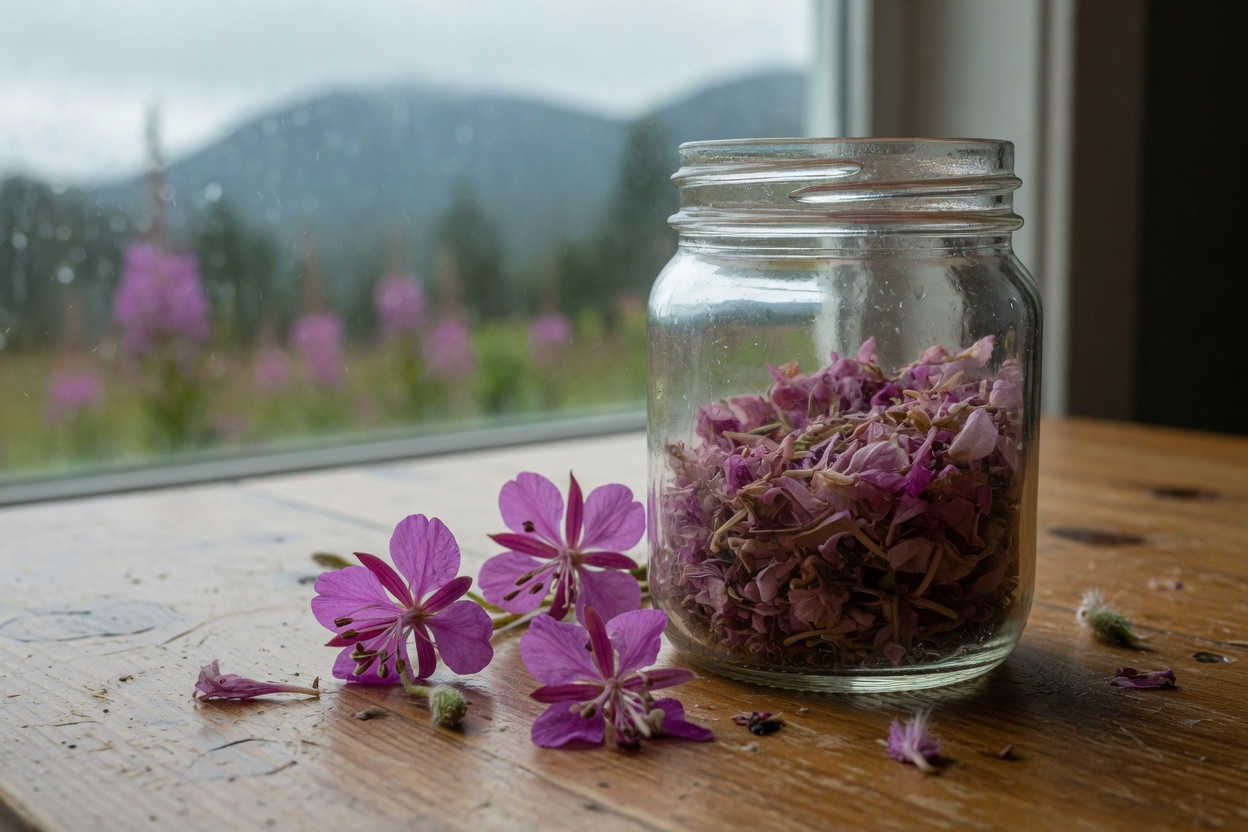
The petals are edible, mild and a little sweet, and they make a good pink infusion. Steep a handful of fresh petals in hot water, let it sit, then strain the liquid through cheesecloth and use it as the base for a jelly, along with sugar and pectin. It’s more of a color and a novelty than a flavor, I’ll admit. The jelly looks wonderful on a winter table and tastes of honeyed hay.
As for what the plant does for the body: fireweed has a long history of folk use, and you’ll find a lot of confident claims online. I don’t make them. What I can tell you is how it has traditionally been used as food and tea. If you take any medication or have a health condition, a qualified professional is a better source than a blog post, and I’m happy to leave it at that.
Take little, leave plenty
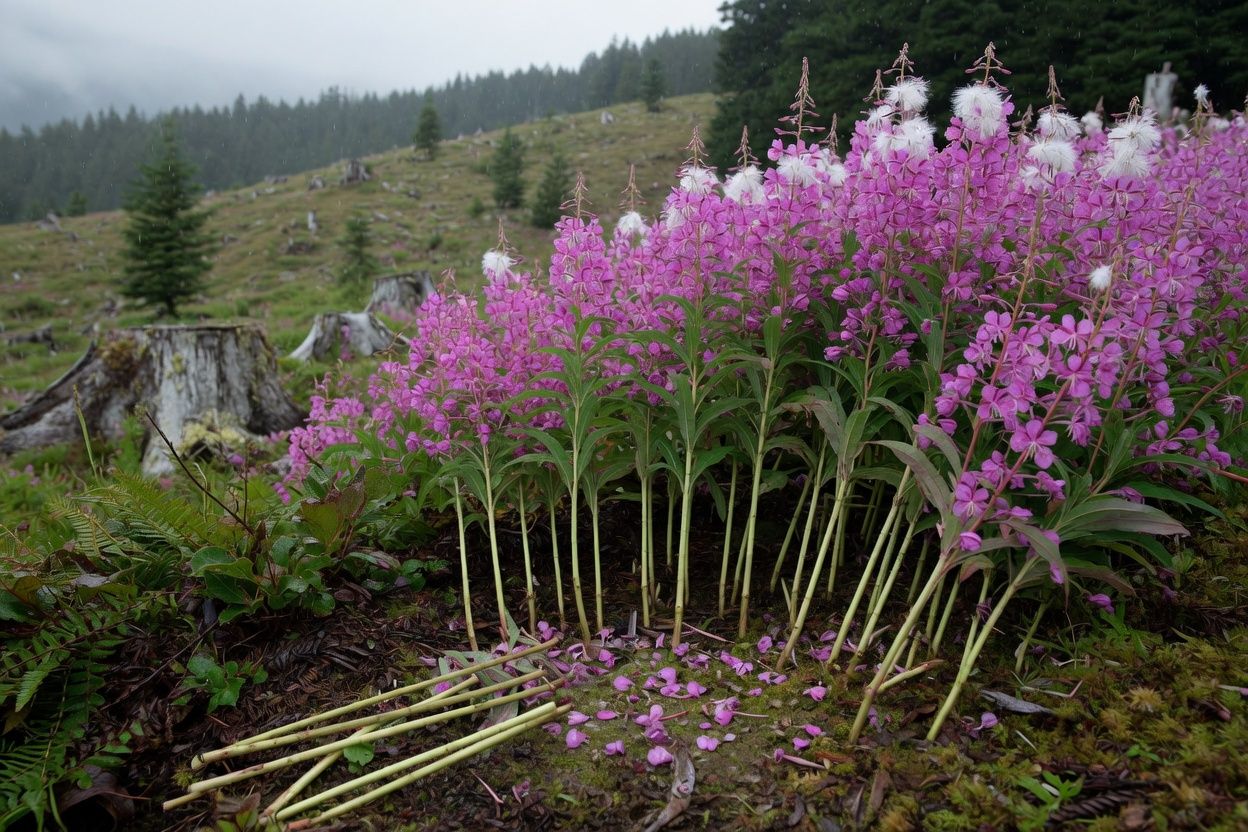
Fireweed is common, and that makes people careless. A few habits keep a patch healthy: take shoots from many plants instead of clearing one, leave the top flowers to seed in summer so the stand renews itself, and ask before you gather on private or managed land. Roadside patches look generous but can carry spray and exhaust, so go a little farther up the road.
Identifying a plant with confidence in every season, knowing its look-alikes, and learning how people before us prepared it is the longer study. Most of what I know about fireweed and the hundred-odd other wild plants of this coast is in my book, Pacific Northwest Medicinal Plants: how to identify each one without guessing, when to gather it, and how it has traditionally been used. The shoots are an easy first spring. The book is how you learn the rest of the woods around them.
