How to Forage and Use Devil’s Club Bark, the PNW Way
How to identify, harvest, and use devil's club bark the way it's traditionally been prepared on the Peninsula — with the respect (and the gloves) this plant demands.
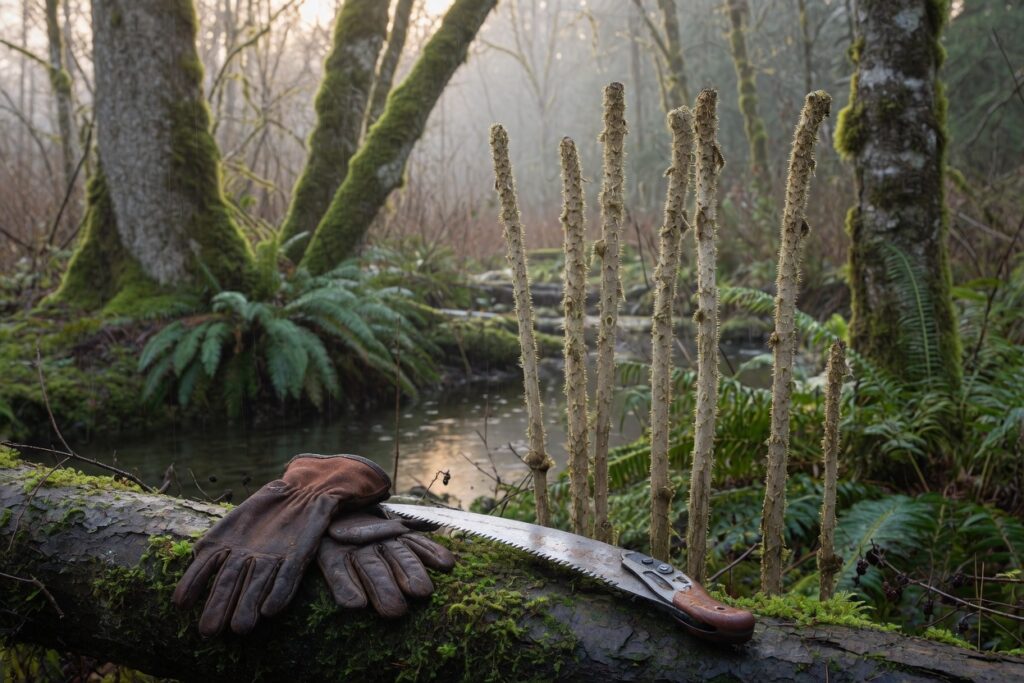
Devil’s club is the plant that teaches you to pay attention, usually the hard way. I have a scar on my left palm from a stand of it I didn’t see clearly enough on a September afternoon fifteen years ago, and I still go back to that same drainage every winter to harvest bark from it. That’s not a contradiction. Some plants are worth the caution they demand.
Oplopanax horridus — the species name tells you what you need to know before the common name does — grows in the wet, shaded understory all through the Olympics and the Cascades, usually along creek bottoms and seep lines where the ground stays damp into summer. Thick woody stems, sometimes taller than I am, covered top to bottom in fine yellowish spines that break off under the skin and fester if you’re careless. The leaves are enormous — maple-shaped, a foot or more across — and in late summer the plant throws up a cone of small red berries at the top of the stalk. In winter, once the leaves drop, you’re left with bare spiny canes, which is exactly when I go looking for it.
I harvest bark in the cold months for the same reason I dig most roots then: the plant has pulled its energy down and in, and the bark comes off cleaner. It also means I’m not fighting through a full canopy of those leaves to get to the stem I want.
One thing first, and I’ll say it once because you’re an adult: never eat or apply a wild plant on the strength of one book, one app, or one person’s word — confirm it against more than one reputable source, and ideally against someone local who’s handled it. Devil’s club is unmistakable once you’ve seen it, but the spines alone are reason enough to move slow and know exactly what you’re reaching for. When in doubt, leave it standing.
You’ll also want leather gloves that go past the wrist and something sturdier than kitchen shears — I use a folding pruning saw on the thicker canes. Ordinary garden gloves will not stop these spines. Ask me how I know.
Knowing it before you touch it
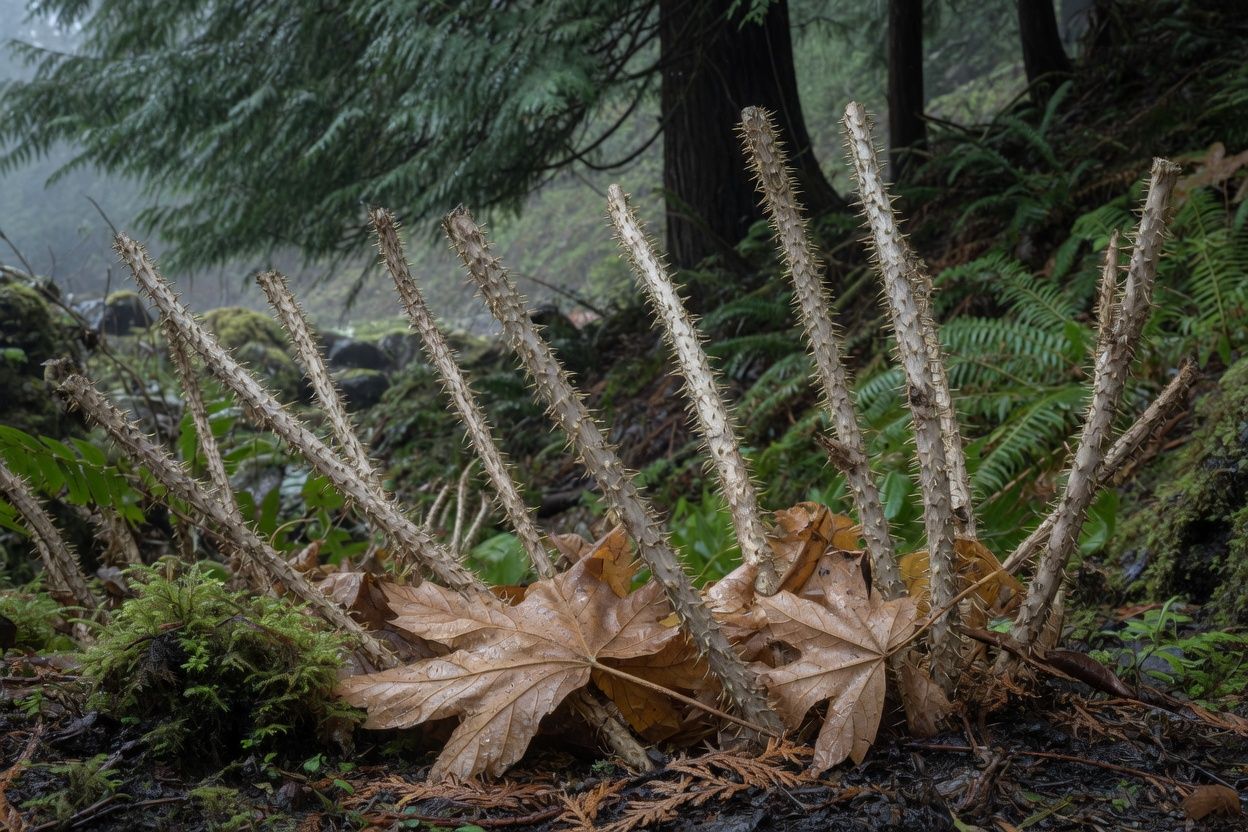
Devil’s club stands in loose colonies, not single plants, usually where you can hear water even if you can’t see it — the base of a north-facing slope, the edge of a seep, the understory beneath red alder and big-leaf maple where the canopy holds in moisture. The canes are unbranched or sparsely branched, woody, and pale gray-brown, and the spines run the entire length of the stem in dense, fine rows — not the occasional thorn of a wild rose, but a stem that looks bristled from a few feet away. If you’re not certain you’re looking at devil’s club and not, say, a young stand of salmonberry or thimbleberry canes nearby, the leaves settle it in season: nothing else in these woods has a leaf that broad and that maple-lobed sitting atop a spined stalk.
Look for the plant in colonies along the lower elevations of the Olympic foothills, in the wetter draws off the forest-service roads, and in the understory wherever a creek keeps a slope damp year-round. I’ve never found it on a dry south-facing hillside, and I’ve never had to look hard for it once I was in the right kind of ground.
Harvesting the bark
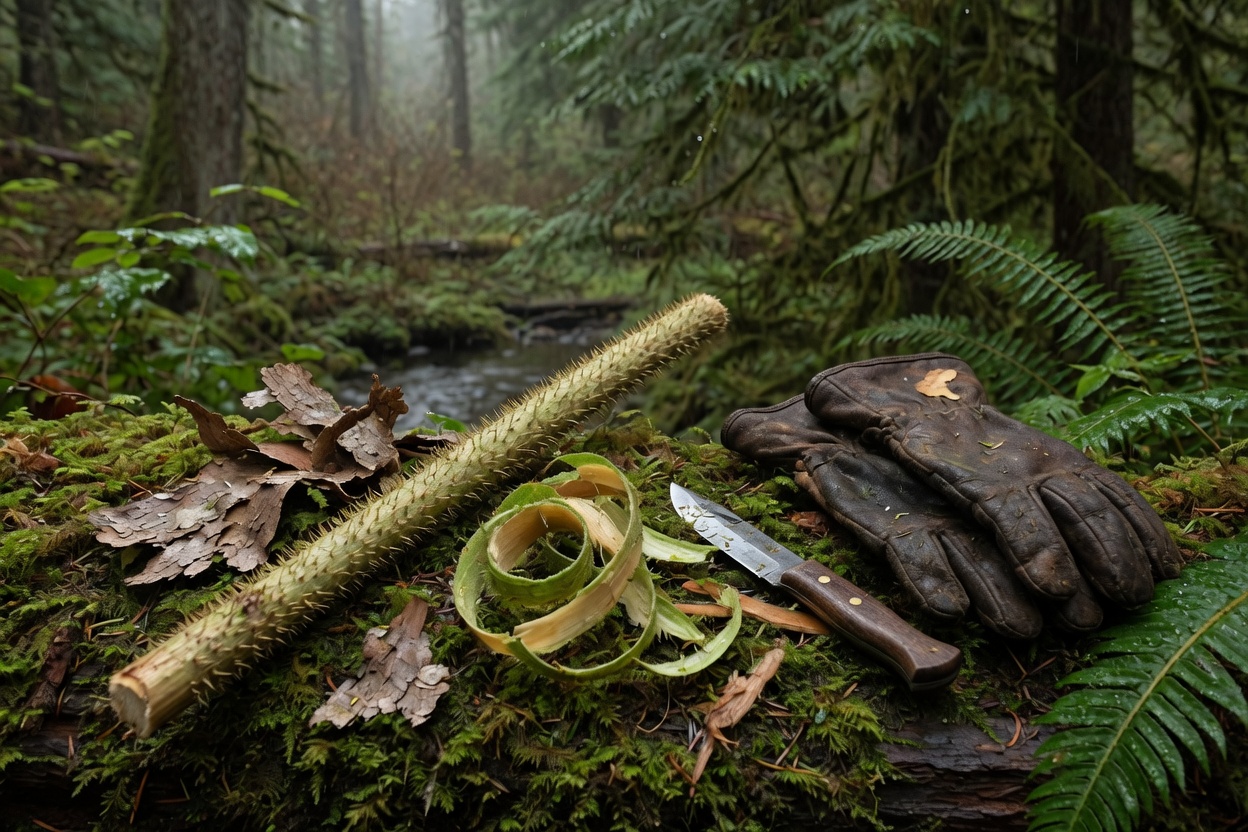
I take the outer bark from mature canes, never the whole plant, and never more than a strip or two from any one stem — devil’s club colonies are slow to recover from heavy cutting, and I’d rather have a stand to come back to next winter than a full basket this year. Gloves on, I hold the cane low with the back of a gloved hand and scrape the outer corky bark away with a knife, working toward myself in short, controlled strokes, then peel the inner green-and-yellow bark layer off in strips. That inner bark is the part I actually use; the rough outer layer gets composted back into the drainage where I cut it.
Cut a cane instead of stripping a living one bare if you can — a fallen or wind-thrown cane still has usable bark and doesn’t cost the colony anything. I look for those first, every trip, before I touch a standing stem.
Drying and storing the bark
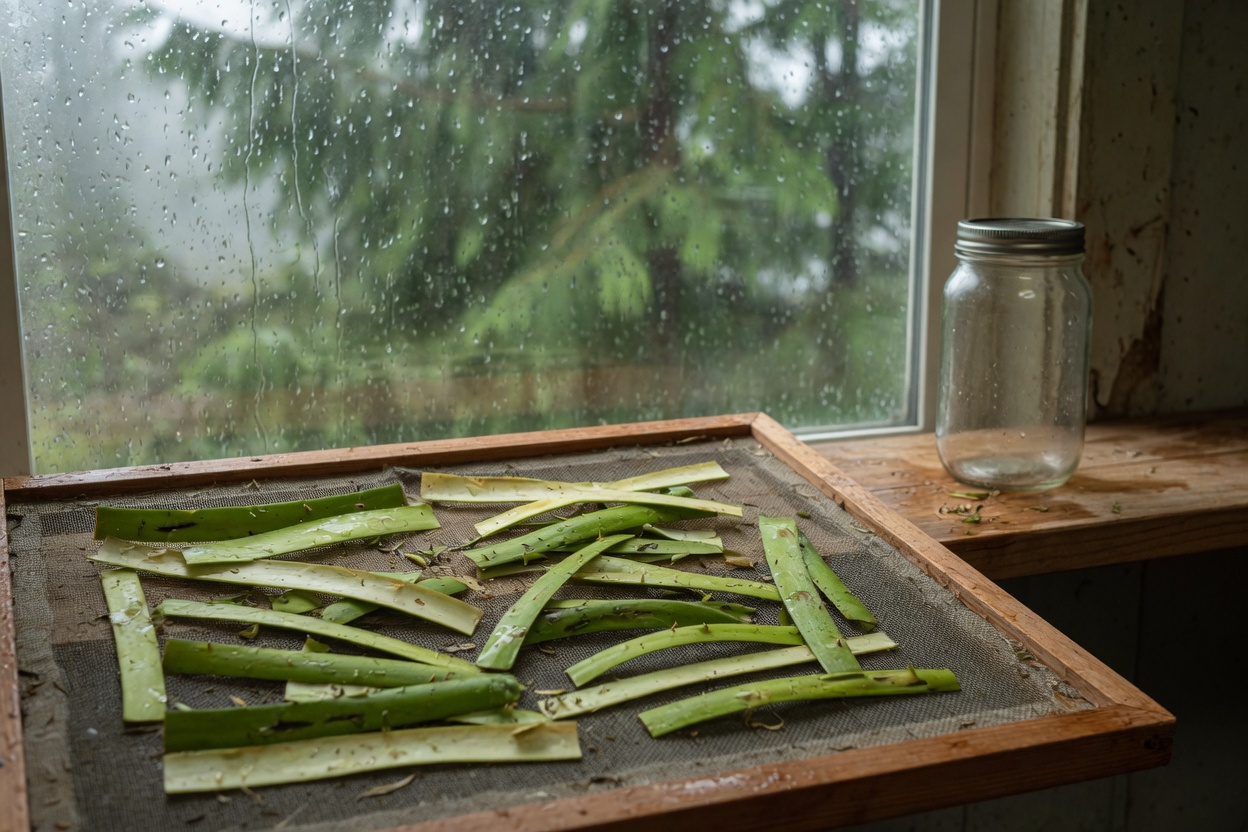
Spread the peeled strips in a single layer somewhere dry and out of direct sun — a mesh drying rack in the mudroom does the job all winter. Devil’s club bark dries slower than a thin leaf; give it a full week or more, and check that it snaps rather than bends before you call it done. Store the dried bark in a clean glass jar, out of the light, and it’ll hold its usefulness for a year or more. I label mine with the harvest date without fail — dried bark from three winters ago and dried bark from three weeks ago look identical on a dark shelf, and I have learned that lesson more than once.
Turning bark into a tincture or a salve
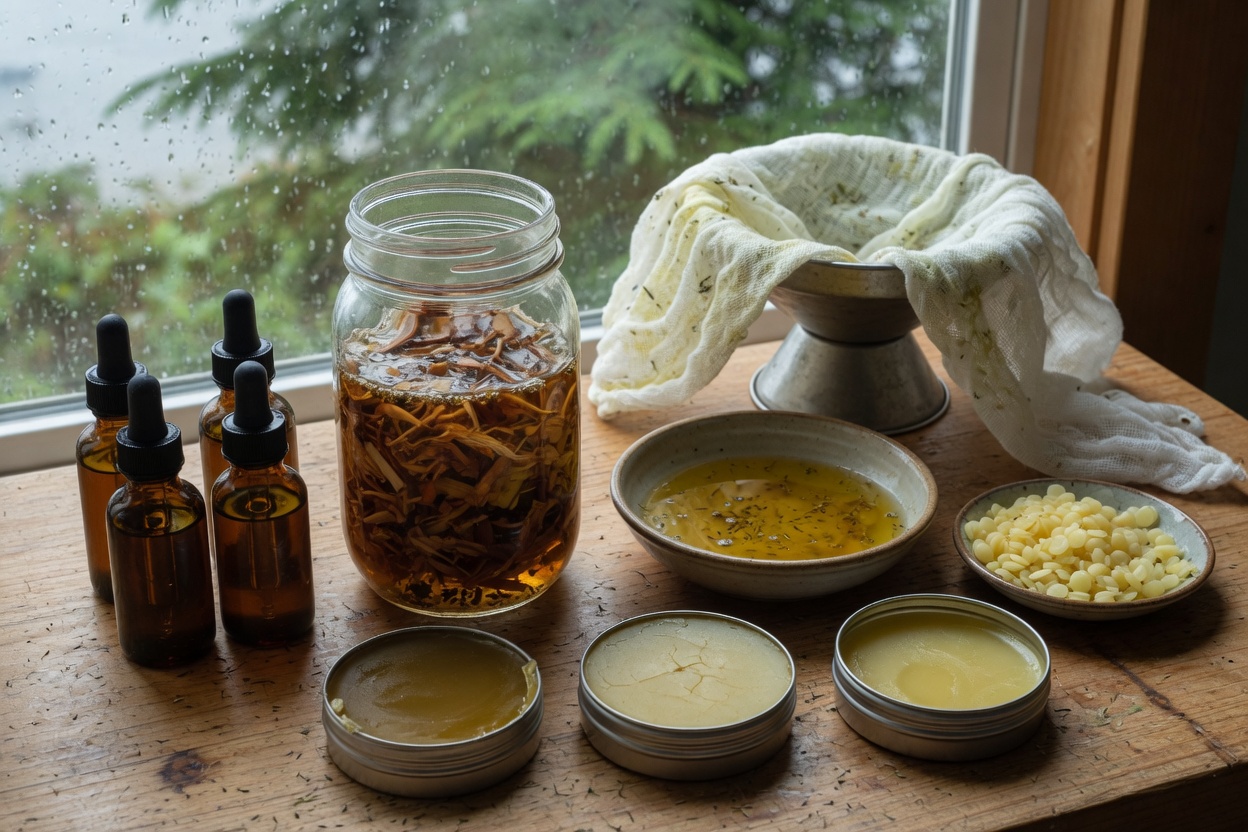
The two preparations I come back to every year are a simple alcohol tincture and an infused-oil salve, and the process for each starts the same way: chop the dried bark small, closer to a coarse powder than whole strips, so you get more surface area into the menstruum.
For a tincture, I pack a clean jar about a third full of chopped bark, cover it completely with high-proof vodka, and let it sit in a dark cupboard for six to eight weeks, shaking it every few days. Strain it through cheesecloth, pressing the spent bark to get the last of the liquid out, and bottle the finished tincture in small dark glass.
For a salve, I do a slow oil infusion instead — chopped bark covered in jojoba oil, kept warm on the lowest setting a dehydrator or a double boiler will hold for several hours, then strained the same way through cheesecloth. Warm the strained oil gently, melt in beeswax pellets at roughly an ounce of wax per cup of oil, and pour it into two-ounce tins to set. Label each one with the plant and the date before you forget which tin is which — every forager’s shelf has at least one mystery salve, and I’d rather it not be yours.
What this plant has been used for, and what I’ll say about it
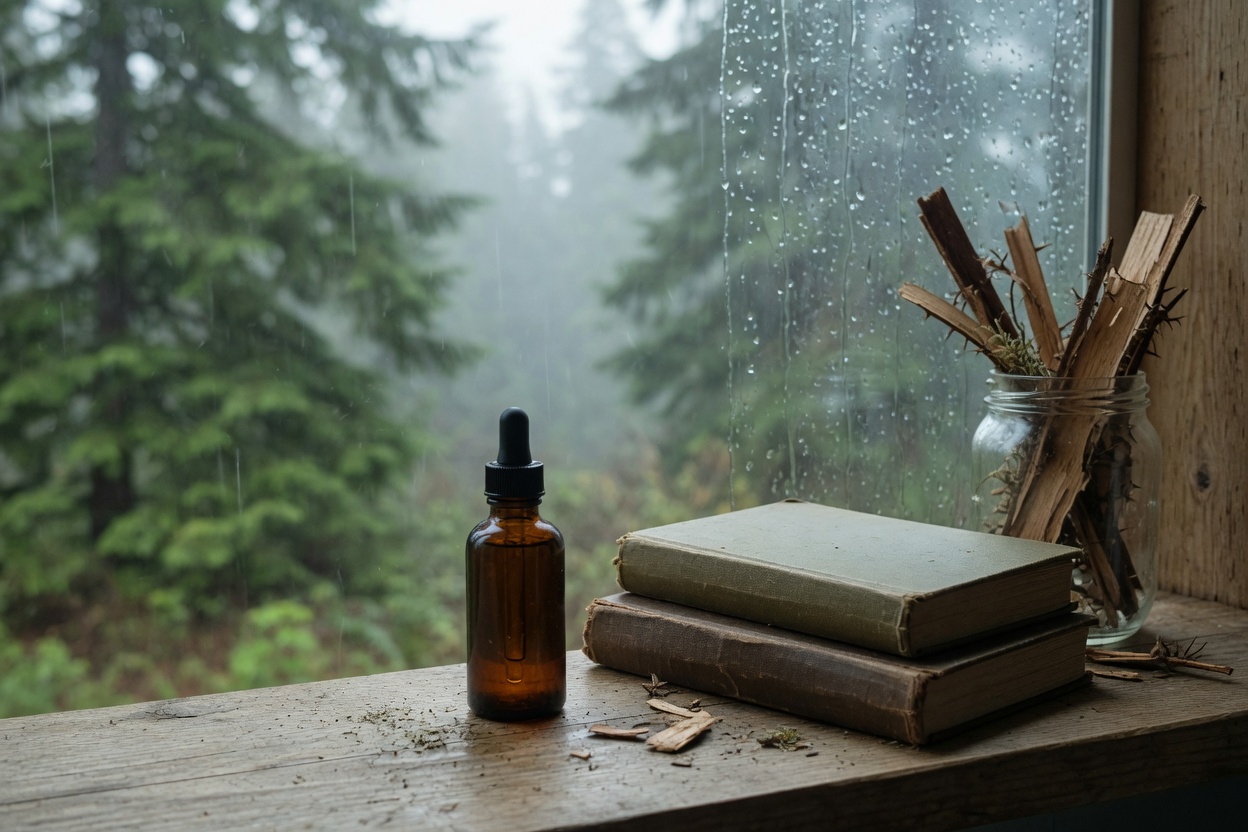
Devil’s club has been one of the most significant medicinal and ceremonial plants across the Pacific Northwest Coast for a very long time, used by the Kwakwaka’wakw, the Haida, the Tlingit, and many other Northwest Coast peoples for purposes both practical and spiritual — documented carefully in Nancy Turner’s Food Plants of Coastal First Peoples and in Tribe-published ethnobotanical sources, which are worth your time if this plant interests you beyond my one post here. I did not learn this plant from any of those traditions directly, and I don’t claim to; I learned it from books, from a working herbalist I apprenticed under in Port Townsend, and from fifteen winters of harvesting my own bark from the same drainage. What I can tell you honestly is that I keep a jar of the tincture on my own shelf and use it the way my teacher showed me, and I’d point you toward the Indigenous-authored sources before you go further than that.
If you’re dealing with anything serious, see a doctor. This is a plant I respect, harvest carefully, and use the way it’s been used in my own small corner of its practice — not a substitute for care you actually need.
The scar is worth it
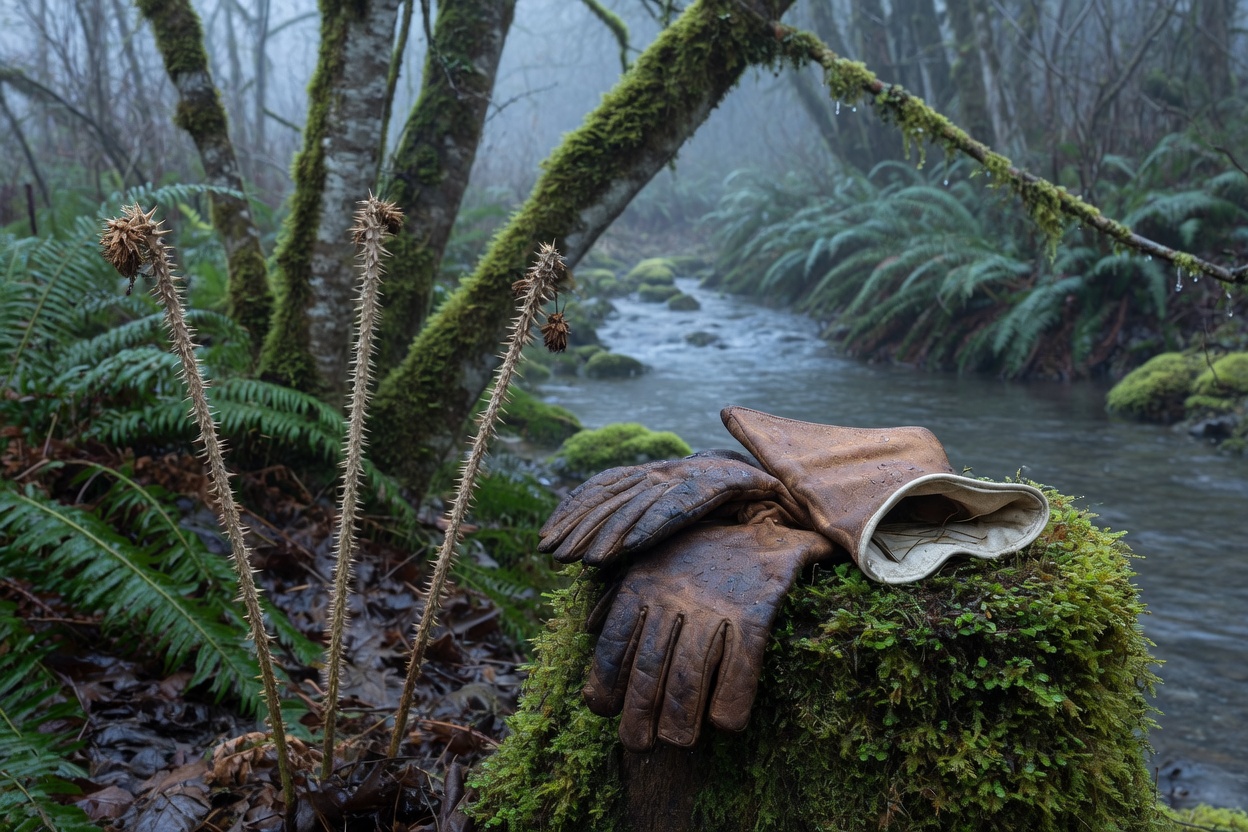
Fifteen years and one bad afternoon later, devil’s club is still one of the plants I look forward to in the coldest, wettest months, when most of the foraging year has gone quiet and there isn’t much else worth going out for. It rewards patience and gloves in roughly equal measure.
I go deeper on devil’s club and the rest of what grows in these woods — 115 plants total, how to know each one without guessing, and how the people who lived here before any of us used them — in my book, Pacific Northwest Medicinal Plants. The bark is out there right now, under the bare winter canes. Go slow, and wear the gloves.
