How to Forage and Use Chickweed, a Common Spring Weed
Forage chickweed the careful way — how I tell it from its one dangerous lookalike, when to gather it, and how I use it fresh and in a simple salve.
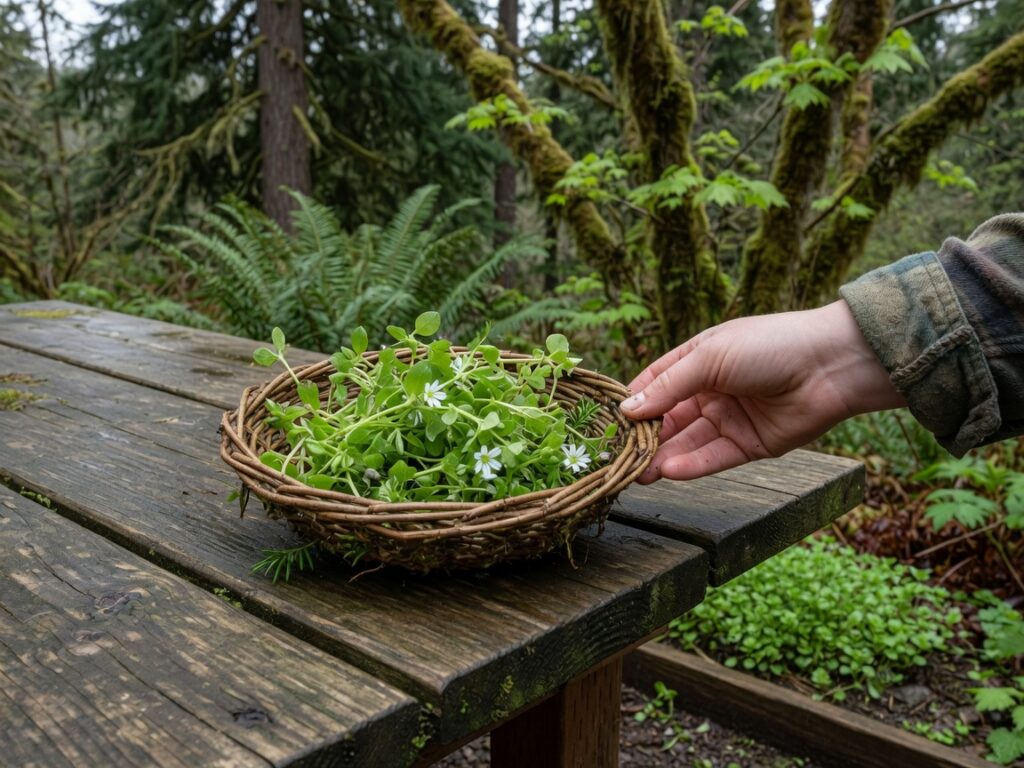
Chickweed is the plant that greens up my beds while I’m still waiting for everything else to wake up. It comes on in the cool, damp shoulder seasons — the tail of winter and the front of spring here on the Peninsula, and again in fall — sprawling in low mats wherever the soil is rich and a little shaded. Most people pull it and curse it. I gather it. It’s mild, it’s abundant, and once you can tell it from the one plant it’s worth confusing with, it’s about as forgiving a wild green as this coast offers a beginner.
Common chickweed (Stellaria media) has been eaten and used as a cooling skin herb for as long as people have been weeding gardens, which is to say a very long time. I’ve had it coming up in the same shaded corner outside Sequim for most of thirty years, and I still crouch down to pick a handful when it’s fresh. This is a plant you already have. The trick is learning to recognize it with real confidence — because chickweed has a lookalike that matters.
Identify it before you trust it
Here is the rule I follow and won’t bend on: never eat or use a wild plant you can’t name with certainty, confirmed against more than one reliable source and, when it matters, an experienced local forager. When in doubt, throw it out. Said once, plainly — I’ll trust you to carry it like an adult.
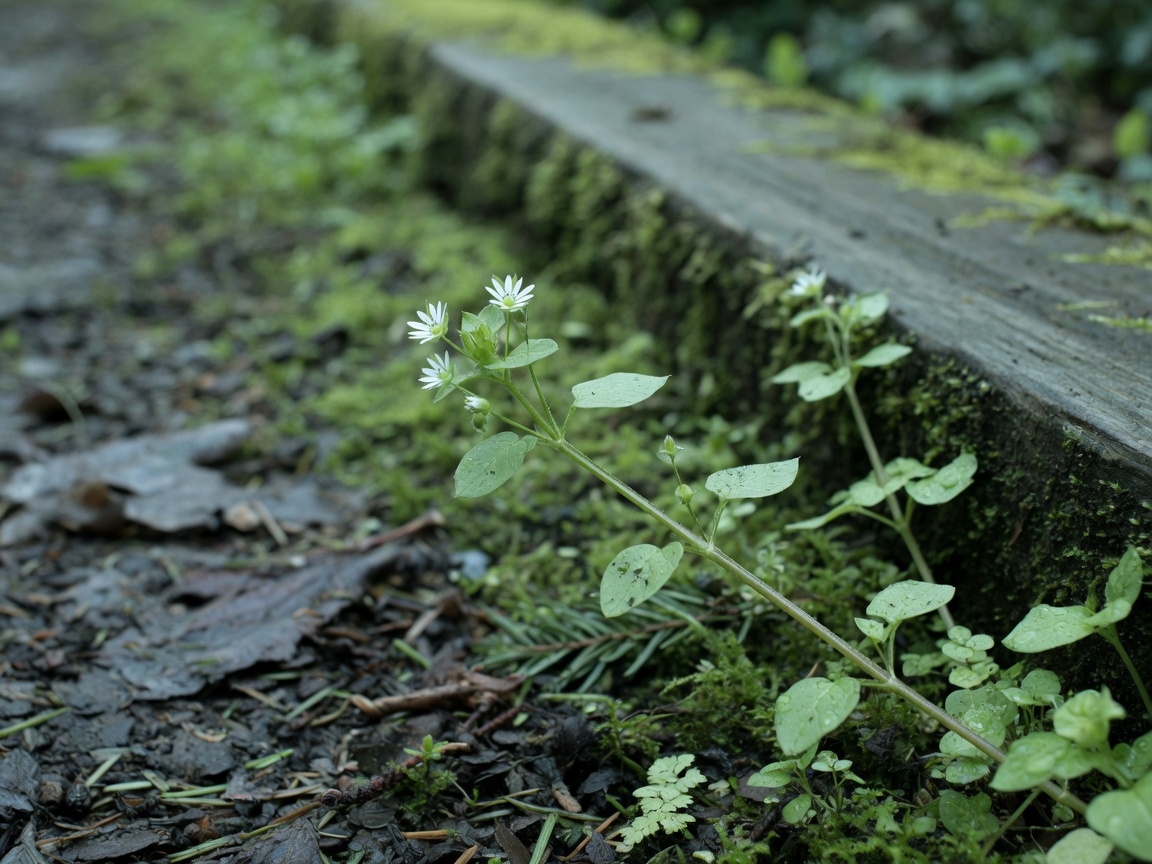
Chickweed gives you three tells, and I want you to check all three, every time, until it’s second nature. First, run your fingernail up the stem: true chickweed carries a single line of fine hairs down one side of the round stem, and that line switches to the other side at each leaf pair. Nothing else common does that. Second, take a stem between two hands and pull it slowly apart — the tough inner core stretches and stays connected for a moment before it snaps, like a tiny elastic thread inside a green sleeve. Third, look at the flowers: small, white, star-like, with what looks like ten petals but is actually five, each split so deeply down the middle it reads as two. Opposite oval leaves, low sprawling habit, that line of hairs, the elastic core, the split-petal star. Confirm the set.
Now the lookalike that earns the caution. Scarlet pimpernel (Lysimachia arvensis, long known as Anagallis arvensis) grows in the same disturbed ground, sprawls the same way, and is toxic. Tell it apart cold: pimpernel has a square stem with no line of hairs, its leaves have tiny dark dots on the underside, and its flowers are usually salmon-orange to brick-red, not white. It also has no stretchy elastic core. None of that overlaps with true chickweed once you’re looking — but you have to look. Learn the pimpernel as carefully as you learn the chickweed. Knowing the wrong plant is half of knowing the right one.
When and where to gather it
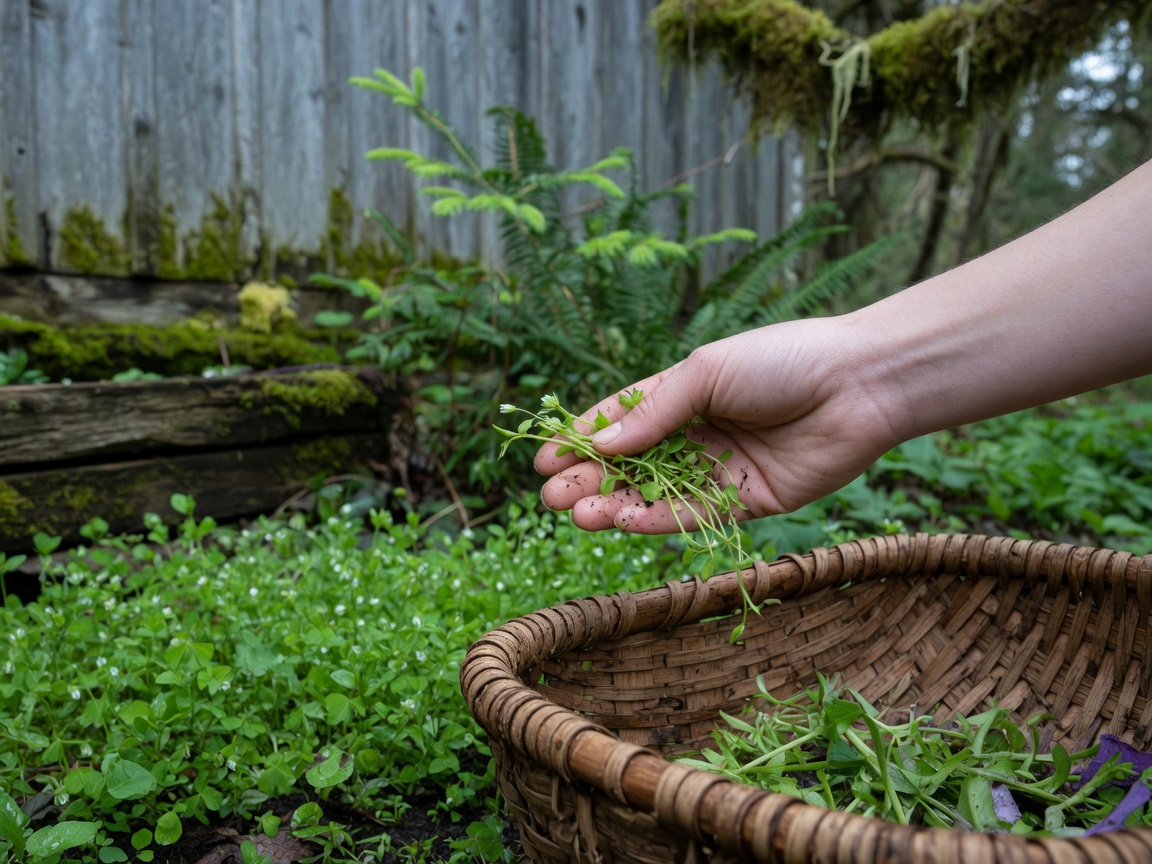
Chickweed is a cool-weather plant, and that’s the whole key to gathering it well. It’s at its best in the damp, mild stretches — late winter into spring, then again in the cool of fall — when the mats are lush, tender, and pale green. Gather it then, in the morning while it’s still crisp, cutting or pinching the top few inches of the sprawling stems and leaving the roots to keep throwing new growth. Treated that way, a good patch will feed you handfuls for weeks.
Once real heat and dry weather arrive, chickweed bolts, goes stringy and yellow, and mostly gives up for the season. That’s not a loss — it’s just the plant telling you the window has moved on. I don’t fight it. I take what’s good while it’s good and let the summer patches go.
Where matters as much as when. Chickweed loves exactly the rich, tended, close-to-the-house ground that people are most tempted to spray. Skip roadsides, skip any lawn or bed that somebody keeps tidy with weedkiller, and skip the strip along a driveway you can’t vouch for. I take mine from the untended shaded corners of my own ground, where I know precisely what has and hasn’t been on the soil. That rule outranks every harvesting technique I could teach you.
The simplest use is to eat it fresh
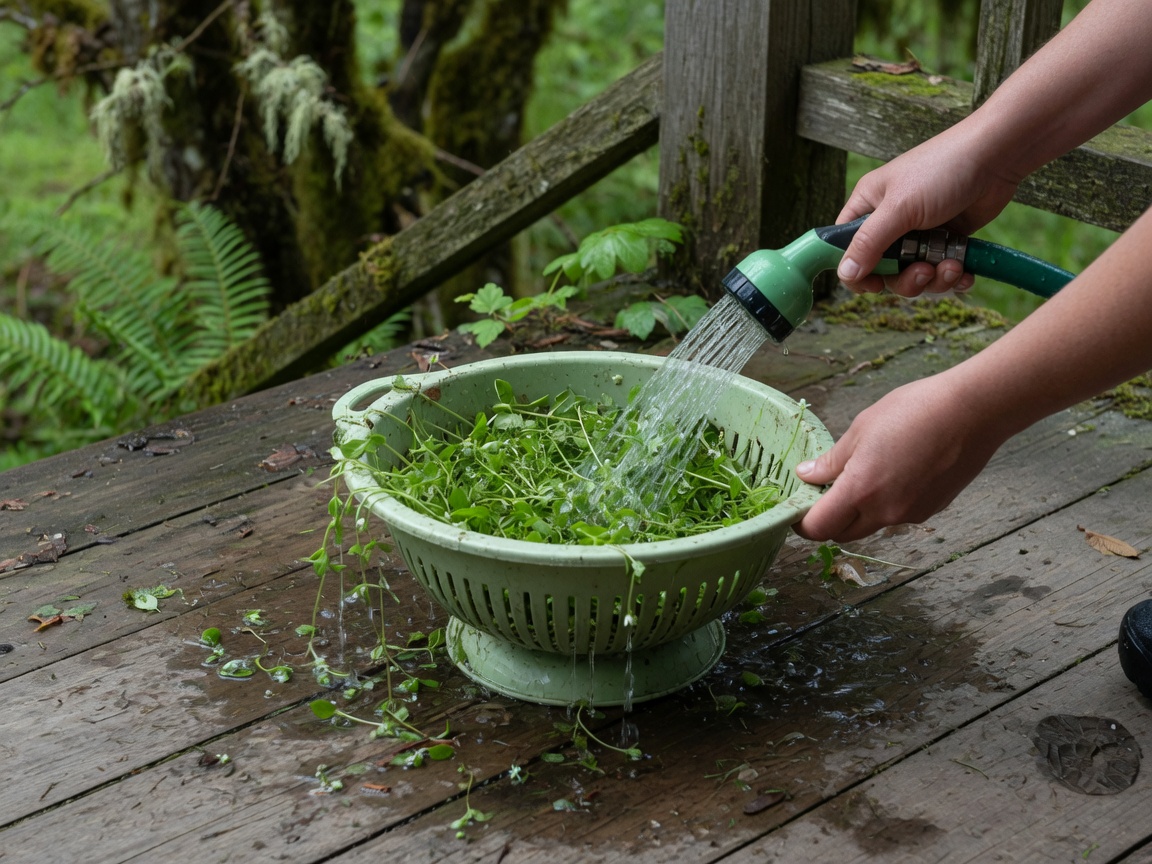
The gentlest thing you can do with chickweed is rinse a handful and eat it. Raw, it’s mild and green with a faint sweetness — closer to corn silk or fresh peas than to a bitter green — which makes it an easy one for people who find dandelion or nettle too assertive. Tear it into a salad, lay it on a sandwich, or stir a handful into soup or eggs at the very end, off the heat, so it just wilts. It’s delicate stuff and cooks down to almost nothing, so treat it as a fresh green, not something to boil hard.
That’s kitchen work more than foraging, and I’ll keep to my lane and leave the recipe-building to a good greens cook. But do start here. Eating a plant fresh, in season, from ground you trust is the oldest and plainest use there is, and it teaches your hands the plant faster than any preparation on the shelf.
Put it up as a simple infused oil and salve
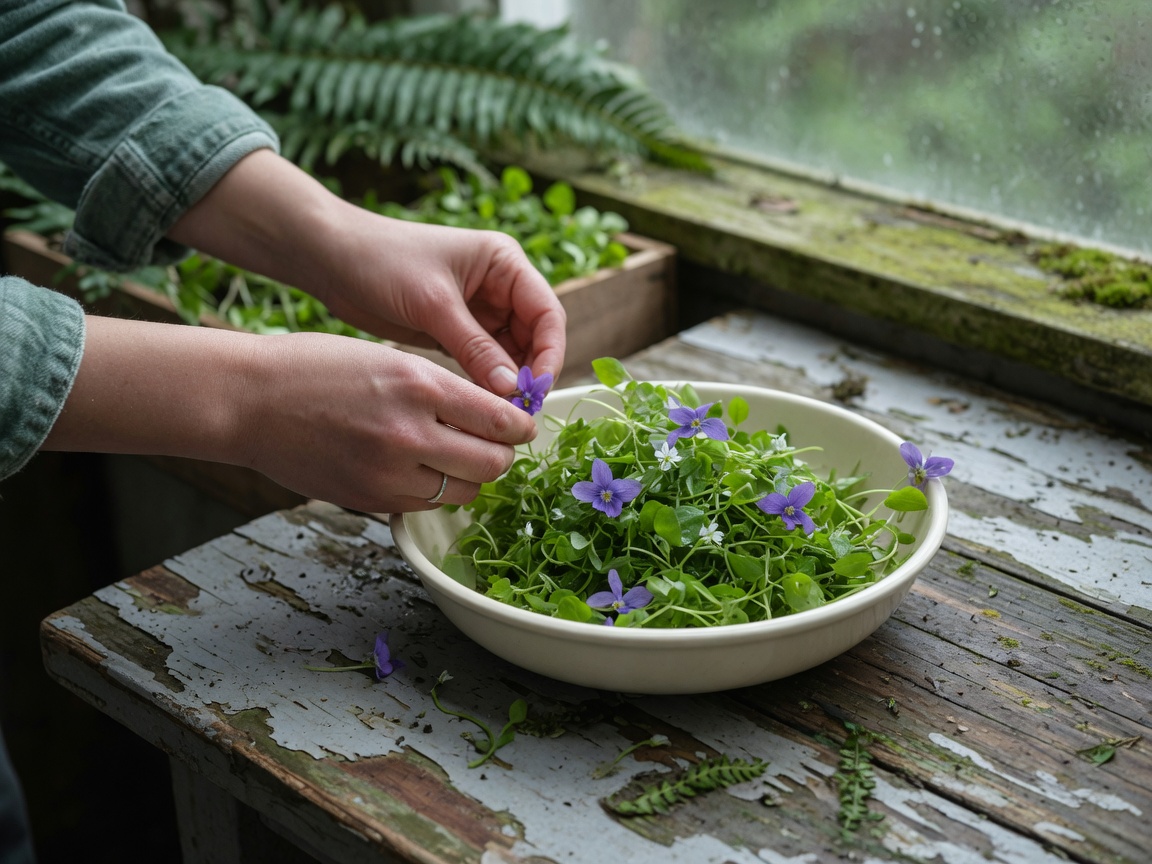
The traditional way to keep chickweed past its short season is as a cooling skin salve — the use generations of gardeners reached for after a day in the dirt. It’s a classic beginner preparation, and chickweed is a forgiving plant to learn it on.
There’s one catch, and it’s the same catch as every fresh-plant oil: water. Chickweed is a juicy, high-moisture green, and water trapped in an oil infusion is how you grow mold instead of medicine. So wilt it first. Spread your clean-gathered chickweed in a single layer somewhere warm and airy, out of direct sun, for a day or so until it’s limp and much of the surface moisture has gone. Then chop it, pack it loosely into a clean dry jar, and cover it completely with jojoba oil. I reach for jojoba because it’s slow to go rancid and keeps well on a counter — it’s the carrier I trust for anything I want to hold onto.
Set the jar somewhere warm out of direct sun for two to three weeks, giving it a gentle turn when you think of it. Then strain the oil through a doubled layer of grade-90 cheesecloth, pressing the spent herb to get the last of it — the tight weave catches the fine plant bits a looser cloth lets slip through. To turn that oil into a salve, warm it gently and melt in beeswax pellets, roughly one part wax to four parts oil by volume, adjusted to the firmness you like. Test the set on a cold spoon: too soft, add a little more wax; too hard, a splash more oil. Pour the warm mix into small lidded tins and let it set. Keep the framing honest — this is a traditional cooling skin salve people have made for generations, the kind of thing my grandmother kept by the sink, not a treatment for anything serious. Anything that needs a doctor needs a doctor.
I’ve lost a batch to a wet jar, same as anyone. The first chickweed oil I ever made went cloudy and off within the week because I packed the herb in barely wilted, still cold and damp from the morning. There was nothing to do but pour it out. Wilt it properly. That one step is the whole difference between a salve that keeps and a jar you throw away.
Learn the common plants all the way through
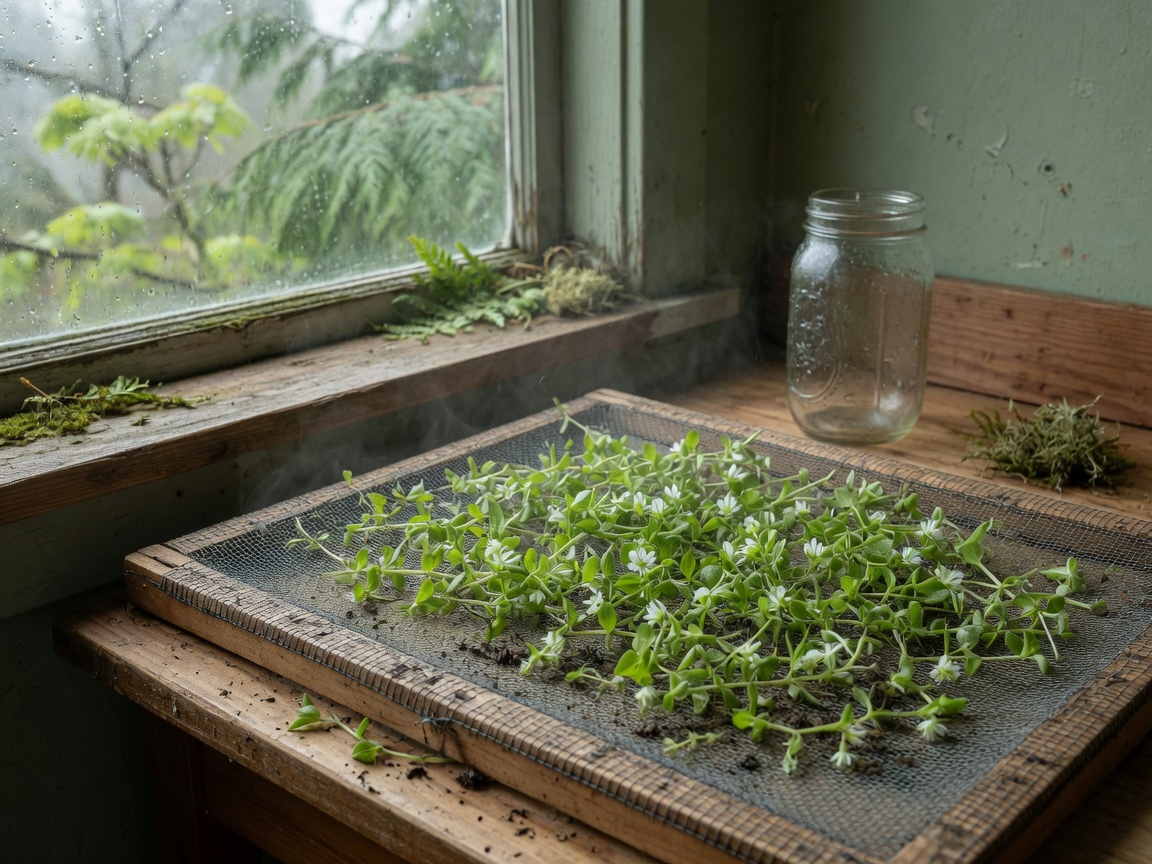
Chickweed is worth this much attention precisely because it’s ordinary — the weed underfoot that most people never look at twice. Learn to recognize it against its one dangerous lookalike, gather it in its cool short season, and use it both fresh and put up on the shelf, and you’ve practiced the whole shape of careful foraging on a plant that’s hard to get badly wrong.
If you want to go further, that’s most of what I put into my book, Pacific Northwest Medicinal Plants: 115 wild plants of this region, how to identify each one without guessing, when to gather it, and how the generations before us prepared it. Chickweed is one of the easy first doors. The book is how you learn which doors to walk through next — and, just as important, which ones to leave shut.
