How to Forage and Use Wild Cherry Bark in the Appalachians
Wild cherry bark in Appalachia: how to know black cherry in winter, why the bark needs real caution, how to gather it from pruned limbs, and how to dry it.
When I was eight my grandmother snapped a twig off the wild cherry at the foot of our pasture, held it under my nose, and told me that bitter-almond smell was the reason the cows were never let into that corner after a storm brought the branches down. She used that tree’s bark every winter. She also respected it, and she taught me both at the same time.
That is still how I think about wild cherry. It is one of the best-known bark medicines in the old mountain tradition, and it is also a tree that carries a real poison in its leaves, twigs, and seeds. If you want to learn it, learn both halves. Here is how I gather it up the hollow outside Marshall, and where I’d ask you to slow down.
You’ll also want a pair of clean hand pruners and a notebook.
Know the tree in every season

Black cherry (Prunus serotina) grows all through these mountains, on old field edges, fencerows, logged slopes, and cove woods up to the higher ridges. Say this part with me, once: never use any wild plant on the strength of one book, one app, or one article, this one included. Confirm it against more than one reputable guide and with an experienced local forager, and when there’s any doubt, leave it where it stands.
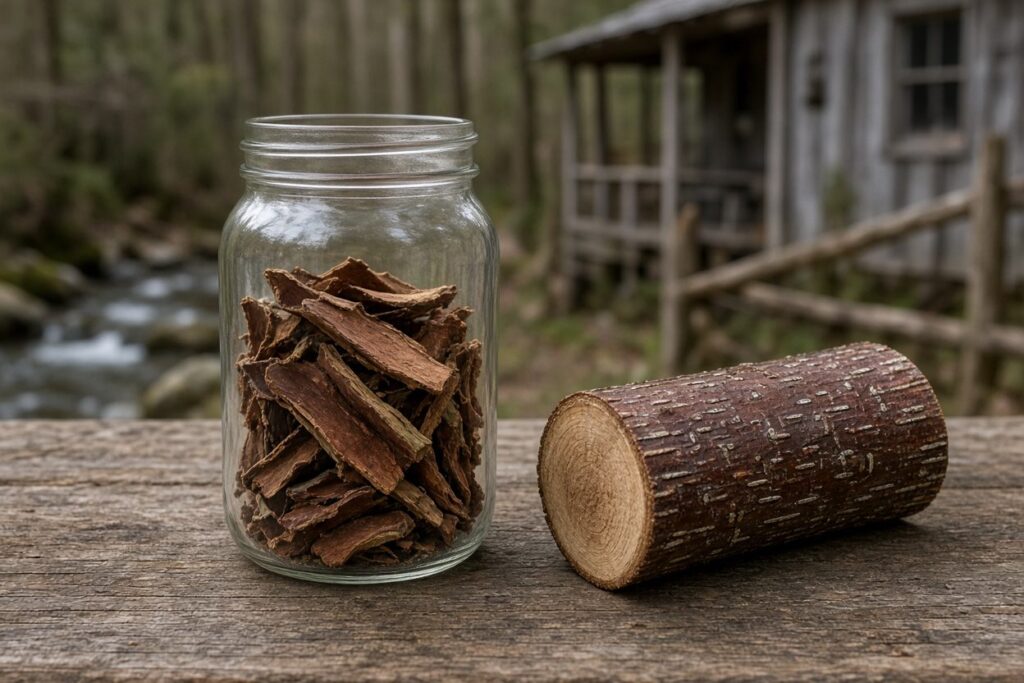
Bark. On young trees and limbs the bark is smooth and reddish-brown to gray, marked with short horizontal lines called lenticels. On old trunks it turns dark and breaks into small curling plates. Folks around here say it looks like a pile of burnt potato chips, and once you’ve heard that, you won’t forget it.
Leaves. Narrow, pointed, finely toothed along the edge, and glossy on top. Turn one over and look at the midrib near the base. Black cherry usually has a line of soft rusty-orange fuzz along it. That fuzz is one of the best summer tells.
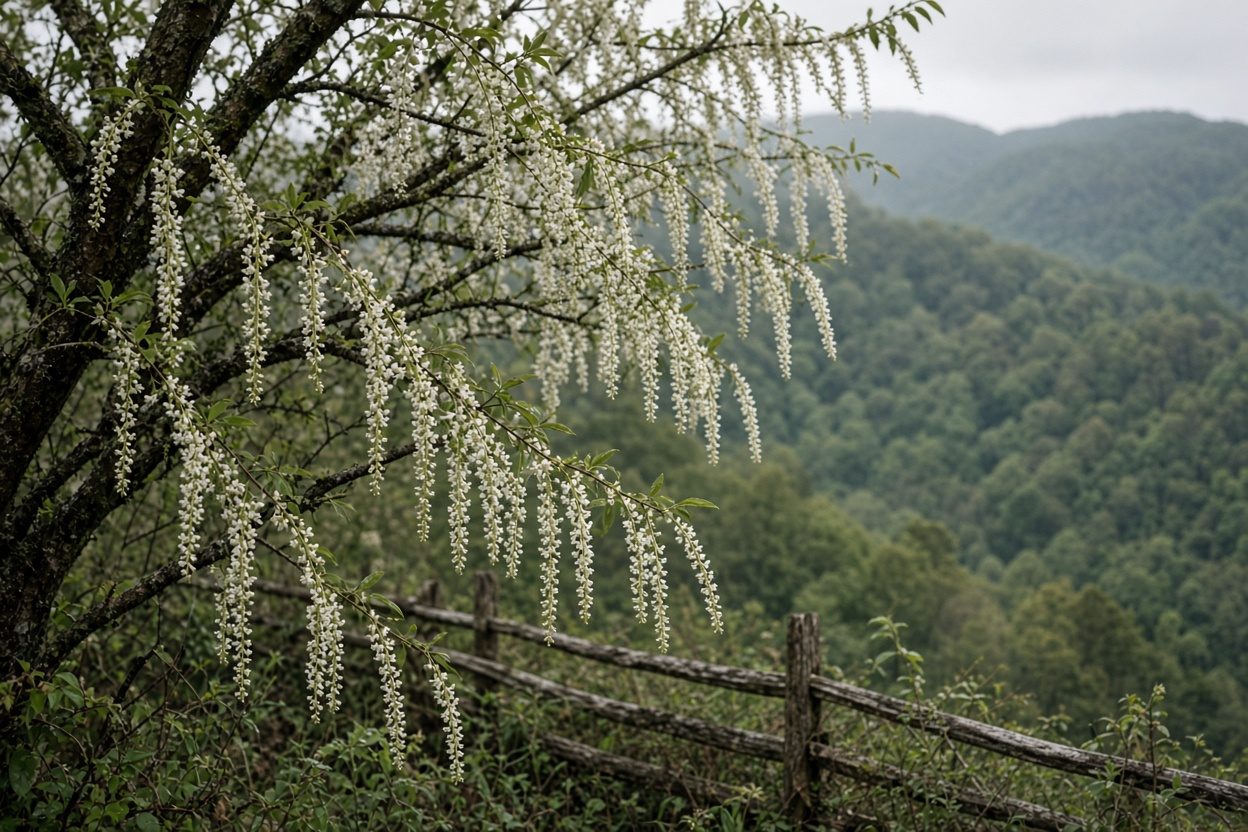
Fruit. Small dark cherries hanging in long drooping clusters in late summer. Birds strip them fast.
Smell. Scratch a young twig and smell it. Black cherry gives off a sharp bitter-almond scent. Sweet birch, which has the same smooth bark with lenticels, smells of wintergreen instead. I wrote about birch in how to forage and use sweet birch twigs, and comparing the two by smell is one of the best lessons a beginner can learn in winter.
As with any tree I gather from, I mark mine in summer when the leaves and fruit settle the question, and I go back to the same tree in winter. If you’re learning bark-only ID, my notes on how to identify Appalachian medicinal plants in winter are a good place to begin.
The caution, said plainly
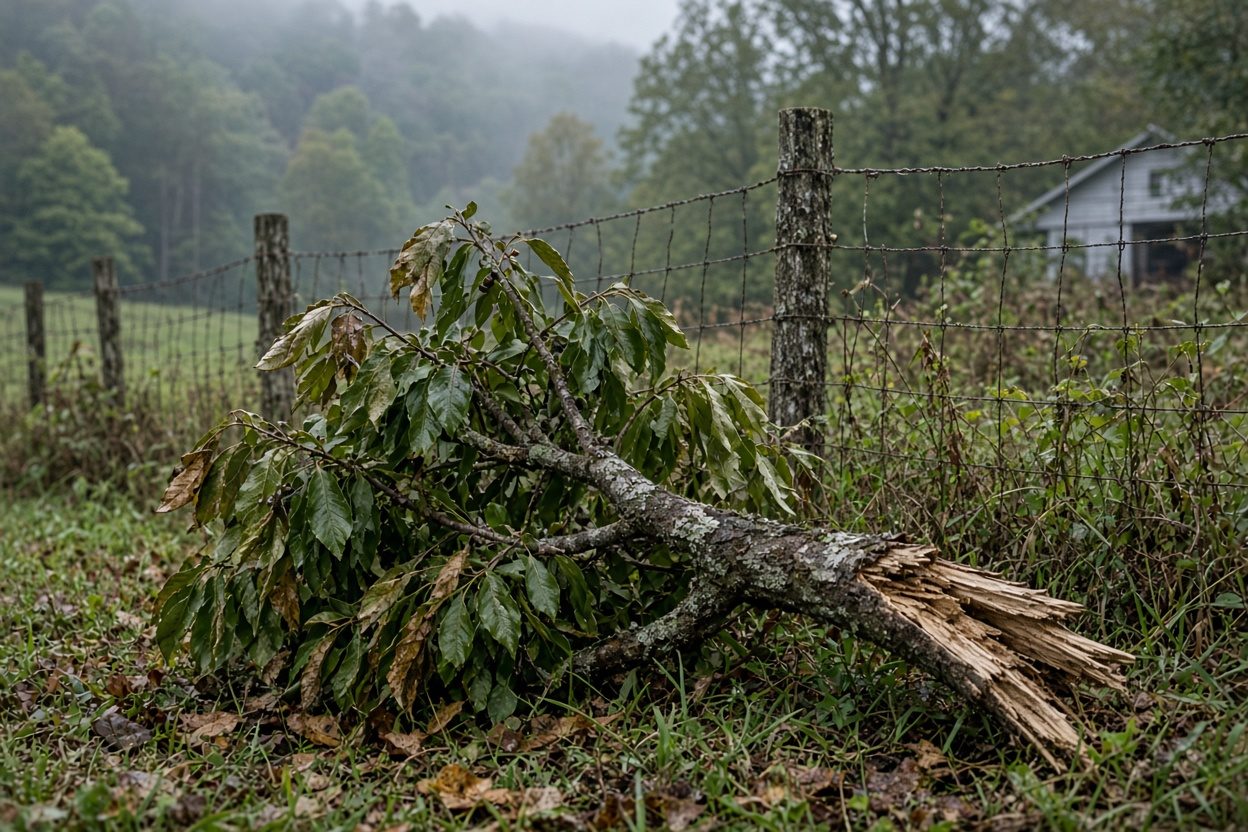
That bitter-almond smell is the warning. The leaves, twigs, bark, and seed pits of wild cherry contain compounds that release cyanide. Wilted leaves after a storm are the classic danger to livestock, which is why my grandmother kept the cows out of that corner. The fresh ripe fruit flesh is fine to eat. The pits are not.
So wild cherry bark is not something to experiment with or to take casually. Do not give it to children. Folk sources advise against it during pregnancy and nursing. Don’t use it for any length of time, and don’t use it if you are taking other medicines without talking to a doctor or pharmacist. I share the tradition below so you understand it, not so you treat yourself with it.
When and where to gather

The old practice is to gather cherry bark in the fall or the dormant months, from the inner bark of young limbs. In my hollow that means late October through February.
Pick a tree you’ve identified, on land you have permission to gather from. Many national forests and parks restrict or ban gathering, so call the ranger district first.
Gather from pruned or fallen limbs, never the trunk

Never strip bark from a living trunk, and never peel a ring all the way around a limb. Girdling kills a tree. The rule I follow is the same for every bark I gather: I take only from a limb that is coming off anyway, like a storm-broken branch, a limb crowding a fence, or a sucker I’m pruning for a reason. Use clean pruners to cut a short section of a branch about as thick as a broom handle to a wrist, then do the rest on the ground.
Scrape off the thin outer bark with the serrated edge of a hori-hori or a paring knife until you see the green-to-tan inner bark underneath. Then peel or shave off that inner layer in thin strips. That inner bark is what the tradition uses. The smell will be strong.
I wrote about the same stewardship habits for another mountain bark in how to forage and use persimmon bark.
Drying and storing it

Cut the inner bark into short pieces and spread them in a single layer on a screen in a shaded, dry, airy spot. No sun and no oven. The old herbals were firm that heat spoils cherry bark, and in my experience they were right; a batch I once dried too close to the woodstove came out flat and lifeless. In my drying shed it takes about a week or two.
When the pieces snap cleanly, pack them into a wide-mouth jar, label it with the tree, the place, and the date on a strip of masking tape, and keep it in the dark. Cherry bark is one of the few things I don’t keep from one year to the next. My grandmother gathered fresh every winter and threw out last year’s jar, and I do the same.
How it has been used traditionally
I’ll tell you how this bark has traditionally been prepared, and I’ll be plain about what that means. This is folk and traditional-use information, how mountain families prepared it, not medical advice, and nothing here treats or cures anything. I do not give amounts or schedules for taking it, and I won’t.
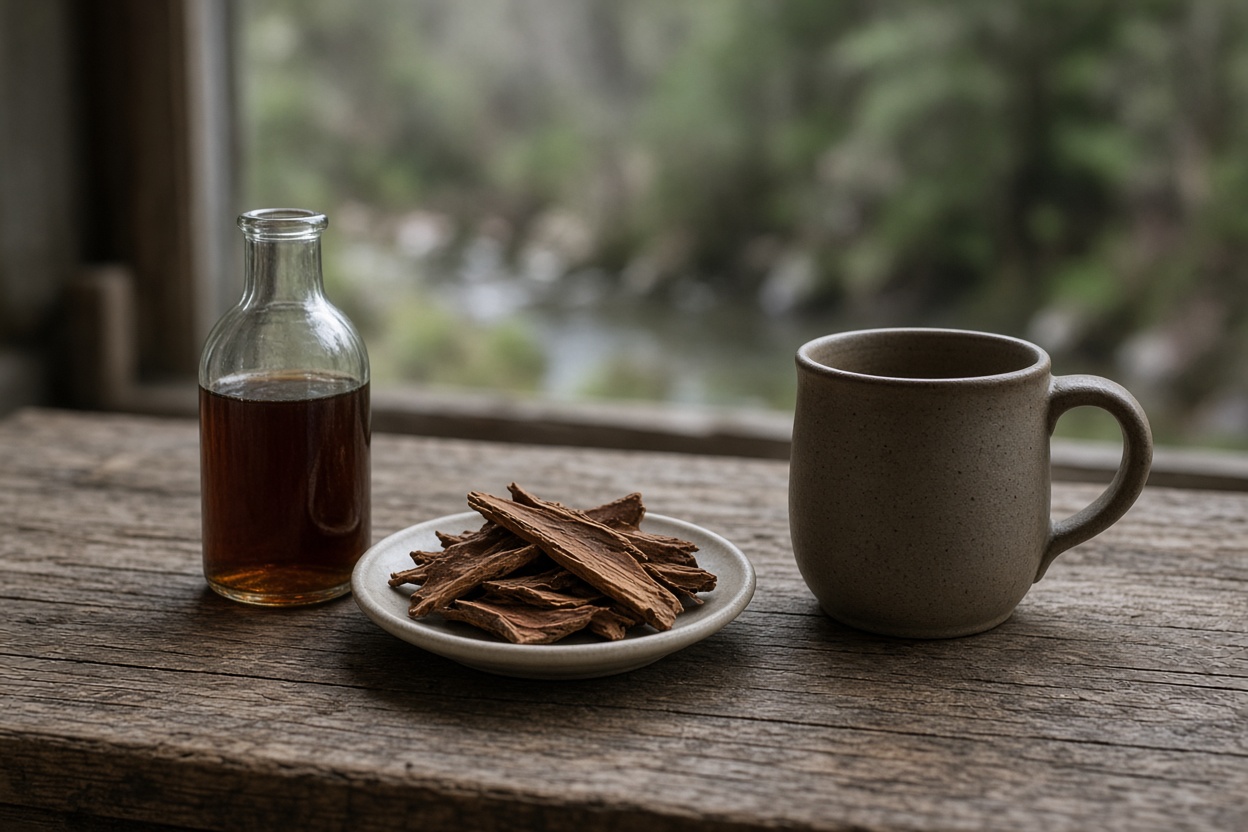
Wild cherry bark was a fixture of the old cough syrups in this part of the country, and for many years it was listed in the official United States Pharmacopeia as an ingredient. In the mountain homes I grew up around, it was the winter bark, steeped and sweetened with honey or sorghum.
Cherokee use of wild cherry is documented in the ethnobotanical record, including in Hamel and Chiltoskey’s Cherokee Plants and Their Uses. I send readers to that source for what the Cherokee themselves recorded, and I don’t try to paraphrase it. They knew these hills first, and I credit them.
The traditional preparation in the old herbals was a cold steep rather than a boil, again because heat was thought to spoil it. A few pieces were set in cool water overnight in a covered jar, then strained through cheesecloth. I describe that as history. If you have a cough that won’t quit, see a doctor.
The honest pros and cons

Black cherry is common, easy to find on any fencerow, and one of the most interesting barks to learn by smell. It’s a fine teaching tree. The cons are serious ones. It carries a real toxin, it’s not for children or pregnancy, and it doesn’t keep well, so you’re gathering fresh every winter. For many readers, learning to recognize it may be enough, and there’s nothing wrong with that.
Where the plant ends and the knowing begins
Knowing a tree in four seasons, knowing what looks like it and isn’t, and knowing when to leave it be is the long work. I walk through all of it, plant by plant, in my book, Appalachian Medicinal Plants: how to identify each one without guessing, when to gather, and how to do it so the mountain still has it for the next person.
