How to Forage and Use Bull Thistle in the Pacific Northwest
Forage bull thistle: tell the first-year rosette from look-alikes, when to dig the root and peel the stalk, how to dry it, and its traditional folk use.

My father cut thistle out of our hayfield every June with a long-handled hoe, and the first time I tried it barehanded I picked eleven spines out of my palm with a sewing needle that night. I have not handled a bull thistle without gloves since. I have, however, dug and eaten a fair amount of it, which tells you something about how a plant you resent at twelve can turn into one you respect at fifty.
Bull thistle is everywhere in western Washington and Oregon, on the edge of every pasture and the shoulder of every logging road, and almost nobody gathers it. October is when I start paying attention, because the first-year plants are sitting in low, gray-green rosettes where the grass has gone brown, and the root underneath is at its best.
What you are looking for
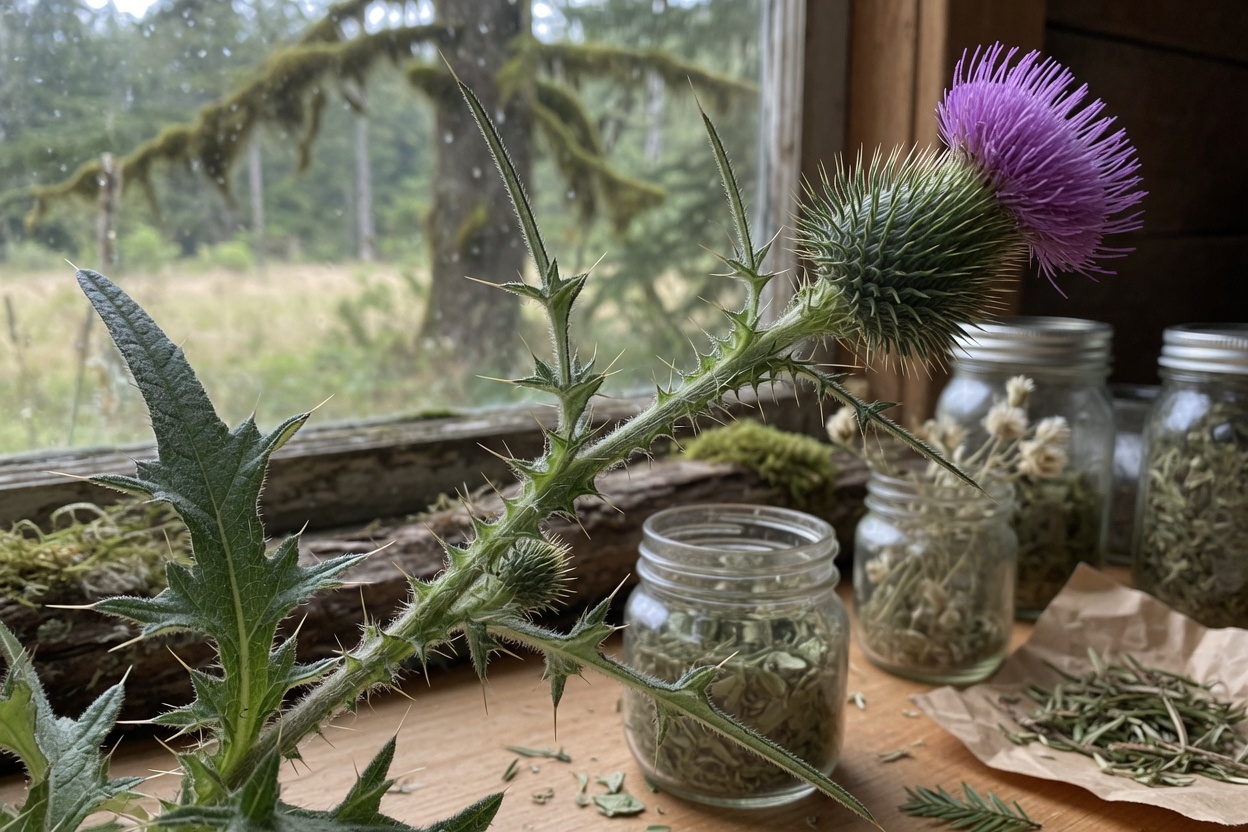
Bull thistle is Cirsium vulgare, a biennial. That one word explains most of what you need to know. In its first year it grows a flat rosette of leaves close to the ground and puts its energy into a thick taproot. In its second year it sends up a branching stalk three to five feet tall, flowers, sets seed, and dies.
The rosette leaves are deeply lobed, gray-green, and covered in stiff spines, with a coarse, prickly hair on the upper surface that feels like sandpaper. The second-year stalk has spiny “wings” running down its length, which is the cleanest field mark I know. The flower head is a purple pom-pom set in a ball of spined bracts, and it shows from July into September.
Here is the line I give everyone. Never gather a wild plant on one source alone. Check it against two good field guides, then against someone who knows the plants of your area, and when in doubt, throw it out. My walkthrough of what to rule out is in how to identify common poisonous plant lookalikes, and it is worth ten minutes before you carry a bag anywhere.
Telling it from its relatives

The thistles can look alike from a truck window, and you will meet several of them. Canada thistle (Cirsium arvense) has smaller flowers, narrower leaves, and a smooth, unwinged stem, and it spreads by creeping roots in colonies rather than standing as single plants. Milk thistle (Silybum marianum) has glossy leaves marbled with white veins, which you can’t mistake. Our native edible thistle (Cirsium edule) grows in the mountains and has softer spines and a different flower head.
None of these is dangerous to handle beyond the spines. The point of getting it right is that the preparation differs, and so does whether you ought to be taking a native plant at all. If the stem has no spiny wings, stop and look again.
Where it grows, and the ground you should avoid

It likes open, disturbed ground: cut-over land, pastures, ditch banks, the edge of a gravel pit. It is not native here, and in parts of the Northwest it is regulated as a noxious weed, so check your county list. That means you can gather it with a clear conscience, and it also means you should never carry seed heads to a new place. Shake out your bag at home and put the spent heads in the trash, not the compost.
Check who owns the ground and what has been sprayed on it. Thistle is exactly what road crews and farmers spray, and a plant that has been through herbicide goes in the discard pile no matter how good it looks. I stay off roadsides and rail corridors entirely and gather from fields where I know the owner and the history.
When to gather

I work with it in two seasons.
Fall and winter, for the root. Dig the first-year rosettes from October through the end of February, while the plant is storing everything it has in the taproot. Look for a rosette about the size of a dinner plate, with no flower stalk. Slide the hori-hori down along the root, work the soil loose, and lift. A good one is as thick as your thumb and eight inches long. Wash it, scrub it, and peel it.
Late spring, for the stalk. In May, before the flower buds open, the second-year stalk is tender. Cut it off at the base, strip the leaves, and peel away the spiny wings and the tough outer skin until you reach the pale, juicy core. That core is the part you eat. It tastes mild and a little sweet, like a cross between celery and a young artichoke.
Take only what the patch can spare. Because bull thistle is so common, that is a looser rule than for most plants, but I still leave at least a third of every stand, and I never dig the last rosette in a small patch. Leaving a few to seed a thin field is better for the birds, too. Goldfinches live on the seed.
Preparing and drying the root

A fresh root can be roasted like a parsnip. Peel it, cut it into chunks, toss it with a little oil and salt, and cook it until the edges brown. It is earthy and slightly sweet, with a hint of the artichoke note the stalk has.
To keep it for winter, slice the peeled root into thin coins and lay them in a single layer on a screen or a clean towel. Cover loosely with cheesecloth so dust and flies stay off while the air still moves. In a heated kitchen it takes two to four days. The coins are dry when they snap clean and do not bend. If they bend, they will mold. Pack them loosely in a wide-mouth mason jar, label the jar with the plant and the date, and put it in a cupboard. I wrote up how to keep a whole shelf of dried plants in good shape in how to store dried herbs so they last.
How it has been used
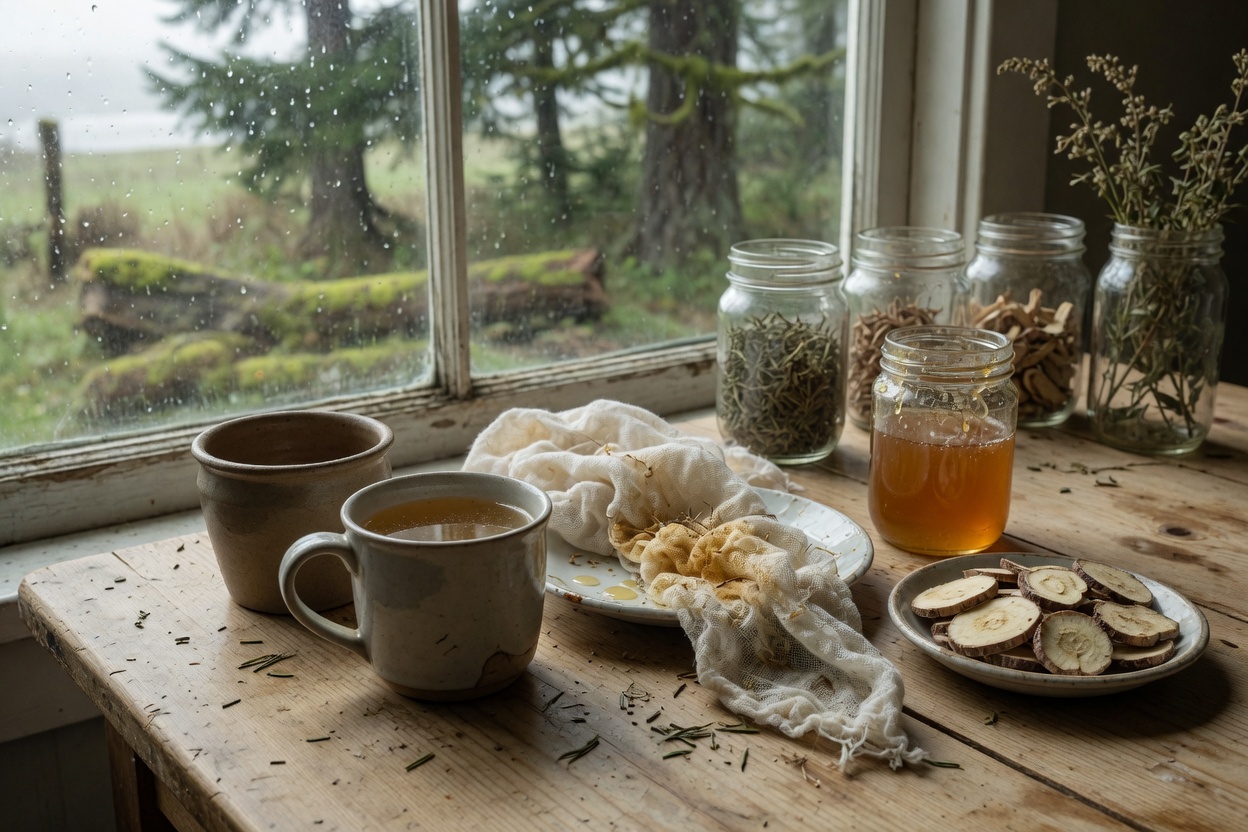
Old European herbals record bull thistle’s root and leaf in folk preparations, usually as a decoction, and some mention the flower heads as well. That is the extent of what I can responsibly say. I don’t tell anyone what it will do for them, and I would be careful of any page that does.
In my own kitchen it is a food first and a tea second. I simmer a spoonful of dried root coins in a pot of water for twenty minutes, strain it through cheesecloth, and drink the result plain or with a little honey. It tastes like a thin vegetable broth with a faint bitterness, and I won’t pretend it’s more exciting than that. The root keeps well in a pantry and has some of the same starchy quality as dried dandelion root, which I describe in how to forage and use dandelion.
Two cautions I take seriously. Thistle belongs to the aster family, along with ragweed and chamomile, and people who react to those plants can react to this one, so if you are allergic to daisies or ragweed, skip it. And if you are pregnant, nursing, on medication, or managing a health condition, ask a qualified practitioner before adding any herbal preparation to your routine. This is traditional use, not advice.
Honest notes on the tools
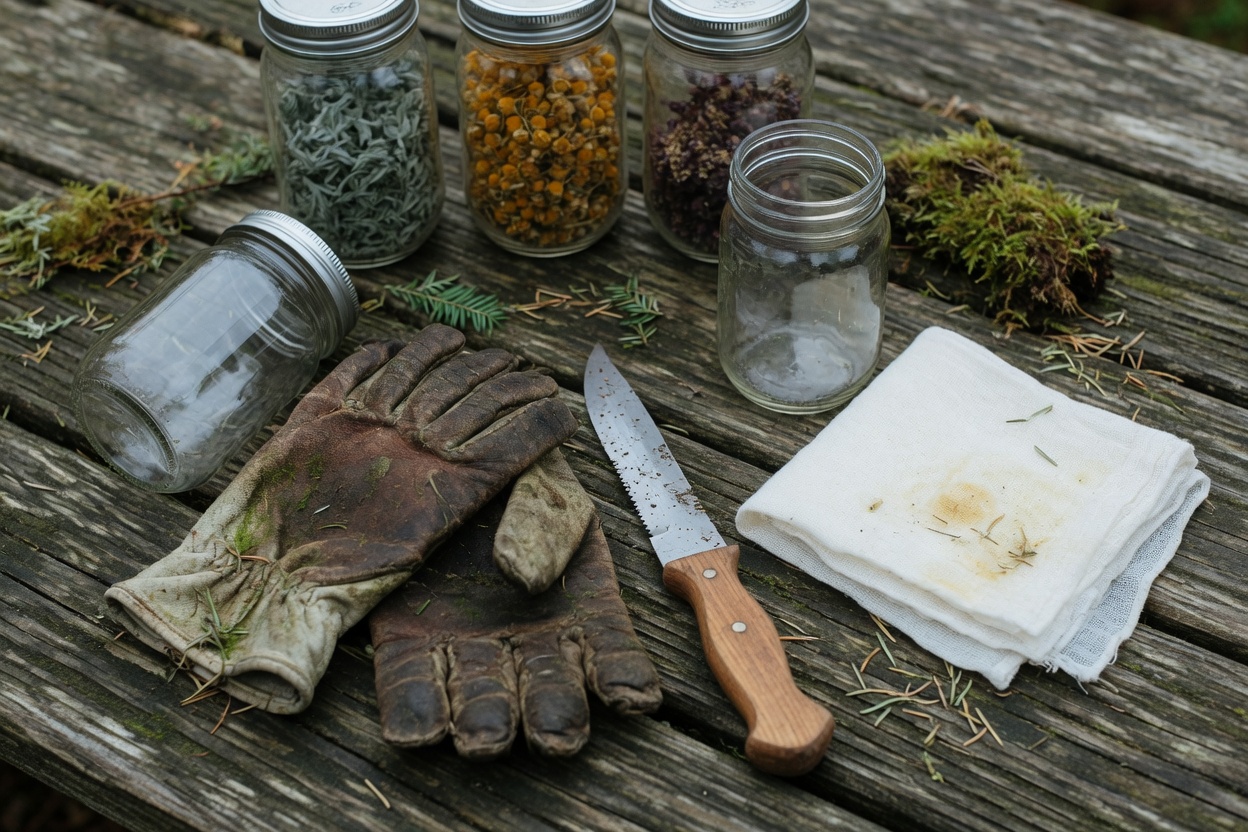
The tool that matters here is a pair of heavy leather gloves, and I have not found a verified pair I can point you to, so go to a farm store and try a few on. The hori-hori earns its keep on this plant more than most. A garden trowel bends against a thistle taproot, and a shovel tears it. The hori-hori slides in beside it and lets you lift it whole. The cheesecloth and jars are not specific to thistle, which is the reason I’d buy them. They work for every plant you will dry.
The downside is that all this effort buys you a modest harvest. A day of digging yields a good bag of roots, not a pantry. If you want a plant that gives you a lot for a little, start with dandelion. Come to thistle when you want to learn something.
Where to go from here

This month, find a pasture edge with permission and walk it slowly, looking down. Learn the gray-green rosette in the cold, and mark where it grows. Come back in May for the stalks, and you will recognize the plant by its spiny wings without a second look.
Bull thistle is one of the many plants I teach in Pacific Northwest Medicinal Plants, with the identification features, harvest windows, and look-alikes laid out so you aren’t guessing: Pacific Northwest Medicinal Plants. If you want another root to work on while the weather is slow, my notes on how to harvest medicinal roots in fall are a good next read.
Learn it before you need it.
