How to Forage and Use Bigleaf Maple Leaf in the Pacific Northwest
How to forage bigleaf maple leaf in the Pacific Northwest: how to know the tree, when to pick, how to dry and store the leaf, and its traditional uses.

The October I moved to the Olympic Peninsula I raked bigleaf maple leaves out of the gutter for a week and cursed every one of them. Each leaf was wider than my head and slick as a wet dish towel once the rain got at it. It took me three more autumns, and a neighbor who laid a leaf over a loaf pan without a word, to see that I had been cursing one of the most useful trees on my road.
Acer macrophyllum is the signature maple of the Pacific Northwest, and you can learn it in an afternoon. This is the time of year to do that, with the leaves down and the tree’s shape bare against the sky. I’ll cover how to know it, when to pick, how I dry the leaf, and how it has been used by the people who knew it long before me. One note up front: the leaf is a spring and summer gathering, so what you do now is scout.
You’ll also want a basket, a pair of clean scissors, and a pencil for your notes. A tree does not ask for fancy gear.
Learn the tree before you pick a leaf
Say this part plainly, once: never prepare or use any wild plant on the strength of one book, one app, or one article, this one included. Check it against more than one reputable guide and, better, walk it with an experienced local forager. When there is real doubt, leave it where it is.
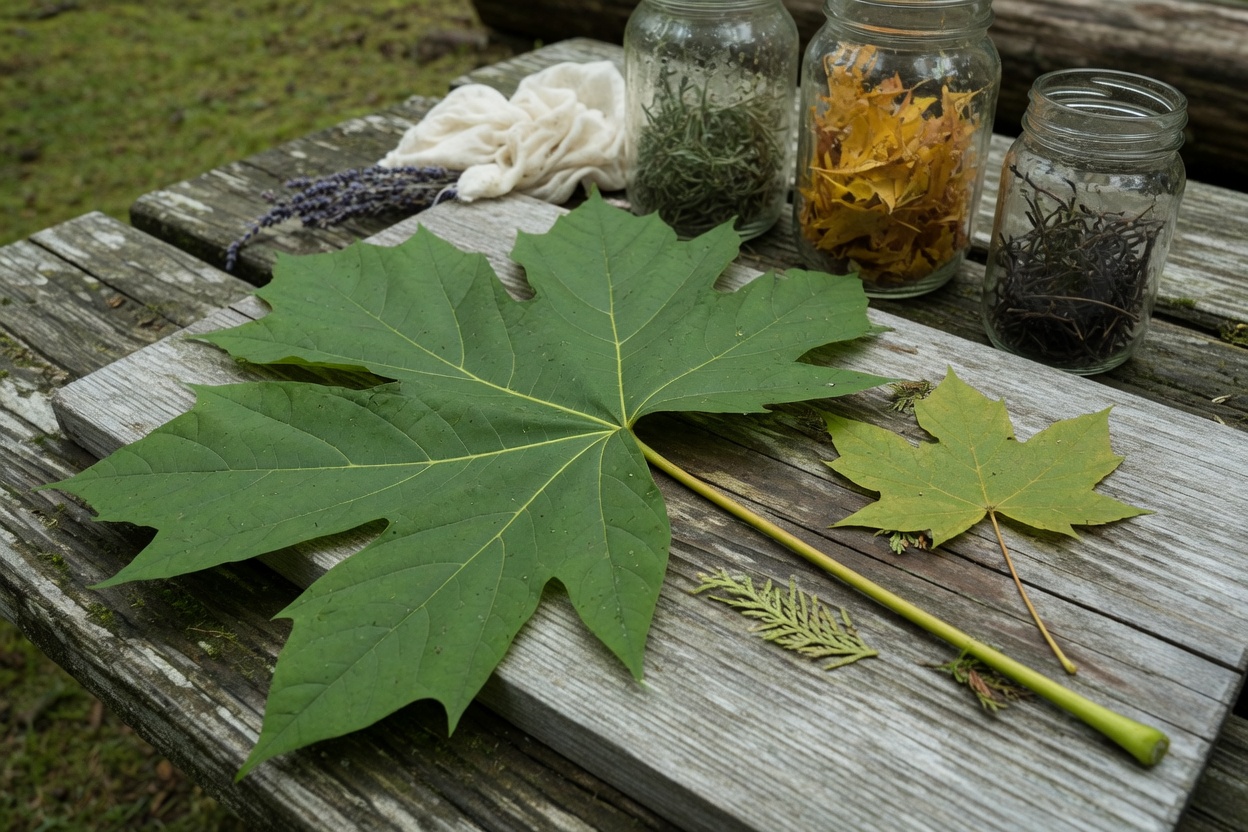
The leaf is the easy tell. Bigleaf maple has the five-lobed, hand-shaped leaf you’d draw if someone asked you to draw a maple, but it is enormous, commonly ten to twelve inches across and sometimes a good deal more, on a long stalk. The lobes have a few rounded, blunt teeth rather than sharp ones. Break the leaf stalk and you may see a milky sap bead up, which is a useful clue among our native maples.
The bark helps in winter. It is gray-brown, ridged, and nearly always furred with moss and licorice fern on the Peninsula, so the trunk looks upholstered. The tree grows tall, often forty or fifty feet before the crown spreads, and the branches make a wide, rounded umbrella. In April it hangs long, greenish-yellow flower clusters. In late summer the paired seeds, the winged “helicopters,” ripen, and they carry a fine bristle that itches if you handle a lot of them.
Vine maple (Acer circinatum) grows alongside it and gets mistaken for a baby bigleaf. It has a much smaller leaf with seven to nine shallow lobes and a shrubby, leaning habit. If the leaf fits in your palm, it is not the tree I am describing.
Where to pick, and where not to

Bigleaf maple grows at low elevations all over the Westside: river bottoms, old homesites, the edges of second-growth forest, city street strips. That last one is the catch. Do not pick from trees along busy roads, beside ditches that carry runoff, or on any strip the county might spray. A leaf that has caught years of exhaust and brake dust is not a leaf for your kitchen.
Pick from trees on land you know. Get permission on private ground. On public land, check the agency’s rules on gathering, since they vary between a state forest, a county park, and a national forest district. Take a few leaves from many branches, not a lot from one, and never strip a limb. The tree will not miss a basketful. It will miss being butchered.
When and how I gather

The best leaf is the young one. In our maritime climate the leaves are fully open by late April or May, large and soft, with a clean green color. Pick them then, on a dry morning after the dew has gone, and choose leaves that are whole, unspotted, and free of the black tar-spot blotches that show up on maples by summer. Tar spot is a common fungus and doesn’t harm the tree much, but I leave those leaves on the branch.
Leaves picked in late summer are tougher and chewy, good for lining and wrapping but not for tea. By October they’re yellow-brown and down, and the leaf mold under the tree is the tree’s own business.
Right now, this month, I walk my neighborhood and note which trees I’ll visit in spring. I write the location in a notebook with a sketch of the bark. It’s the best thing I do all winter for next year’s gathering.
Drying and storing the leaf

Wash the leaves briefly in cold water and pat them dry with a clean towel. Lay them in a single layer on a screen or a clean cotton cloth, because a leaf this size will mold if you pile it. Drape cheesecloth loosely across the top to keep off dust and flies. In a warm, shaded room with moving air, they take three to five days to dry crisp. They’re ready when they crumble at a touch.
Break the dried leaf into pieces by hand and pack it loosely in a wide-mouth jar. Write the plant and the date on a strip of masking tape and keep the jar in a dark cupboard. I use it within the year. My longer notes on keeping dried plants are in how to store dried herbs so they last.
A dried leaf this large doesn’t pack tight, so expect a lot of jar for not much leaf. That’s fine. It’s a quiet, mild plant, and you won’t be using much at a time.
How it has been used
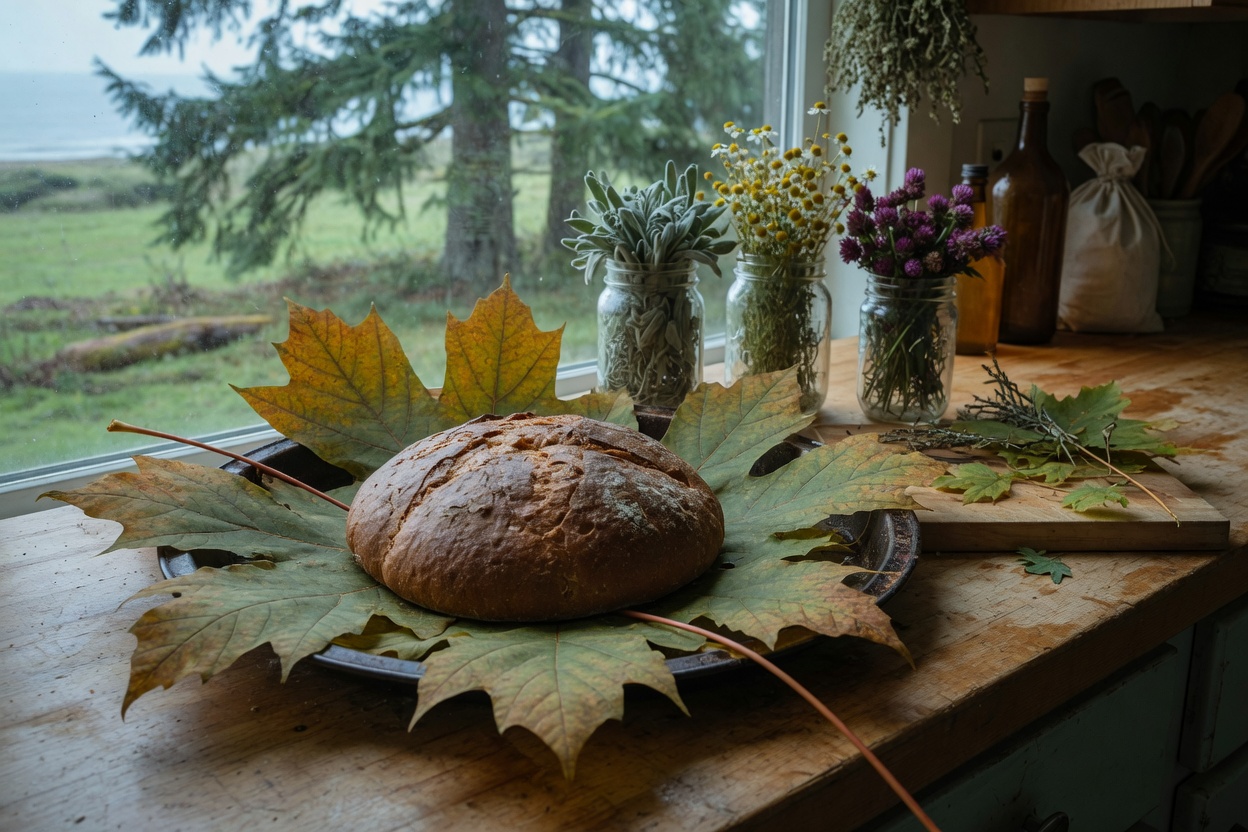
Start with the older use, because it’s the one the tree is known for. The people of this region have long used the big leaves for practical work: lining a cooking pit, wrapping food, laying out berries to dry. This is well documented by ethnobotanists, and I will point you to their published work and to the tribal sources themselves for the details. It is not my family’s knowledge to retell as mine.
In my own kitchen, the leaf’s size does the work. I line a baking pan with a fresh, washed leaf under a loaf of bread, or wrap a fillet in one to bake, and the leaf holds moisture and leaves a faint, green, woodsy taste. Do not eat the leaf itself, only what it wrapped, and do not use a leaf from a roadside tree.
The tree also gives a sap. In late winter, before the buds break, bigleaf maple can be tapped much like a sugar maple, and the syrup is milder and runs more thinly. It takes a lot more sap per jar. That is a project for a different post, and I mention it so you’ll know why the tree is worth knowing.
As for the leaf in folk herbalism, older sources record it in teas and in washes, and I’ll say that as history, not as advice. I do not claim that it treats anything, and I don’t give amounts. If you have a real health concern, see a qualified practitioner. If you’re pregnant or nursing, or take any medication, I would leave unfamiliar plants out of your cup altogether.
What I got wrong
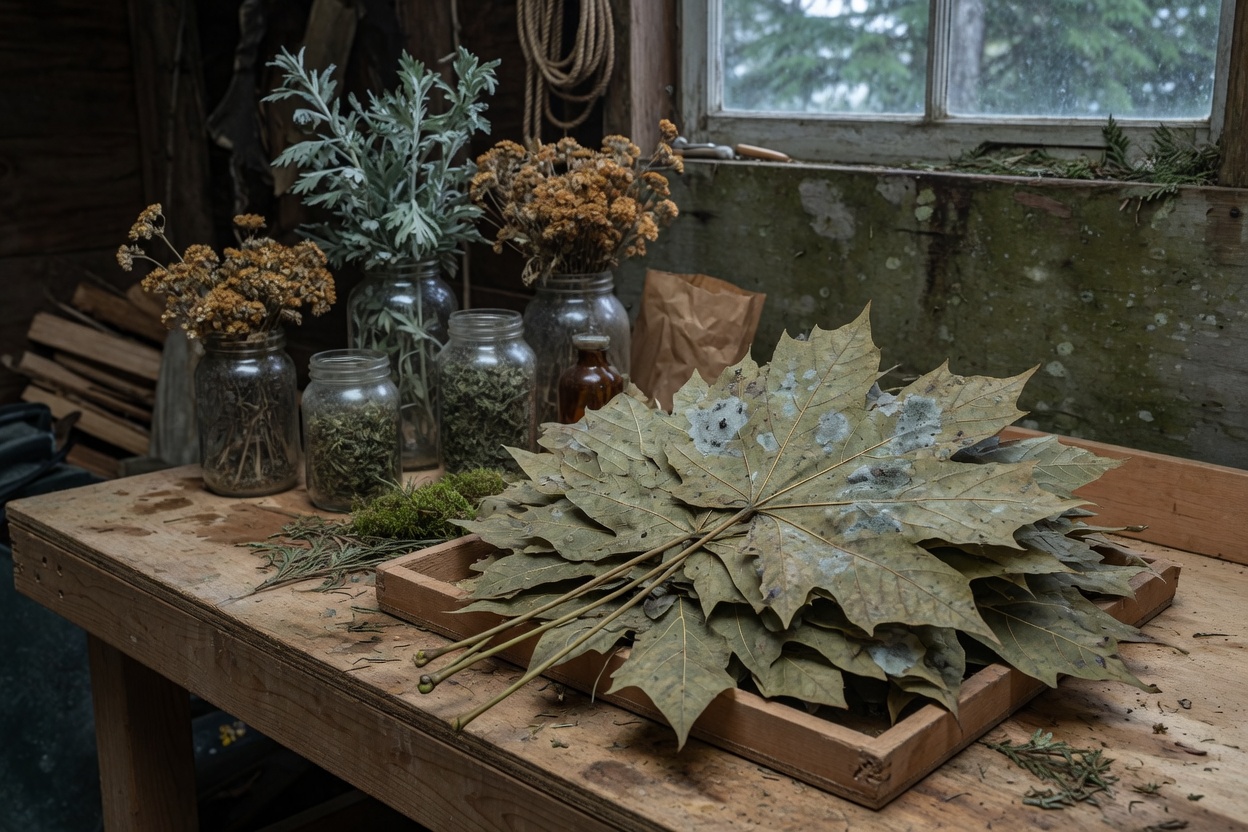
My first spring I dried a tray of leaves in a damp March garage, stacked three deep, and a month later they smelled of old basement. A leaf this big holds a lot of water. Spread it thin, give it air, and don’t jar it until it snaps.
I also picked from a tree beside a gravel pull-off, because the leaves there were the biggest, and then remembered where I was standing. Big leaves on a roadside tree are a warning, not a prize.
Where the tree ends and the study begins
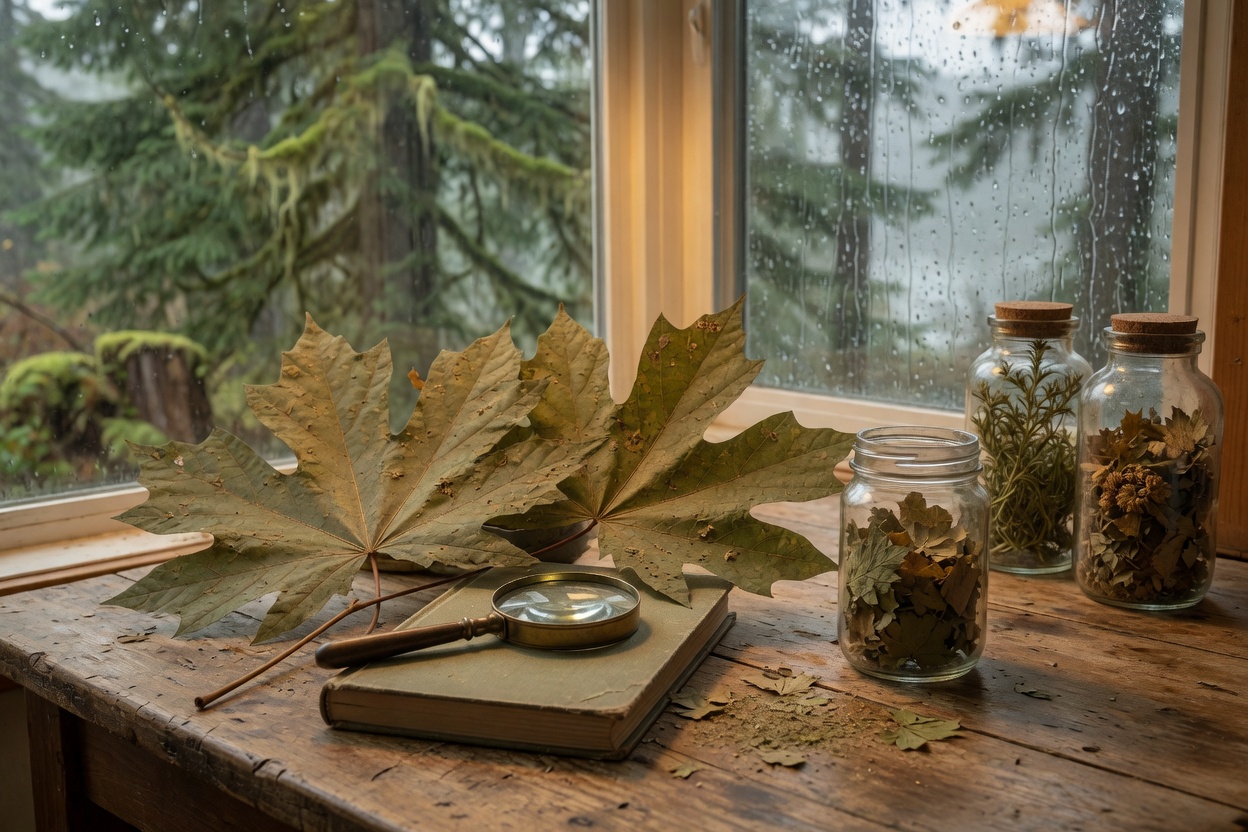
A jar of dried leaf is the easy part. Knowing the bigleaf from its relatives in every season, knowing which trees are safe to pick and which only look safe, and building the habit of confirming before you use anything, takes years. That slow study is the part I care about most.
I take it plant by plant in my book, Pacific Northwest Medicinal Plants: how to identify each one without guessing, when to gather it, and how the people before us prepared it. If you want a plant to start with this spring, my notes on how to forage and use thimbleberry leaf cover another big, soft Westside leaf, and how to identify common poisonous plant lookalikes is the page to keep open while you learn.
Learn it before you need it.
