The No-Waste Chicken Feeders I’ve Actually Used
Three no-waste chicken feeders I've actually run in my own coop — a port feeder, a treadle feeder, and a hanging feeder — with the honest pros and cons of each.
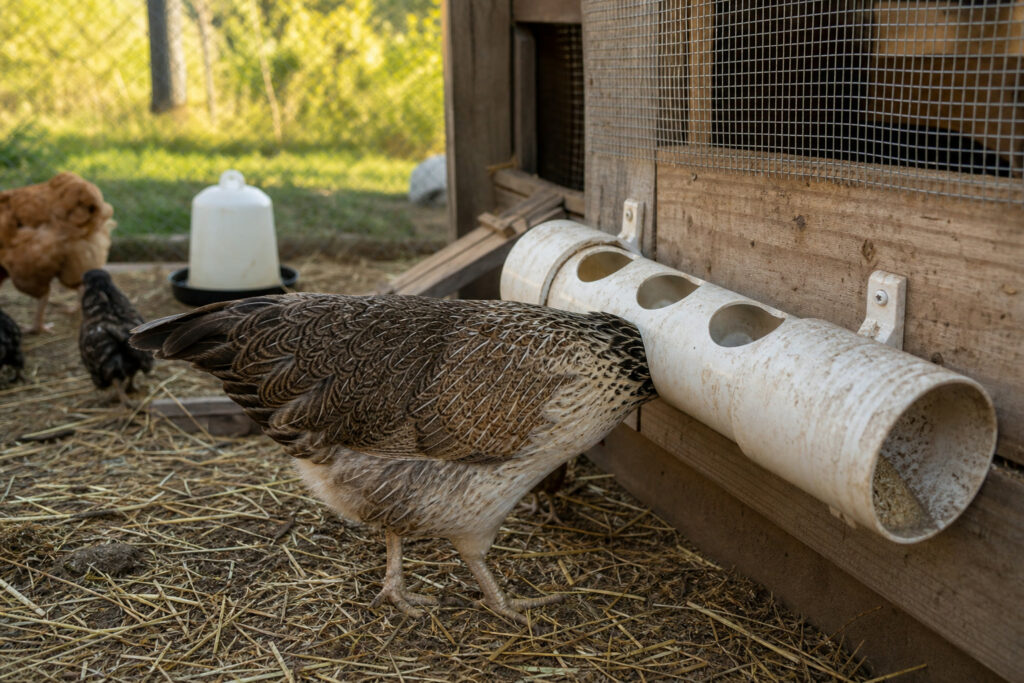
For my first year and a half I fed my flock out of a wide-mouth galvanized trough, the kind everybody starts with. The girls would stand in it, scratch feed out onto the ground by the beakful, and then a fat groundhog and a rotating cast of sparrows would clean up what they flung. I was buying a fifty-pound bag of layer feed every couple of weeks for eight hens, and I genuinely could not figure out where it was going. It was going on the ground. It was feeding every wild animal in Knox County except, apparently, my chickens.
Feed is the single biggest ongoing cost of keeping chickens. Cutting waste is the one place you can actually move that number. I’ve run three different no-waste feeders since I wised up, and they each solve the problem a different way. Here’s the honest rundown — what each one does well, where each one falls short, and which of the girls took to which.
Why a trough loses you so much feed
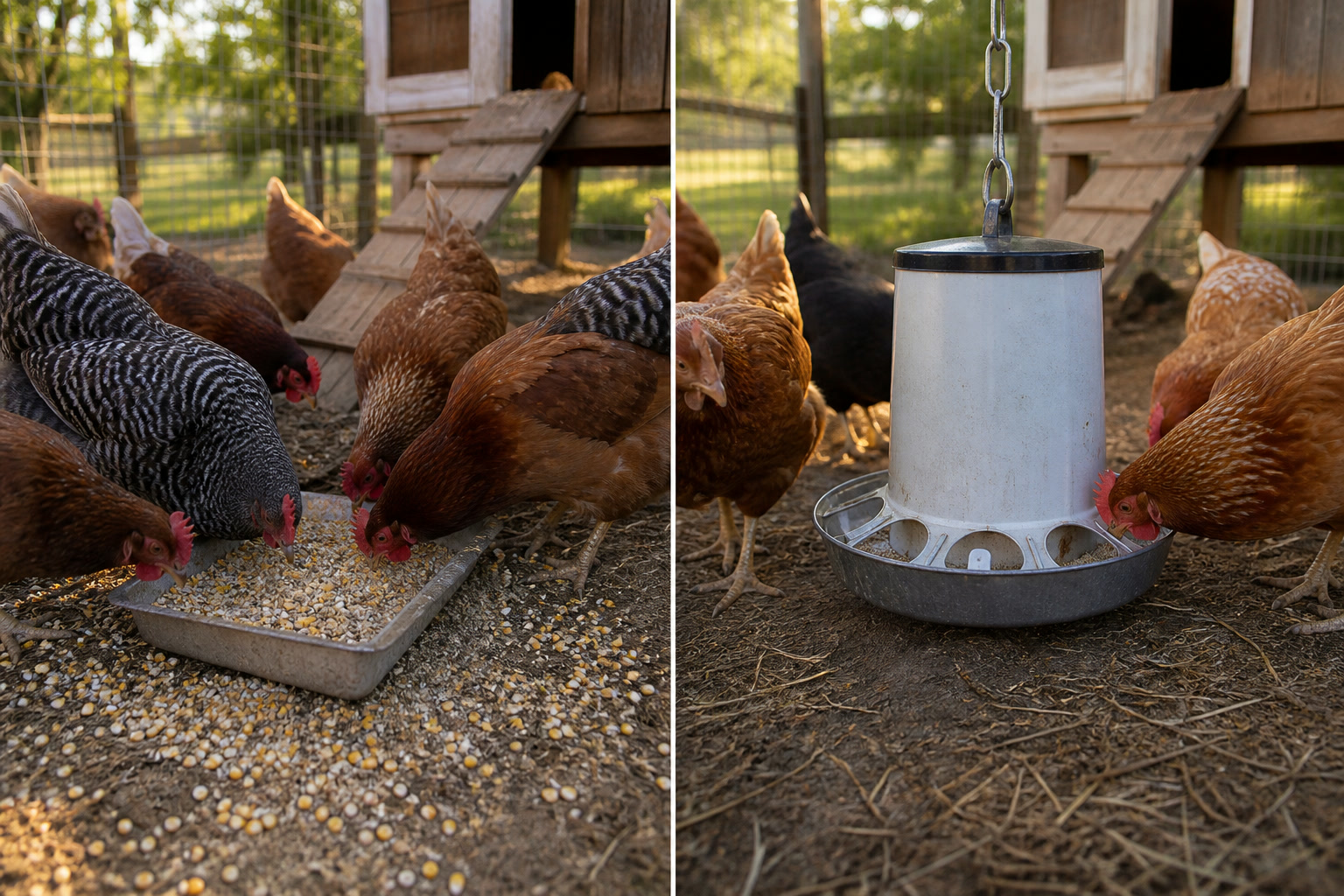
Before the feeders themselves, it helps to understand what you’re fixing. Chickens forage by scratching and billing — they sweep their beaks side to side through feed to pick out what they want, and a trough or an open pan lets them fling the rest onto the ground. Out in the open run, that spilled feed does three bad things. It draws rodents and wild birds, which is how you get mice in the coop and, worse, the diseases wild birds carry. It molds in the damp, and moldy feed makes hens sick. And it’s just gone — money on the dirt.
A no-waste feeder fixes the scratching problem one of two ways: it either gives the hen a port she has to put her head into, so she can’t bill feed sideways, or it raises the feed up where she has to peck deliberately. The treadle feeder does something different again, which I’ll get to.
The port feeder: my everyday workhorse
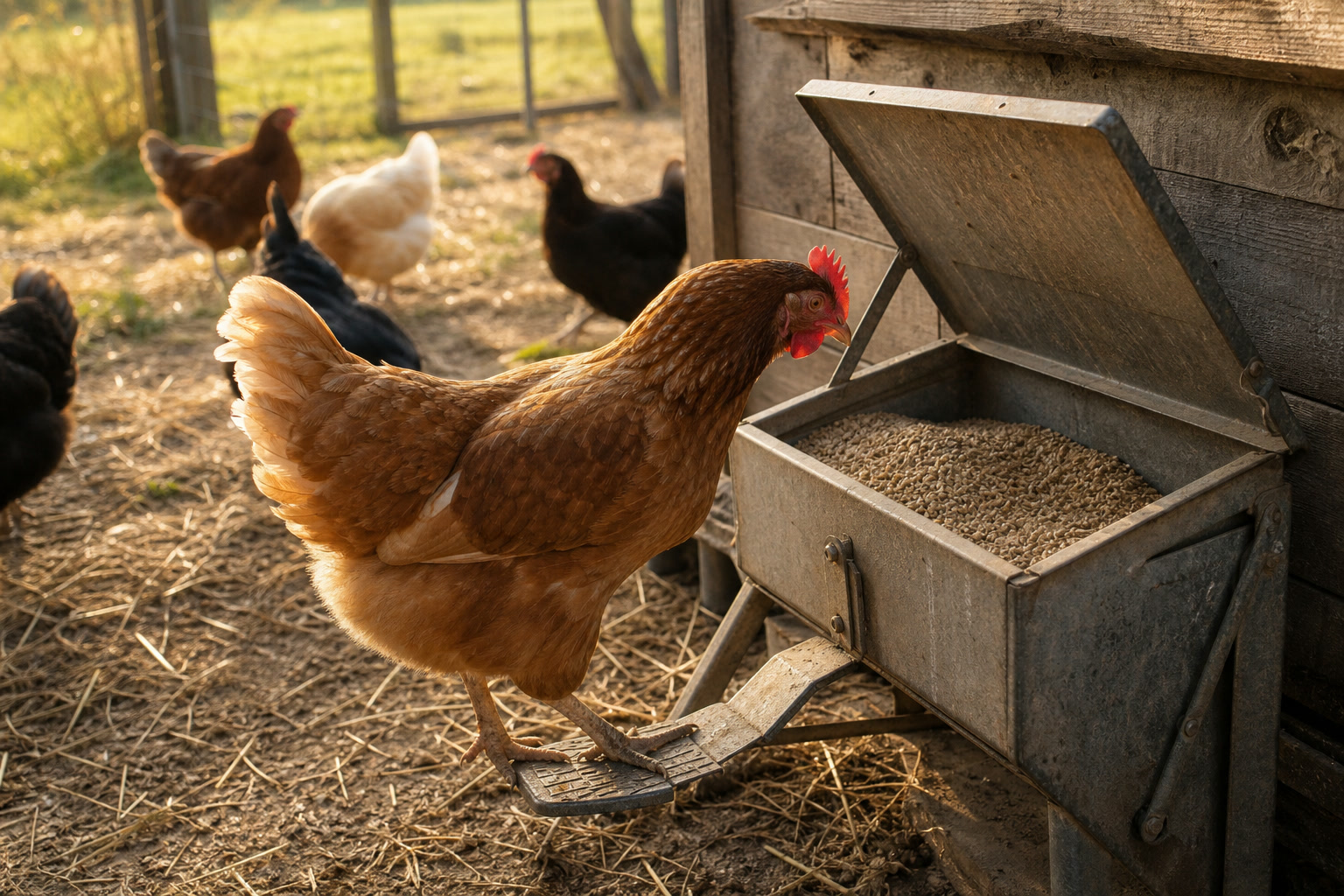
This is the one I run year-round. A port feeder is a sealed bucket or tube with a hole — the port — that the hen pokes her head into to reach the feed. Because her head is down in the port, she physically can’t sweep feed out the sides. What she doesn’t eat stays in the feeder. Mine has a rain hood and an anti-roost lid, which matters more than you’d think — a feeder the girls can perch on top of is a feeder full of poop by morning.
The honest downside: there’s a short training period. A couple of my hens, especially an older Plymouth Rock who was set in her ways, stood and stared at the thing for two days before she’d put her head in. I left the old trough next to it for about a week, half-full, and slowly let it run empty. By the end of the week everyone had figured out the port. Once they’re trained, my feed bill dropped by close to a third — that’s not a number I made up, that’s me buying one bag a month instead of three bags in five weeks. The single-port style I use is right for a small backyard flock; if you’ve got a dozen-plus birds you’ll want a multi-port version so there’s no traffic jam at breakfast.
The treadle feeder: when rodents are your real problem
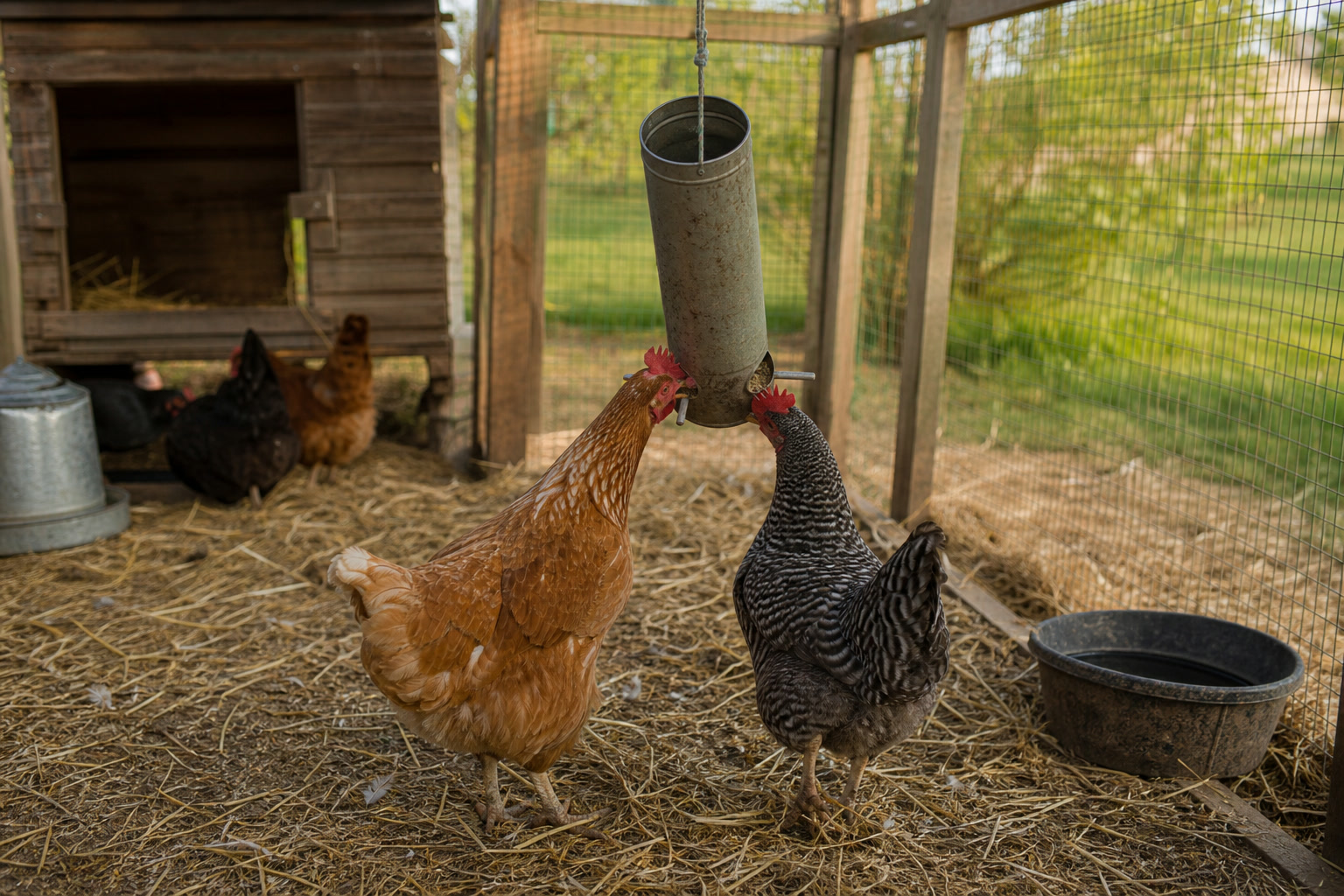
If your problem isn’t so much the girls flinging feed as it is the mice, rats, and wild birds raiding the feeder overnight, the treadle feeder is the answer. The bird steps onto a foot pedal, the pedal’s weight lifts a lid, and the feed is exposed only while she’s standing on it. Step off, lid closes. A mouse or a sparrow isn’t heavy enough to trip the treadle, so the feed is locked away from everything but a full-grown hen.
I added a treadle feeder the summer I found mouse droppings in the coop and realized the open feed was the buffet drawing them in. It worked exactly as advertised — the rodent sign was gone within a couple of weeks. The galvanized steel ones hold up to weather and the birds can’t destroy them. The catches: it’s the priciest of the three, the training takes longer than the port feeder did (some hens are genuinely nervous about a lid that moves, and you have to prop it open for a week or two while they get brave), and bantams or very light hens sometimes can’t trip the pedal at all. Match the feeder’s pedal weight to the size of your birds. For a standard-breed flock with a rodent problem, though, it’s the one that earns its keep.
The hanging feeder: the easy first upgrade
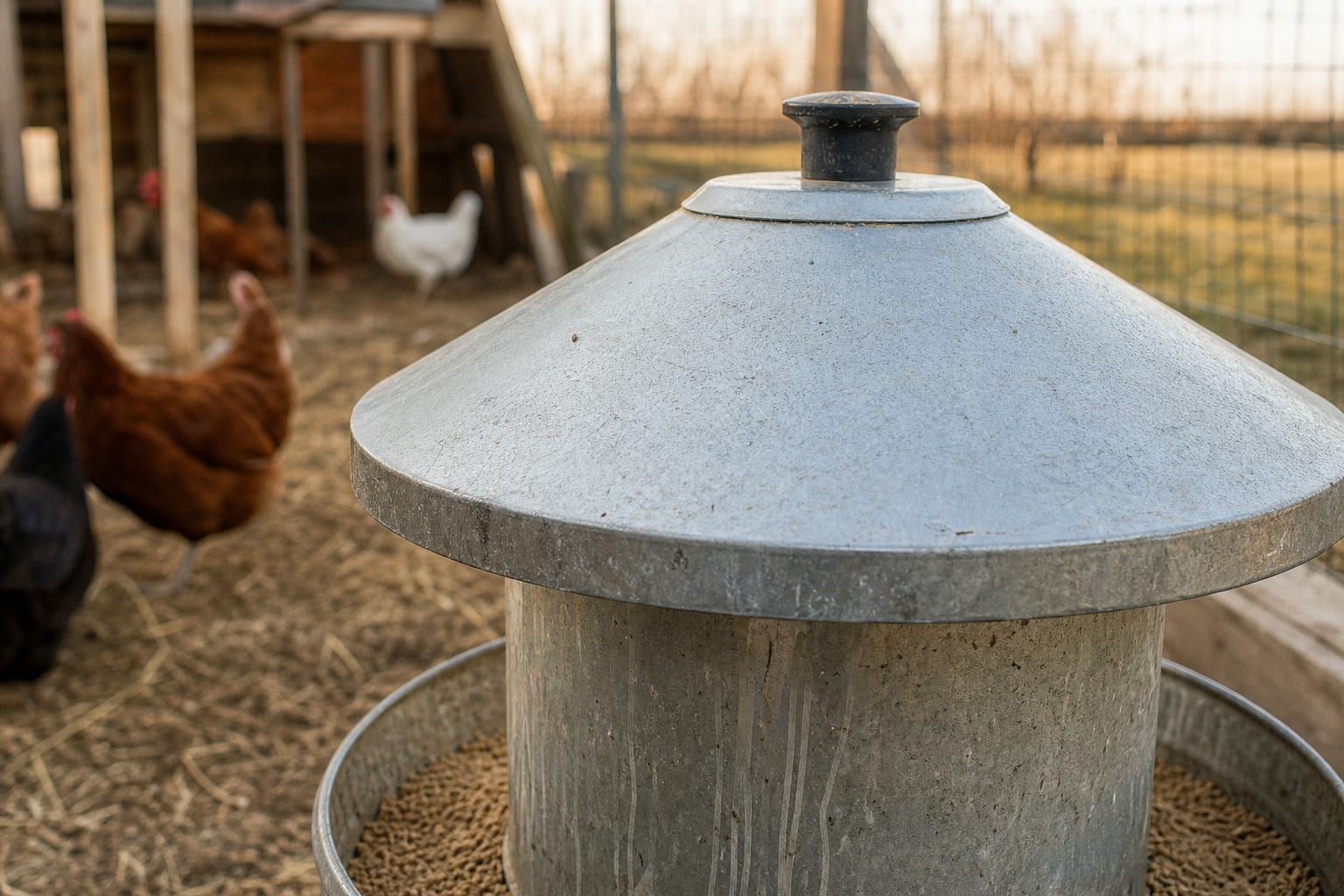
If you’re feeding out of a pan or a trough right now and you want the simplest improvement that costs the least, a hanging feeder is where I’d start. You hang it from the run roof or a sturdy bracket so the feed pan sits at about the height of the girls’ backs. Raised up like that, they have to reach up and peck deliberately instead of standing in the feed and scratching, and the anti-scratch vanes around the base cut the billing-out way down. Because it swings, it’s also harder for rodents to climb into.
It won’t get you to true zero waste the way a port feeder will, and a determined hen can still flick a little feed over the lip. But it’s a genuine improvement over a trough for a fraction of the fuss, with no training period to speak of — they just walk up and eat. I keep one going in my grow-out pen for the younger birds who aren’t ready for the port feeder yet. For a brand-new keeper who isn’t ready to commit to the bigger setups, this is the honest starting point.
Which one should you get
If I had to send one new keeper home with one feeder, it’d be the port feeder — it’s the biggest drop in waste for the least money, and it’s what I use every single day. Add a treadle feeder if and when rodents become a problem, not before. And if you’re just trying to do better than the trough you’ve got without overthinking it, hang a hanging feeder and call it a good first step. The girls don’t care which one you pick. Your feed bill very much will.
I go into feed management, what to feed at every age, and how to keep the cost of a flock honest in my book, Raising Backyard Chickens for Beginners. The feeders above are the quick win you can set up this weekend. The book is the rest of the picture — the part that keeps a flock from quietly costing you more than it should.
