How to Clean a Fish for Beginners (Bream and Catfish)
How to clean a fish for beginners — scaling and gutting a bluegill, skinning a channel catfish, and keeping your catch fresh, from an old hand who fries what he catches.

Catching the fish is only half of it. The other half is what you do with them on the bank when the fishing’s done, and that’s the part a lot of beginners never get shown. So they let a good mess of fish go soft in a bucket, or they wrestle one so badly there’s hardly anything left to fry. It doesn’t have to be hard. My granddaddy showed me at a cleaning board by the pond, and I’ve shown my grandson Isaiah the same way. Let me walk you through it plain.
I’ll cover the two you’ll most likely bring home around here — a bream, meaning a bluegill or one of its sunfish cousins, and a channel catfish. They’re cleaned two different ways, and once you have both, you can handle just about anything that comes off a freshwater pond.
First thing: keep them cold and keep them fresh
A fish starts to go the moment it leaves the water, and heat is what ruins it. So the first rule of cleaning a fish well is to have kept it well before you ever pick up a knife.
The best way, if you plan to keep a fish, is to put it on ice as soon as you can — a cooler with ice in the bottom, right there on the bank. A fish kept cold and cleaned within a few hours is a different thing on the plate than one that rode home warm in a bucket. If you’re keeping a few for supper, ice them. If you’re not going to eat them, let them go gently and let them grow. A pond fishes better for a keeper who takes what he’ll use and no more.
What you need — and it isn’t much
You don’t need a fancy setup. A steady surface to work on, a sharp knife, and clean running water or a bucket to rinse in will do the whole job. For panfish, a small, thin, sharp knife is plenty. For catfish, a good pair of pliers earns its keep, and I’ll get to why.
The one piece worth spending a little on when you’re ready is a proper fillet knife — a thin, flexible blade makes clean work of a fish where a stiff kitchen knife fights you. I’m not going to point you at a particular one yet, because I haven’t settled on a beginner’s knife I’d put my name to; when I do, I’ll say so here. For now, the sharpest thin knife in your kitchen drawer will get you started. A dull knife is the real hazard — it slips. Keep whatever you use sharp.
Cleaning a bream: scale, gut, and fry it whole
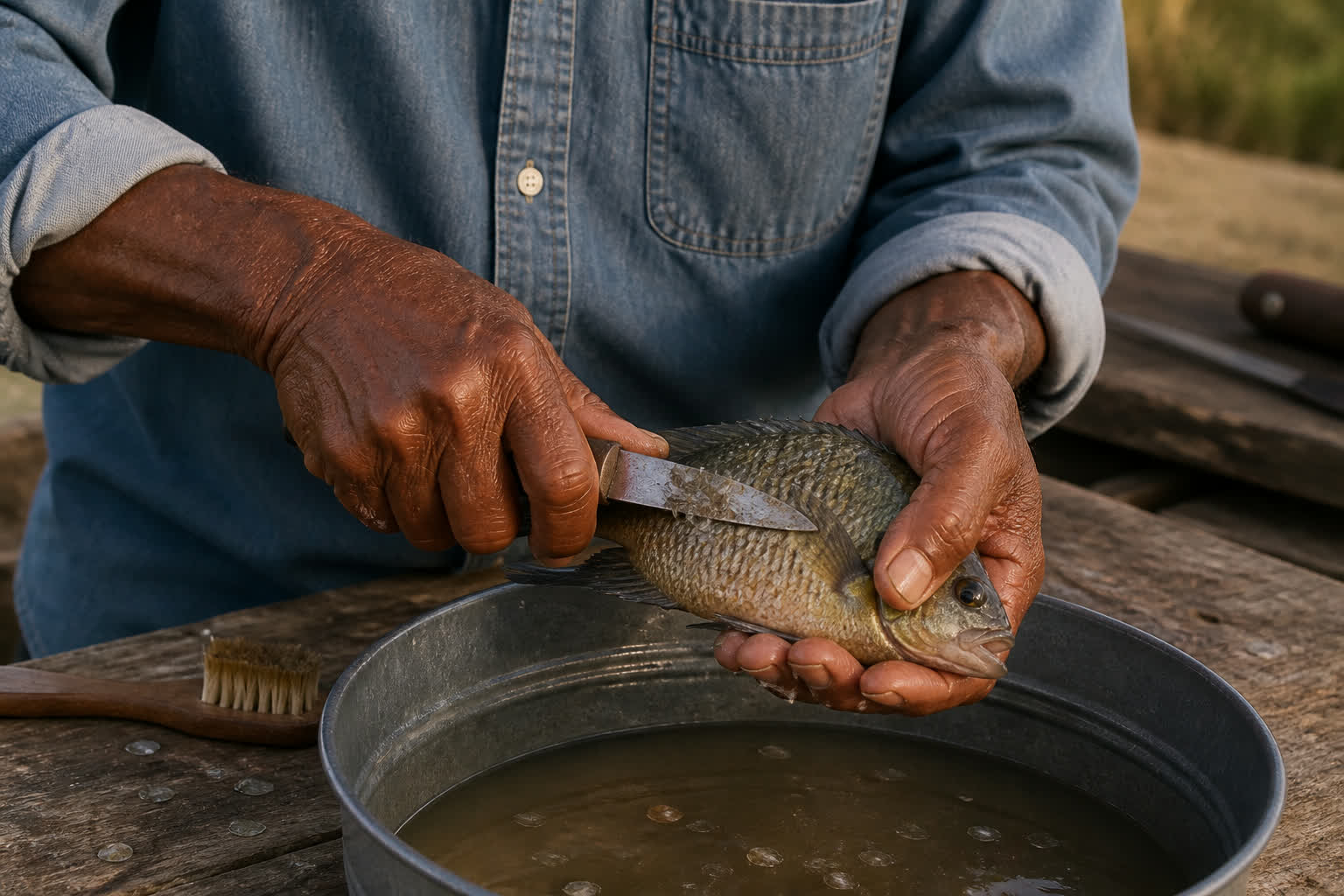
A bluegill is small, and the sweetest way to eat one is whole — scaled, gutted, head off or on as you like, dropped in cornmeal and hot grease. That’s how my church fixed them at the Friday fish fry for longer than some of the congregation has been alive, and Audra still runs that kitchen. Here’s the order.
Scale it first. Hold the fish by the tail and run the back of your knife, or a spoon, from the tail toward the head, against the way the scales lie. They’ll fly, so do it in a bucket of water or outside — never over your good kitchen sink the first time, unless you like finding scales for a week. Work both sides and around the base of the fins until the skin feels smooth.
Then open the belly. Lay the fish down and run the knife tip shallow up the belly from the vent — that’s the little opening near the tail — toward the head. Shallow is the word; you’re opening the belly, not cutting into the insides. Spread it and pull out everything inside with your fingers or the knife tip. Scrape along the backbone where a dark line of blood sits and get that out too — it’s bitter if you leave it.
Take the head if you want. For frying whole, a lot of folks cut the head off just behind the gills. Some leave it on. Rinse the fish clean inside and out, and it’s ready for the meal. A bream cleaned this way, fried crisp, is as fine a supper as this water gives.
If you’re still working on catching a mess of them to clean, I laid out the how in catching bluegill for beginners.
Cleaning a channel catfish: skin it, don’t scale it
A catfish is a different animal, and beginners get tripped up because they try to treat it like a bream. A catfish has no scales — it has a tough, slick skin you take off — and it has sharp spines on the fins you need to respect. So we skin and fillet it instead.
Mind the spines first. A channel cat has a stiff, sharp spine on the top fin and each side fin, and they’ll put a hole in your hand that stings for a day. Handle the fish firmly from behind those front fins, or trim the sharp fins off with kitchen shears before you start. Once you’ve been finned once, you’ll never forget to.
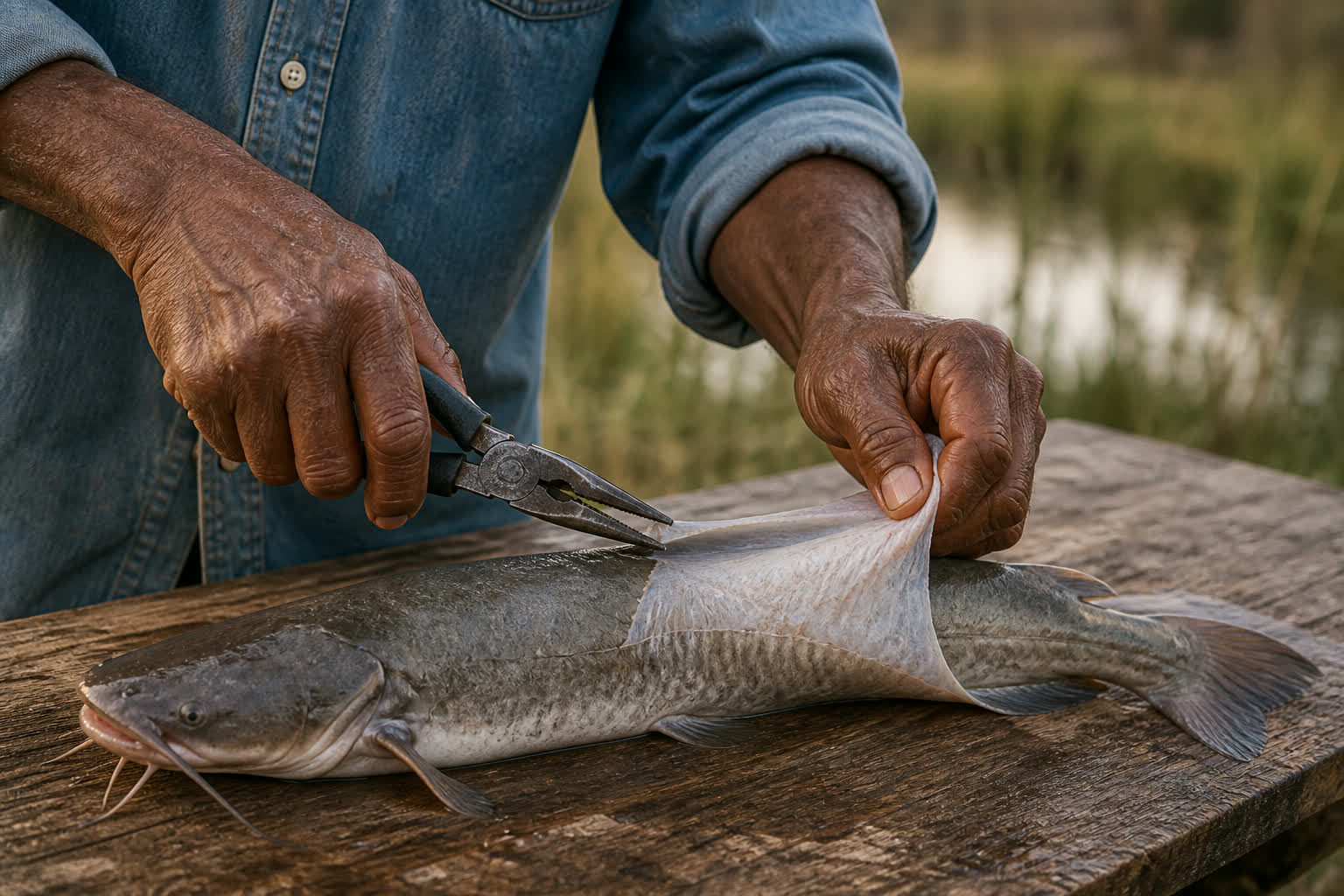
Skin it with pliers. The traditional way, and still the easiest for a beginner, is to cut through the skin all the way around behind the head, then get a grip on the cut edge with a pair of pliers and pull the skin back toward the tail. It comes off like a glove. That’s the whole reason pliers belong on the cleaning board with a catfish.
Then fillet or steak it. For a smaller channel cat, cut down behind the head to the backbone, then turn the knife and run it flat along the backbone to the tail, taking the fillet off one side; flip and repeat. For a bigger one, plenty of folks just cut it into steaks across the body, bone and all — a good honest way to fix a big catfish. Rinse the meat clean and keep it cold until it hits the pan.
Read the signs, and teach one while you clean
Cleaning a fish is a good, quiet job, and it’s one of the best things you’ll ever teach a young one. A child who learns to catch a fish and then clean it and cook it has learned the whole circle of it — where supper comes from and the work that brings it to the table. That’s worth more than the fish.
I keep a little almanac of my own pond, and I put together a free one you can use for yours — it marks the best days by the moon with a plain checklist for the water and the weather, so you catch enough to be worth cleaning. You can read the method in my post on reading the three signs, and pick up the free Best Days to Fish starter kit here.
And if you’ve got a young one coming along to the bank, let them keep a record of it — the first fish they caught, the first one they cleaned, the day. I helped make a simple journal for exactly that, My First Catch — A Fishing Journal for Young Anglers, so a child can write down and draw what they caught and carry the memory of it. Mine did, and they still do.
Read the signs. Tight lines — and I’ll see you at the water.
