How to Catch Channel Catfish From the Bank
How to catch channel catfish from the bank — where they hold, the simple bottom rig, the bait that works, and how to handle one safely — from an old pond hand.

There is no better fish for a beginner to fill a cooler with than a channel catfish, and no easier way to catch one than from the bank. You don’t need a boat. You don’t need to cast far. You need a spot where the fish come to you, a bait they can smell in the dark, and the patience to let the rod sit. I’ve caught channel cats off the bank of my own pond here in eastern North Carolina for the better part of a lifetime, and I’ve never once needed to make it complicated. Let me show you how it’s done, plain.
Folks sometimes think of catfish as a hard fish, or a rough one. They’re not. A channel cat is a smart, careful eater that feeds mostly by smell, which means the whole game is putting a bait he can find on the bottom where he travels, and waiting for the water to do the rest.
Where the channel cats hold

Start by reading the water, because a catfish doesn’t wander a pond at random. He follows the low ground and the edges. In a pond, look for the deepest water you can reach from shore — the old creek channel if there is one, a hole scooped out below a dam or a spillway, the drop where a shallow flat falls off into deeper water. In a creek or a river, it’s the deep bend, the slow eddy below a riffle, the water behind a fallen tree where the current sets down what it’s carrying.
Cover matters, too. A laydown log, a brush pile, a rock ledge, the mouth where a smaller branch feeds in — these are the pantries. A catfish will lie up in that kind of place through the bright part of the day and slide out along the bottom to feed as the light goes. Which brings me to the most important part of where: the when. Channel cats feed hardest in low light and after dark. The last hour of daylight and the first few hours of night, in warm weather, are worth more than a whole bright afternoon. Fish a summer evening into the dark and you’ve stacked the deck. This is the same low-light truth I teach for bluegill — most fish come to the table when the sun’s off the water.
The rig is simple, and it sits on the bottom
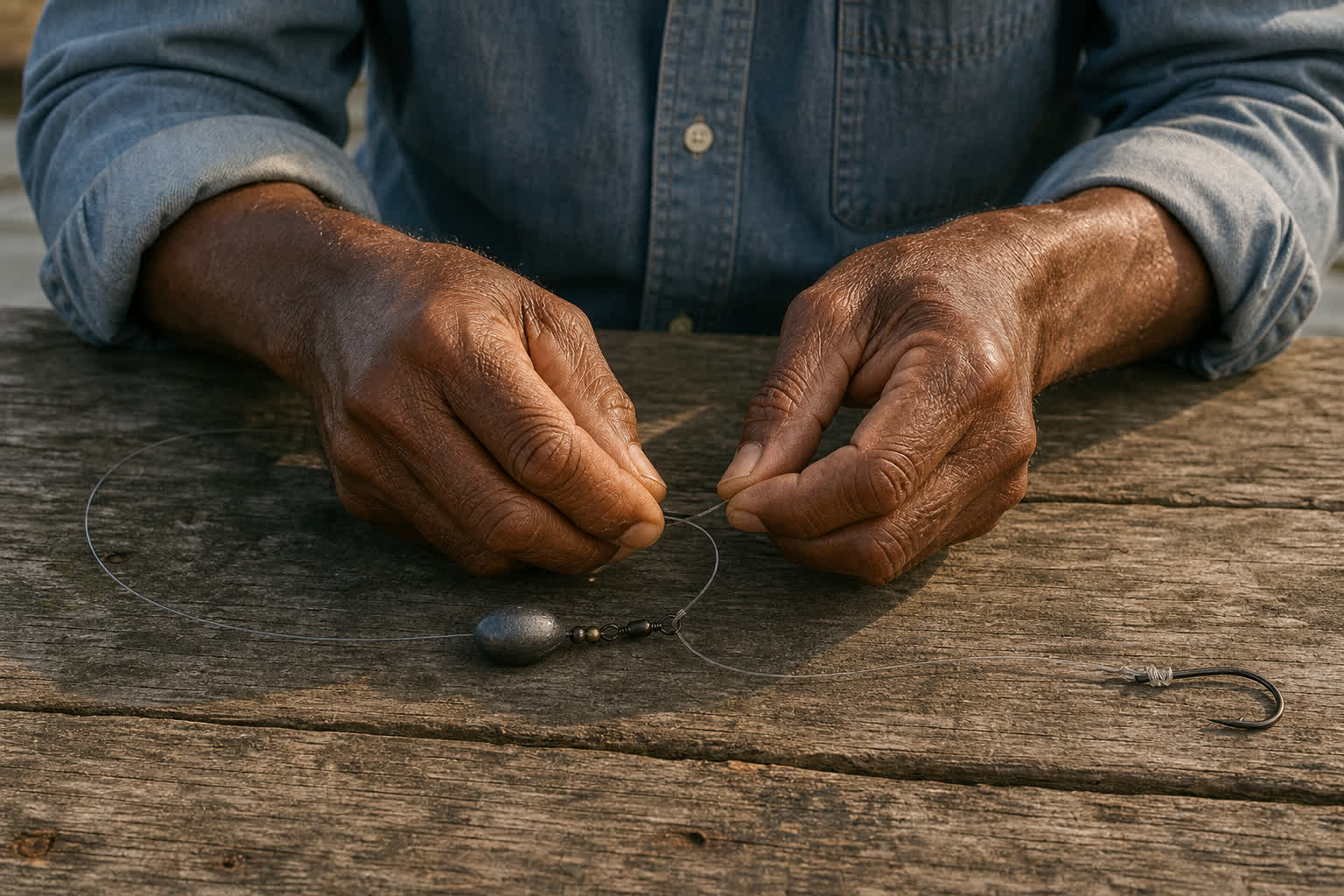
Since the fish feeds on the bottom, your bait belongs on the bottom. The rig for that is about as plain as fishing gets, and I’ll give it to you from the weight up.
Slide a sinker onto your line first — an egg-shaped sliding sinker is the classic, heavy enough to hold your bait still against any current. Below it, tie on a small swivel so the sinker can’t slide down to the hook. Then a foot or so of line off the swivel, and a hook on the end. A hook shaped like a circle is the one I’d hand a beginner, because a channel cat will most often hook his own self on it — you don’t have to snatch, you just tighten up and lift when the line comes tight. The sliding sinker is the trick of the thing: when the cat picks up the bait and moves off, the line slides through that weight and he doesn’t feel the drag, so he takes it with confidence instead of dropping it.
Cast it out to your deep spot or your cover, let it settle to the bottom, and take up the slack until your line is just tight. Then set the rod in a forked stick or a holder, and watch the tip. When a channel cat means it, that rod tip will bounce, then bend, then load up steady. That’s your fish.
Bait: let him smell his supper
A catfish hunts with his nose, so the best baits are the ones that put the most scent in the water. You have good choices, and none of them cost much.
A nightcrawler is the everyman’s bait and it catches everything, catfish included. Cut bait — a chunk of a fresh-caught bluegill or shad — is hard to beat for bigger channel cats, because it bleeds and oils a scent trail right to your hook. Chicken liver is an old reliable, cheap and strong-smelling, though it’s soft and you’ll want to bind it on with a bit of thread or a scrap of mesh so it doesn’t wash off. And there are the prepared stink baits and dip baits made for exactly this — they smell like something died, which is the whole point, and channel cats love them. Fish whichever you can get. The rule underneath all of them is the same: the more a bait smells, the farther off a catfish can find it in the dark.
Handle him with respect, and mind the fins
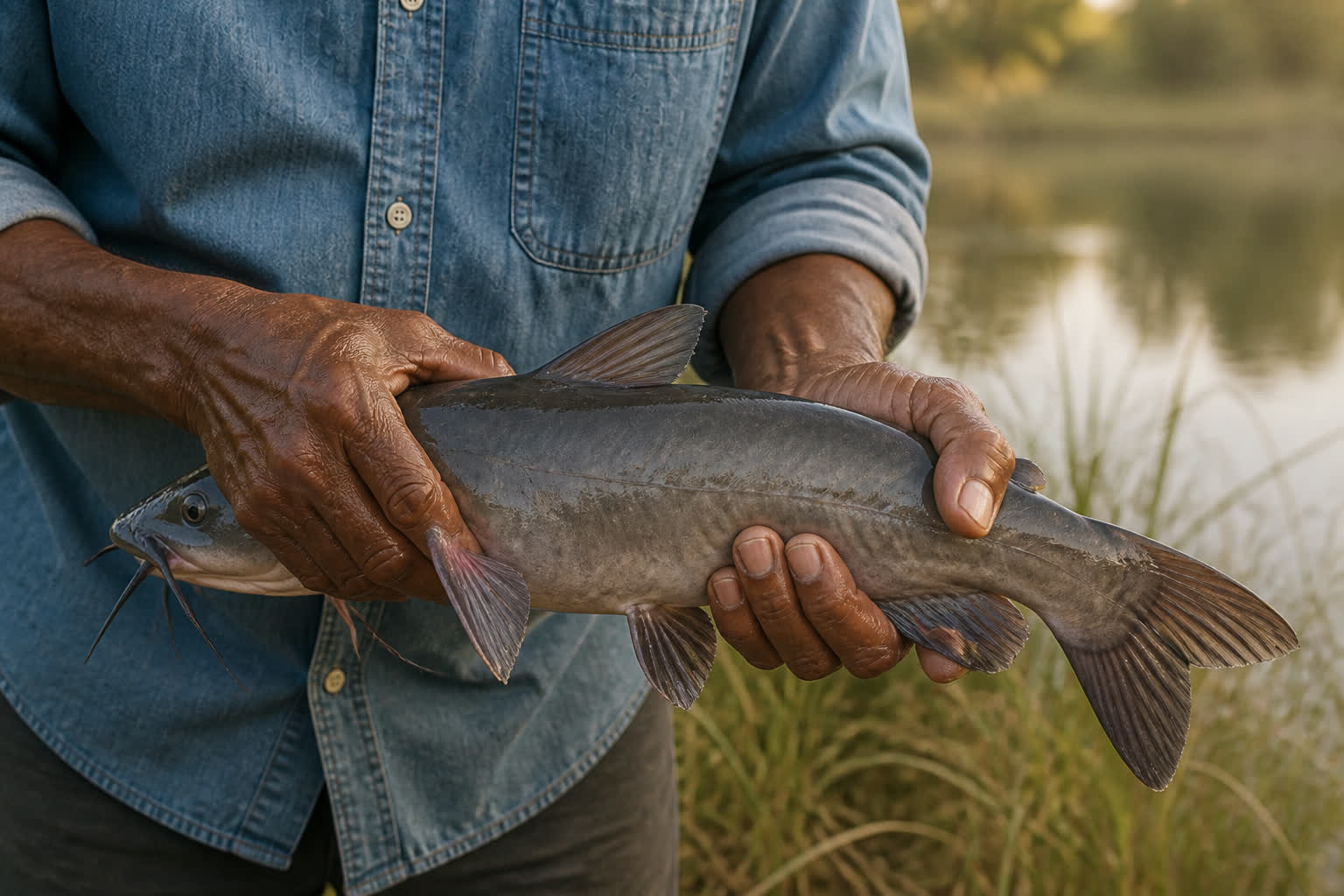
When you land your first channel cat, there’s one thing to know before you grab him, and I tell every new hand and every grandchild the same. A catfish carries a stiff, sharp spine on the leading edge of each side fin and the top fin, and they’ll stick you good if you close your hand over them wrong. It isn’t dangerous, but it hurts and it can get sore.
So don’t grab across the middle. Take him from behind the side fins — slide your hand up from the belly, one finger ahead of a side fin and your thumb behind the other, so those spines are splayed out safe between your fingers, not driving into your palm. A smaller channel cat you can hold easy that way. Do it once with an old hand watching and you’ll have it for life. Handled right, a catfish is no trouble at all, and a whole lot of good eating.
Keep a few, and pass it on
A pond will feed you if you let it, and a mess of channel cats — skinned, and the fillets rolled in seasoned cornmeal and dropped in hot oil — is as fine a supper as this water gives. A pond that’s got too many small cats in it fishes better for keeping some, so don’t feel bad about filling a cooler within your limits.
But the best thing a bank and a catfish rod give you isn’t the fish. It’s the evening, and the company. Some of my clearest memories are of sitting on a bank at dusk with a grandchild, both rods propped on sticks, waiting for a tip to bounce. If you’ve got a young one to bring along, let them keep a record of it — I helped put together a simple journal for just that, My First Catch — A Fishing Journal for Young Anglers, so a child can write down and draw the first fish and the day they caught it.
Time your evenings by the water and the weather, and you’ll catch more with less effort. I keep an almanac of my own pond for it, and I put together a free one you can use for yours — you can pick up the free Best Days to Fish starter kit here, and I walk through the whole method in my post on reading the three signs. Cooler weather changes their habits some, too, and I cover that in fishing a pond in cooler weather.
A bank, a bottom rig, and a little patience. That’s the whole thing. Read the signs, and I’ll see you at the water.
