Poisonous Plant Look-Alikes Every Forager Should Know
The poisonous plant lookalikes that fool Pacific Northwest foragers — hemlock, death camas, foxglove — and the plain habits that keep you from making the wrong call.
Most of what I forage is boring, in the best way. Nettle doesn’t have a twin that will hurt you. Dandelion doesn’t either, nor does the elderflower on the shrub by my gate. But a handful of the plants people most want to gather out here have a look-alike that ranges from “will make you sick” to “will kill you before the drive to the hospital,” and those are the ones worth slowing down for. The safest foragers I know aren’t the ones with the most plants memorized. They’re the ones who know exactly which few pairings can fool them, and treat those with respect.
So this is that short list — the poisonous plant lookalikes I make sure every beginner on my walks can tell apart before they gather anything in that family. If you’re brand new to all of this, start with my beginner’s safe-start guide first; this piece assumes you already know how to work a plant slowly.
The carrot family is the one to fear
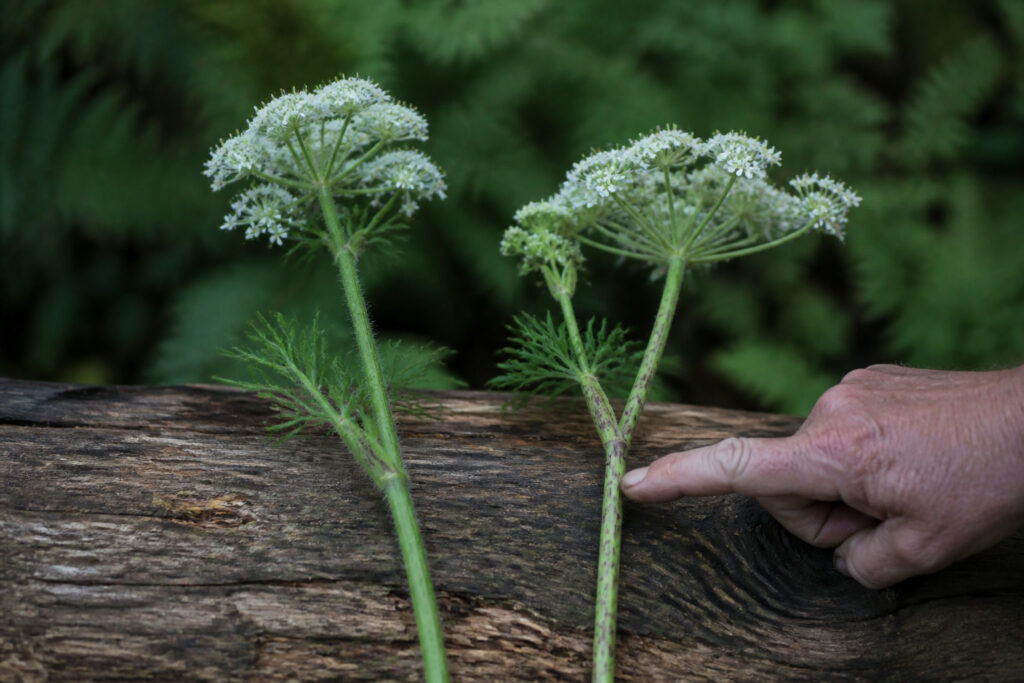
If you learn nothing else here, learn this. The plants that kill foragers in North America, more than any other single group, are in the carrot and parsley family — the Apiaceae, the ones with the little umbrella-shaped flower heads called umbels. Wild carrot, cow parsnip, and Queen Anne’s lace live in that family. So do poison hemlock and water hemlock, and water hemlock is about the most violently toxic plant on this continent.
Here is the honest truth about telling the good ones from the deadly ones: it is genuinely hard, the margin for error is zero, and I do not teach beginners to eat wild members of this family at all. Not because you can’t learn it, but because the cost of one wrong call is your life, and there are a hundred safer plants to practice on first.
If you insist on knowing the tells, know the deadly ones cold rather than the edible ones. Poison hemlock has a smooth, hairless stem, usually blotched or streaked with purple, and it smells rank and mousy when you crush a leaf. Water hemlock grows in wet ground and ditches and has a thick rootstock that’s chambered inside like a series of little rooms. Cow parsnip, the big edible one people go after, is coarse and hairy-stemmed and doesn’t carry those purple blotches. But a hairy stem in dim light, a plant that’s a little atypical, one distracted afternoon — that’s all it takes. I’d rather you walk away from every umbellifer for your first few years than get one wrong once.
Death camas and the wild onion smell test
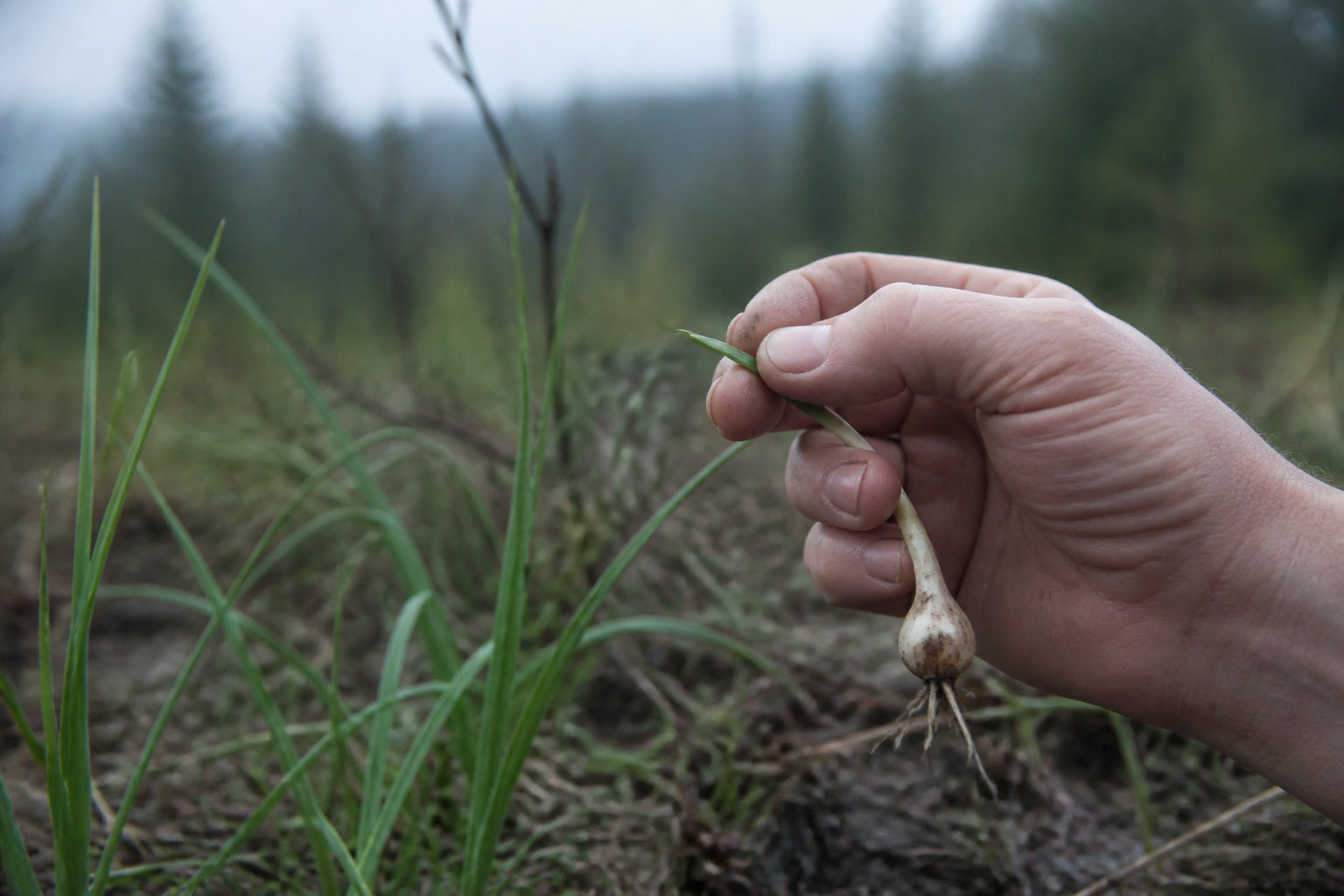
This one has a clean, reliable rule, which is why I love teaching it. In spring and early summer, foragers go looking for wild onions and the edible camas bulb. Growing right alongside them, often in the same meadow, is death camas — and the name is not decoration.
The bulbs look enough alike to fool anyone from the neck down. The tell is the nose. A true wild onion or wild garlic smells like onion or garlic when you crush the leaf or nick the bulb. Death camas does not — it smells green and grassy, like nothing in particular. So the rule I hand people is simple and absolute: if it doesn’t smell like an onion, it is not an onion, and you don’t eat it. No onion smell, no exceptions, put it back. That single habit has kept more people safe than any drawing in any book.
Camas itself (the blue-flowered, edible one long harvested by Coast Salish and other Peoples of this region — a foodway I credit to them and don’t claim as my own) is a harder case, because its dangerous look-alike shares its habitat and the bulbs are near-identical out of flower. That’s why traditional harvesters dug camas in bloom, when the flower color separates the edible blue from the toxic cream-white, and marked their beds. If you can’t tell them apart in flower, you can’t tell them apart at all.
Foxglove hiding in the comfrey and mullein
Not every dangerous look-alike is something you’d eat on purpose. Some slip into a harvest by accident, and foxglove is the one I watch for most out here, because it grows absolutely everywhere on the west side — roadsides, clearings, the edge of my own hoop house.
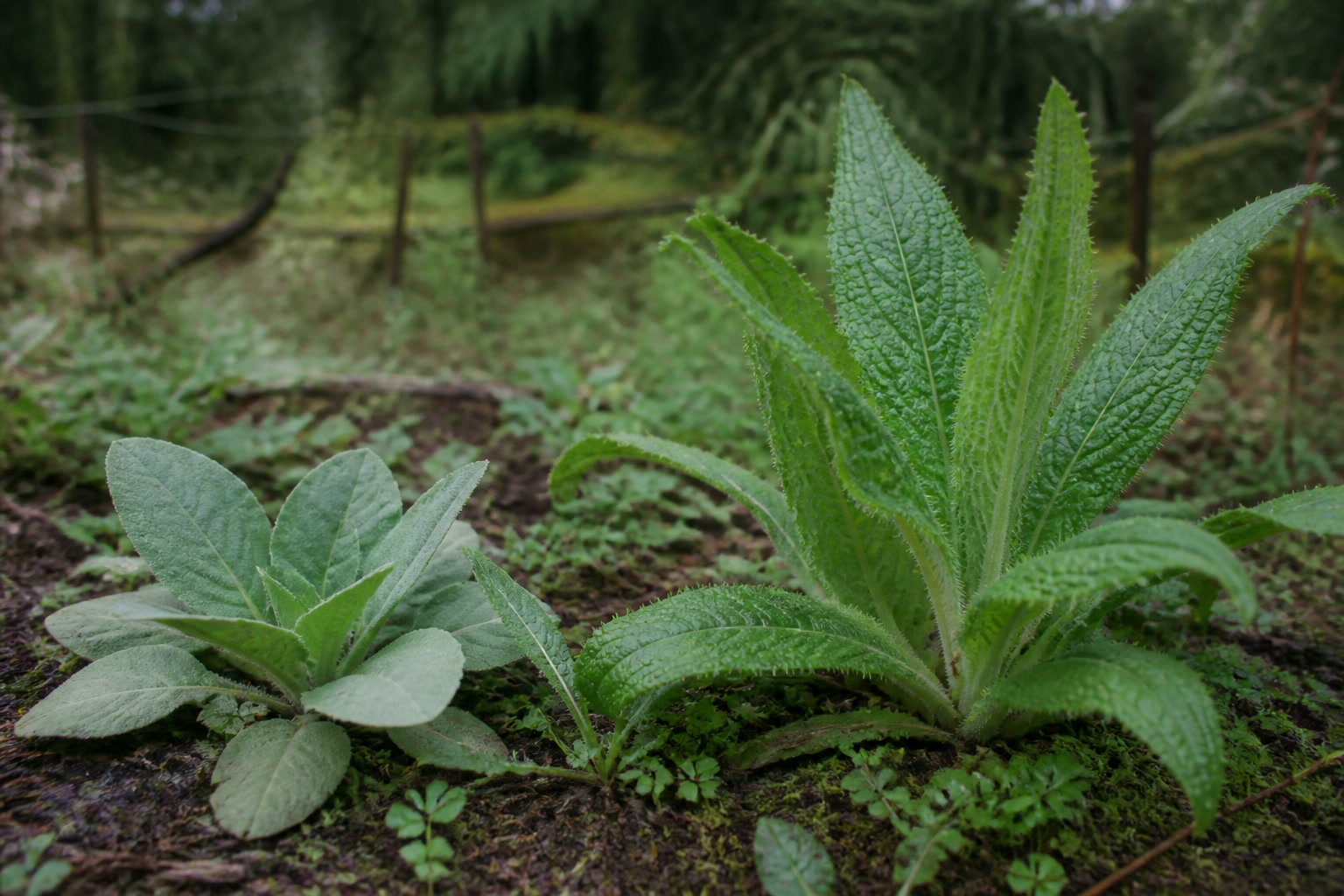
Before it sends up that unmistakable spire of purple bells, foxglove sits as a low rosette of soft, gray-green, fuzzy leaves. And that rosette looks an awful lot like the first-year rosette of comfrey, and a fair bit like young mullein — both plants people gather. Foxglove is a serious heart poison; a few leaves are a real emergency. The tells are subtle: comfrey leaves feel scratchy-bristly and run their veins straight out to the edge, while foxglove leaves are softer, more finely toothed, with a network of veins that quilts the surface into little puckers. Mullein is paler and far more densely woolly, like felt.
I don’t offer those distinctions so you’ll feel confident harvesting a mystery rosette. I offer them so you’ll respect how easily a fuzzy gray-green rosette can be the wrong one. When I’m not certain a rosette is what I think it is, I wait for it to grow up and tell me. A plant in flower rarely lies; a plant in rosette often can.
Blue elder, red elder, and the shape of the cluster
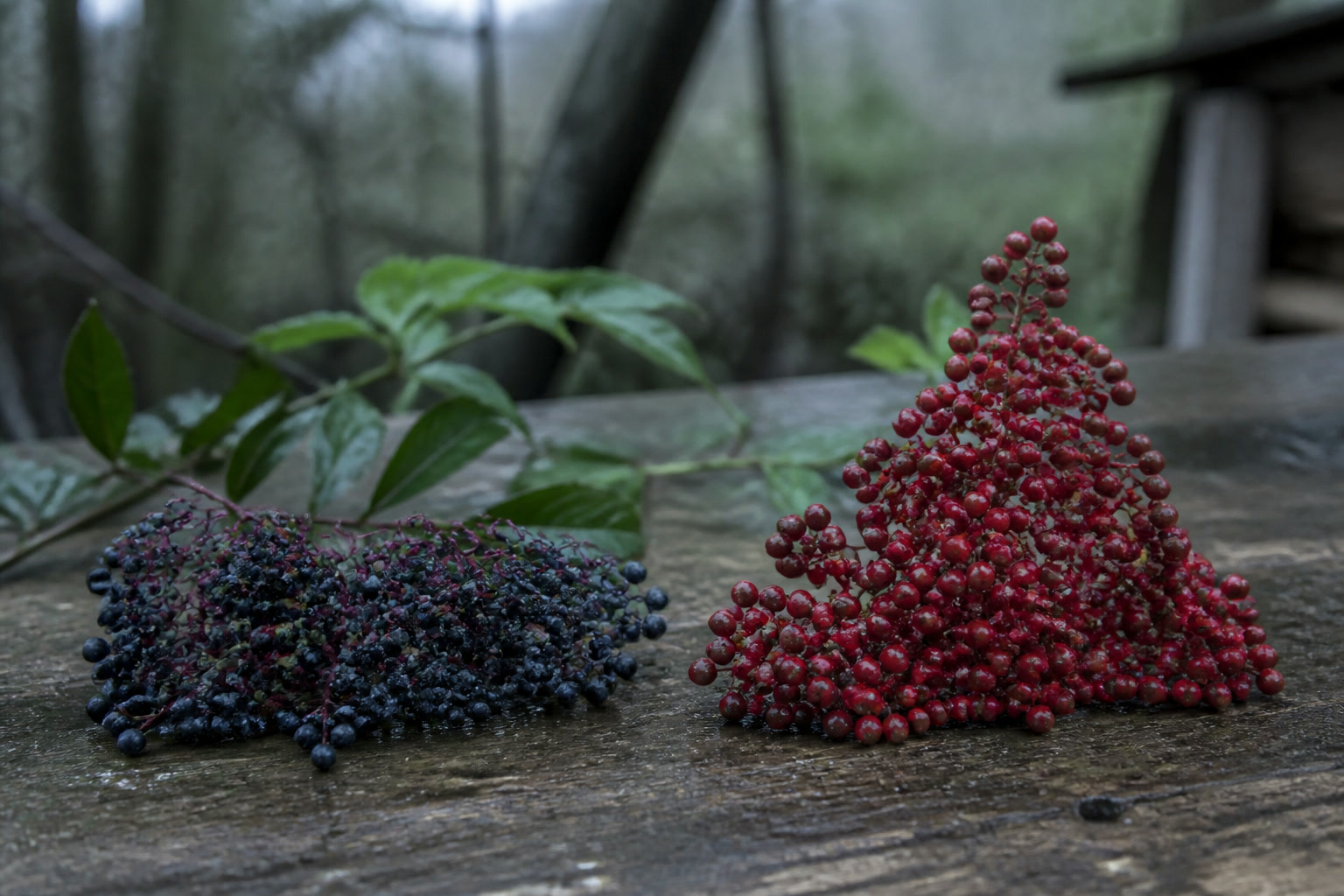
A gentler pairing to end on, because not every mistake is fatal — some just make for a bad night. When you gather elderberry, you want the blue elder, with its flat-topped flower and fruit clusters and dusty-blue berries. Its cousin red elder carries its flowers and bright red berries in a rounded, dome- or cone-shaped cluster, and red elder is the one to leave — its raw berries and the rest of the plant will make you good and sick.
The tell is the silhouette: flat-topped means blue and worth cooking down; rounded and pointed means red, leave it be. And cook your blue elderberries regardless — raw elderberries of any color don’t sit well. I walk through the whole harvest in my elderflower cordial post, where the same flat-cluster rule tells you which shrub to pick from in the first place.
The habit is worth more than the list
Here’s the thing I most want you to take from this. A list of look-alikes is useful, but it will never be complete, and the woods don’t care what you memorized. What keeps you safe is the habit — identify by positive traits, not by ruling things out; confirm every new plant against more than one reputable source and, better, an experienced local before it goes anywhere near your mouth; and when there’s any real doubt at all, throw it out. I said the onion rule was absolute. So is that one.
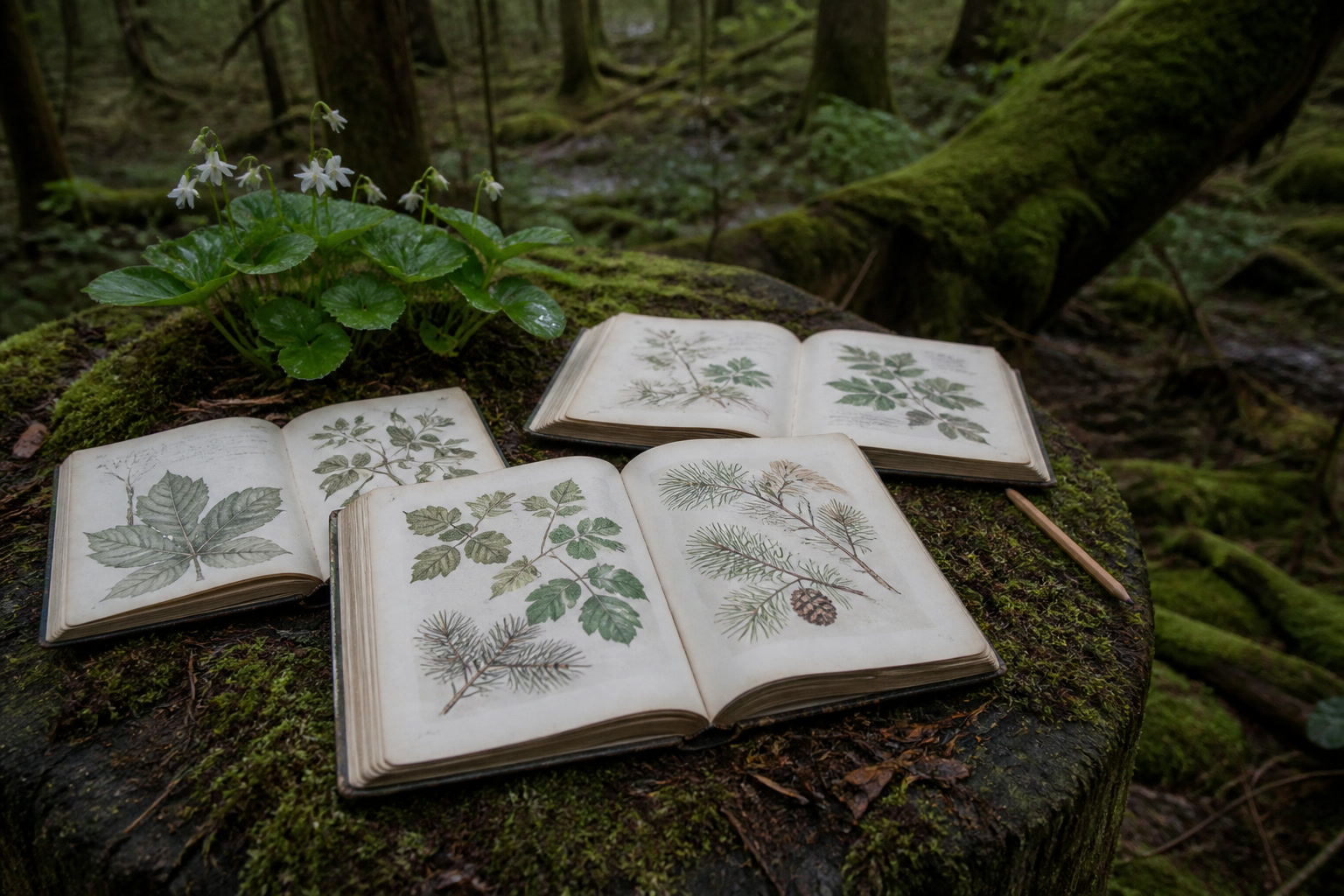
Build the habit on the easy, unmistakable plants first — the stinging nettle and dandelion that have no deadly twin — so that by the time you’re near anything that does, careful identification is just how you move through the woods. A good field guide or three, read against the living plant, is how you cross-check yourself.
Every plant I put in Pacific Northwest Medicinal Plants is written the way I’d teach it on a walk — what it is, what grows near it that you’d want to be sure you’re not holding, and how to tell them apart in each season. The look-alikes are the whole reason the book spends as much ink on what not to pick as on what to gather. Learn it before you need it.
