How to Catch Bluegill for Beginners, From the Bank
How to catch bluegill for beginners — where to find them, the simple rig that works, and how to teach a child — from an old hand who fishes his own pond.
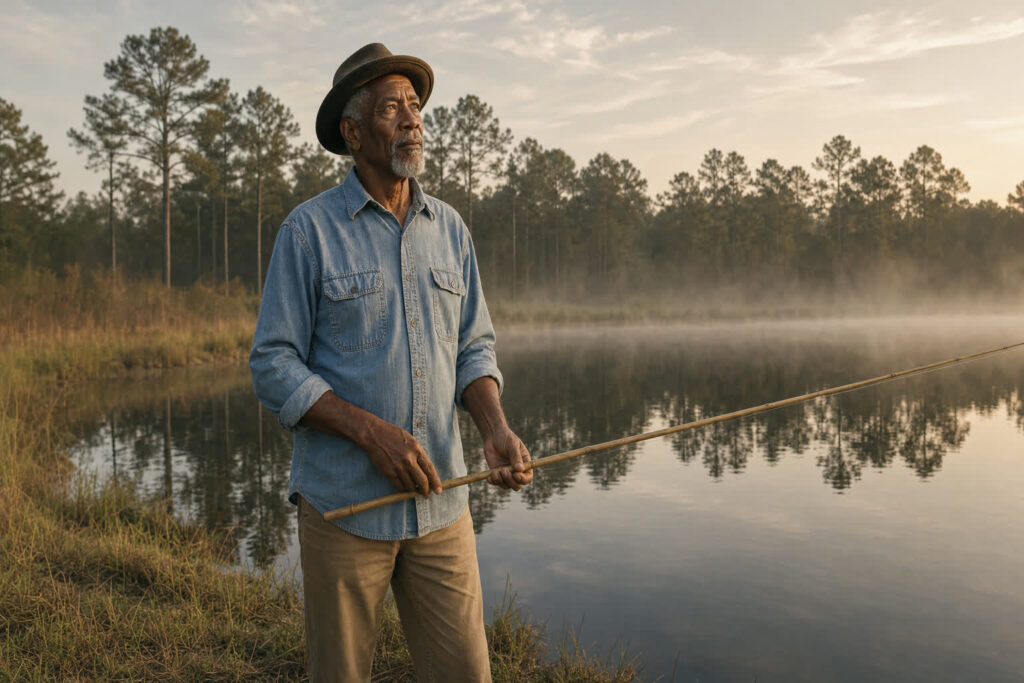
If you are new to fishing and you want to catch something today, catch a bluegill. There is not a more willing fish in fresh water, and there is not a better one to learn on. I have caught them my whole life off the bank of my own pond here in eastern North Carolina, and I taught my grandson Isaiah on them, the same as my granddaddy taught me. A bluegill will forgive a beginner’s mistakes. That is a rare and generous thing in a fish.
Folks around here call them bream, and you’ll catch a few of their cousins by the same methods — shellcracker, warmouth, the sunfish family. It doesn’t matter much what you call them. What matters is that they gather thick in nearly every pond and lake in the country, they bite in daylight when you can see what you’re doing, and a mess of them fried up is as fine a supper as this water gives. Let me walk you through it plain.
Where the bluegill are — find the shade and the cover
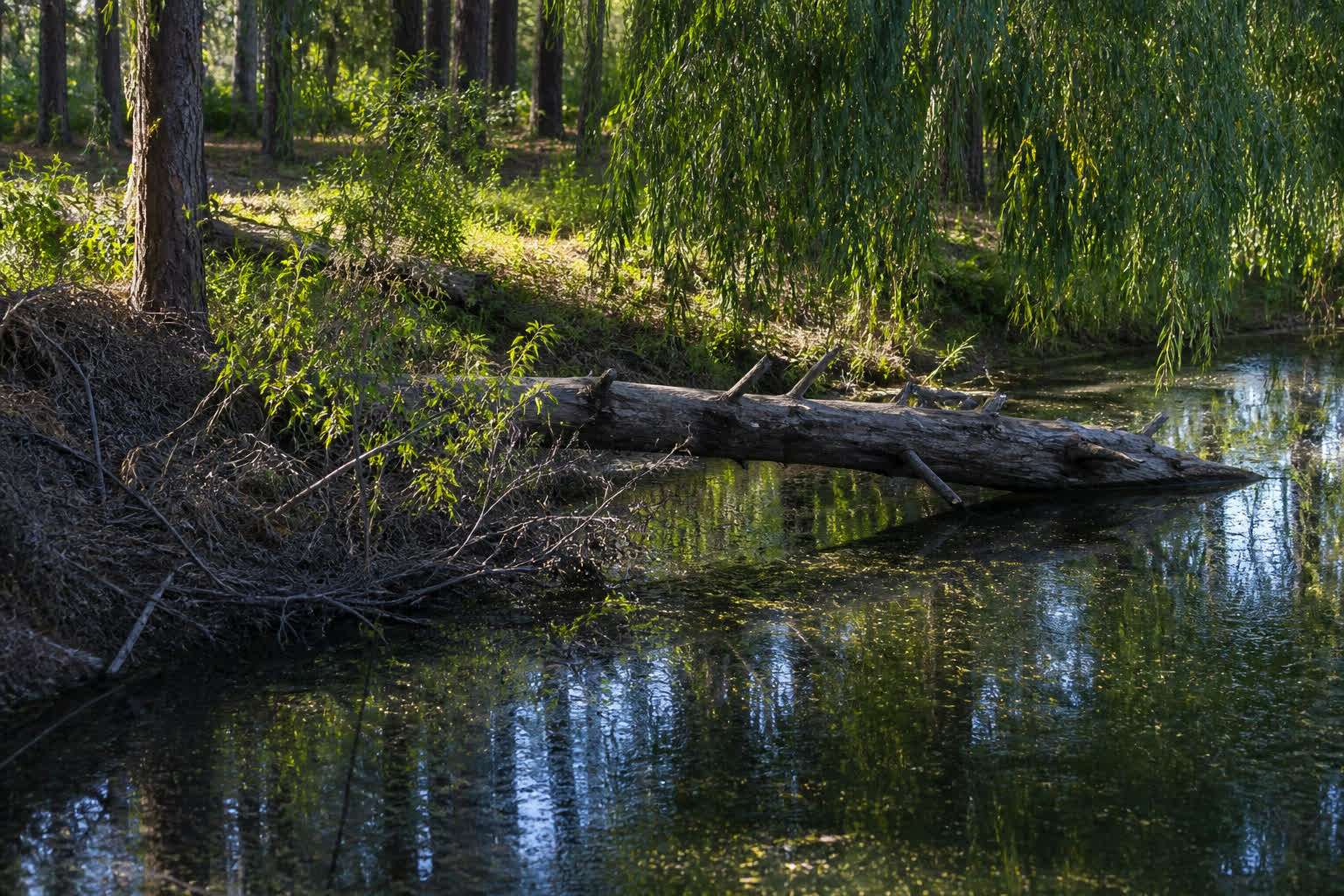
The first thing to learn is that bluegill don’t scatter all over a pond. They hold tight to cover, in the shade, near the edges. So you don’t fish the open water — you fish the structure.
Look for a dock, a laydown log, a stand of cattails, a brush pile, the far bank where the willows lean out over the water. Anywhere the sun is broken and there’s something for a small fish to hide against, that’s where they’ll be. In the warm months they’ll sit in that shade through the bright middle of the day and move up shallow to feed in the low light of morning and evening.
There’s one time of year they make it even easier on you. In late spring, when the water warms up around sixty-five to seventy degrees, the bluegill move into the shallows to spawn. They fan out round beds in the sandy bottom, close to the bank, and they get bold and territorial. Find a colony of those beds in a foot or two of water and you have found the finest, easiest bluegill fishing of the whole year. That’s when I put a child on them.
The rig is about as simple as fishing gets
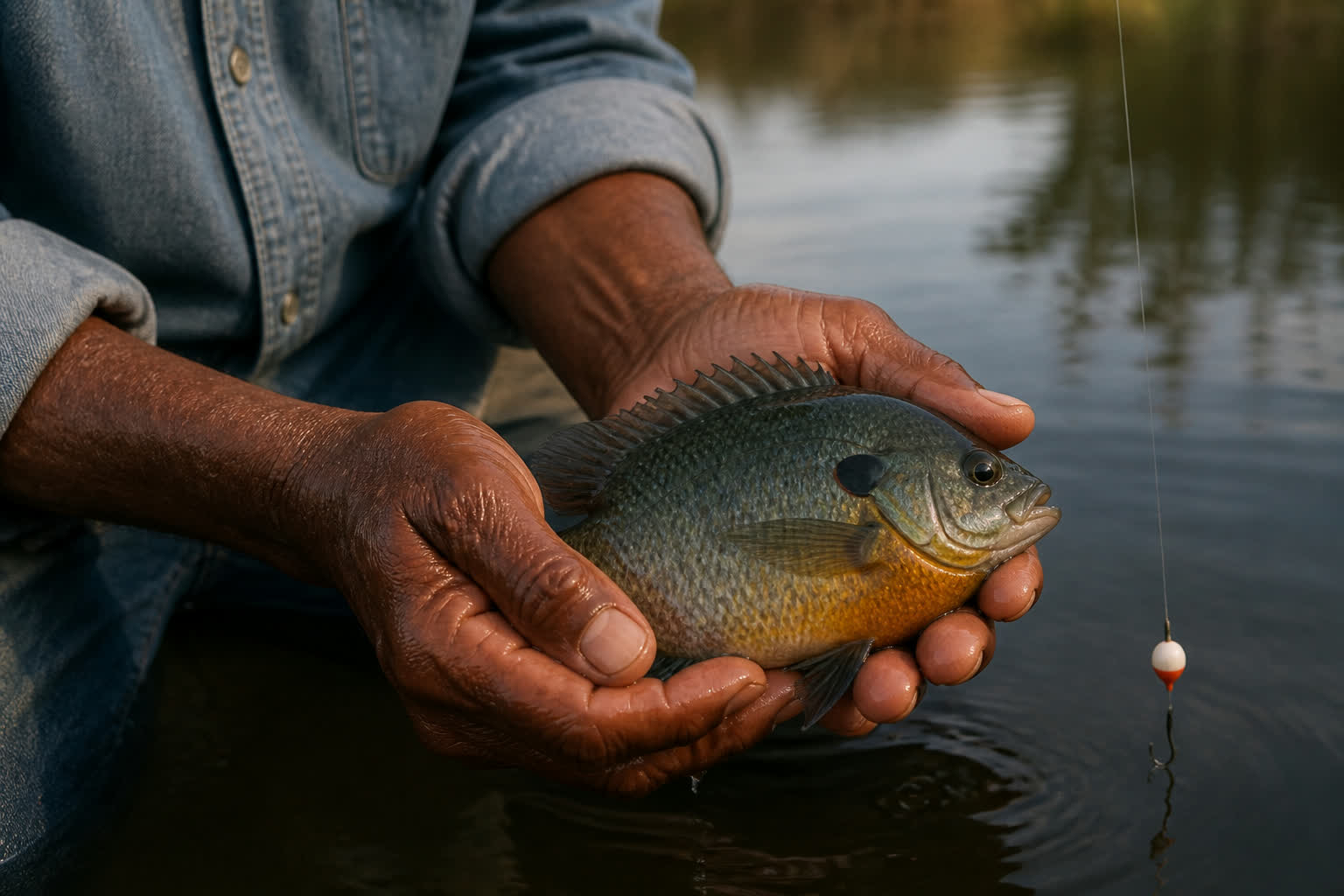
You do not need much, and you do not need anything fancy. I have caught a lifetime of bream on a cane pole, and a cane pole is still the honest way to teach a child, because there’s no reel to backlash and nothing to think about but the bobber. A simple spincast combo — the push-button kind — does the same job with a little more reach.
Here’s the whole rig, from the top down. A small bobber. A foot to a foot and a half of line below it, a little split-shot weight to carry the bait down, and a small hook on the end — a size 6 to a size 10, because a bluegill has a small mouth and a big hook just gets stolen from. For bait, nothing beats a live cricket or a red worm. A piece of nightcrawler works fine too. Thread it on so the point stays hidden, and you’re fishing.
Set the bobber so the bait rides about a foot under the surface, up in that zone where the bluegill are cruising. Then swing it in gentle beside the cover — not on top of it, beside it — and watch.
When the bobber goes under, don’t snatch
This is the one thing new folks get wrong, and it’s the one thing I’ll ask you to remember. When that bobber twitches and dips and finally slides under, the whole body wants to yank the pole back hard. Don’t.
A bluegill takes a bait in little pulls before he commits. If you snatch on the first twitch, you pull it right out of his mouth. So let the bobber go all the way under and stay under a beat — let him take it — and then just lift, a smooth firm lift, no violence in it. The fish will be there. My grandkids learned that rhythm in an afternoon: watch, wait, lift. Ruby’s only eight and she’s got it now, and she’ll out-fish me on a good bed if I’m not paying attention.
Read the signs, and go at the right hour
The same signs I read for every fish hold for bluegill, and they’re worth knowing. The water wants to be past sixty degrees before they feed with any real interest — below that they go sluggish. And like most warm-water fish, they feed best in low light: that first hour after sunup and the last hour before dark, when the sun’s off the shallows and they come up to eat where you can reach them. The middle of a bright day, they’ll ease back into the shade and wait.
So you stack it the way my granddaddy taught me: warm water, low light, and your bait beside good cover. Get those three lined up and you won’t be standing there wondering if there are any fish in the pond. You’ll be busy. I keep a little almanac of my own pond for exactly this, and I put together a free one you can use for yours — it marks the best days by the moon with a plain checklist for the water and the weather. You can read the whole method in my post on reading the three signs, and pick up the free Best Days to Fish starter kit here.
Keep a few, and teach a child while you’re at it
A pond full of bluegill can stand to have some kept — in fact a lot of ponds fish better for it, because bluegill will overpopulate and stunt if nobody thins them. A mess of hand-sized bream, cleaned simple and fried in cornmeal, is what my church put on the table at the Friday fish fry for longer than some of the congregation has been alive. Audra still runs that kitchen.
But the best thing a bluegill gives you isn’t supper. It’s the chance to put a rod in a child’s hands and hand down something that lasts. If you’ve got a young one coming along, let them keep a record of it — the first fish, the pond, the day. I helped make a simple journal for exactly that, My First Catch — A Fishing Journal for Young Anglers, so a child can write down and draw what they caught and carry the memory of it. A bluegill and a cane pole is how most of us started. It’s still the best way there is.
Read the signs. Tight lines — and I’ll see you at the water.
