How to Forage and Use Oregon Grape (Root and Berry)
Oregon grape is one of the easiest PNW medicinals to learn. Here's how to forage Oregon grape, harvest the yellow root in fall, and use the tart berries.
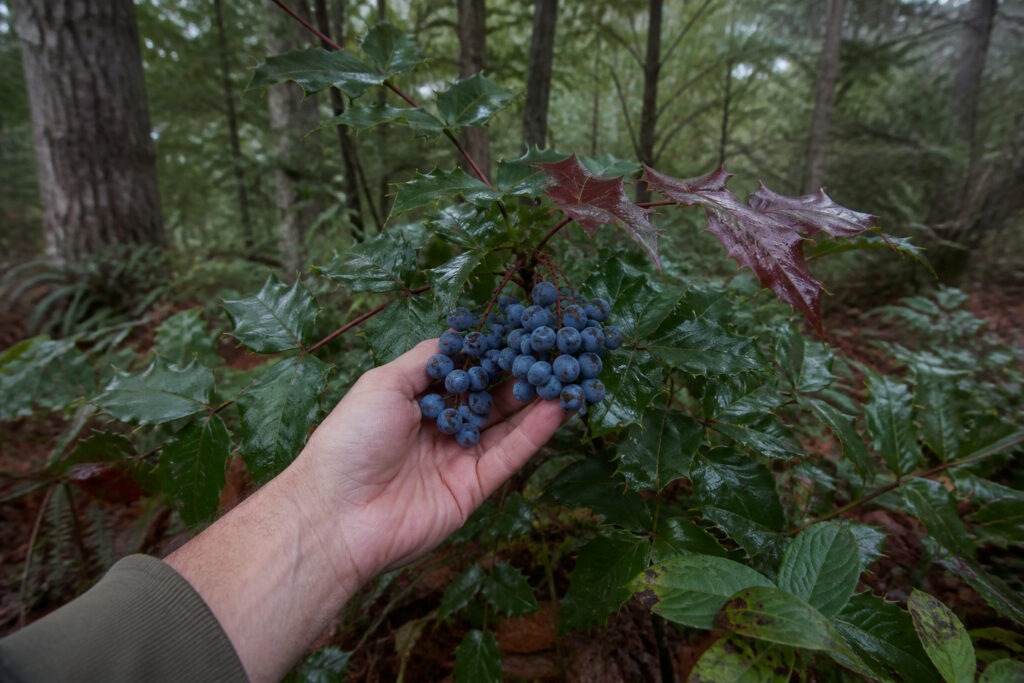
If you have driven a forest-service road anywhere west of the Cascades, you have passed Oregon grape a hundred times without knowing it. It’s the low, holly-leaved evergreen that lines the dry cuts and the edges of the Douglas-fir woods, glossy in every season, with clusters of dusty-blue berries in late summer and a root that is the most startling yellow you will ever cut into. Mahonia aquifolium — you’ll also see it written Berberis aquifolium, the two names have been arguing with each other for a century — is the Oregon state flower, and one of the first plants I put in a beginner’s hands. It doesn’t hide, it doesn’t have a deadly look-alike waiting to fool you, and it has been used on this coast for longer than any of us have been writing things down.
I dig a little of the root most falls, and I pick the berries most Augusts, and I’ve been doing both on the dry slope behind my place outside Sequim for the better part of thirty years. Here is how I’d walk a neighbor through it, start to finish.
One thing I can’t hand you a link for yet: a set of wide-mouth glass jars for drying and storing the cut root, and for a tincture if you go that way. Any clean quart jar from the pantry will do the job — I just won’t point you at a listing I haven’t stood behind myself.
Learn to know it cold before you cut anything
Oregon grape is easy, but easy is not the same as skip-the-work. Look for a low woody shrub, usually knee to waist high, with stiff evergreen leaves made of five to nine leaflets, each one edged in small spines like a holly leaf. New growth comes in bronze-red; older leaves often flush deep burgundy in cold weather, which is one of the prettiest things in a January woods. In spring it carries bright yellow flower clusters; by late summer those become the drooping bunches of blue berries with a pale waxy bloom on them, like tiny wild grapes.
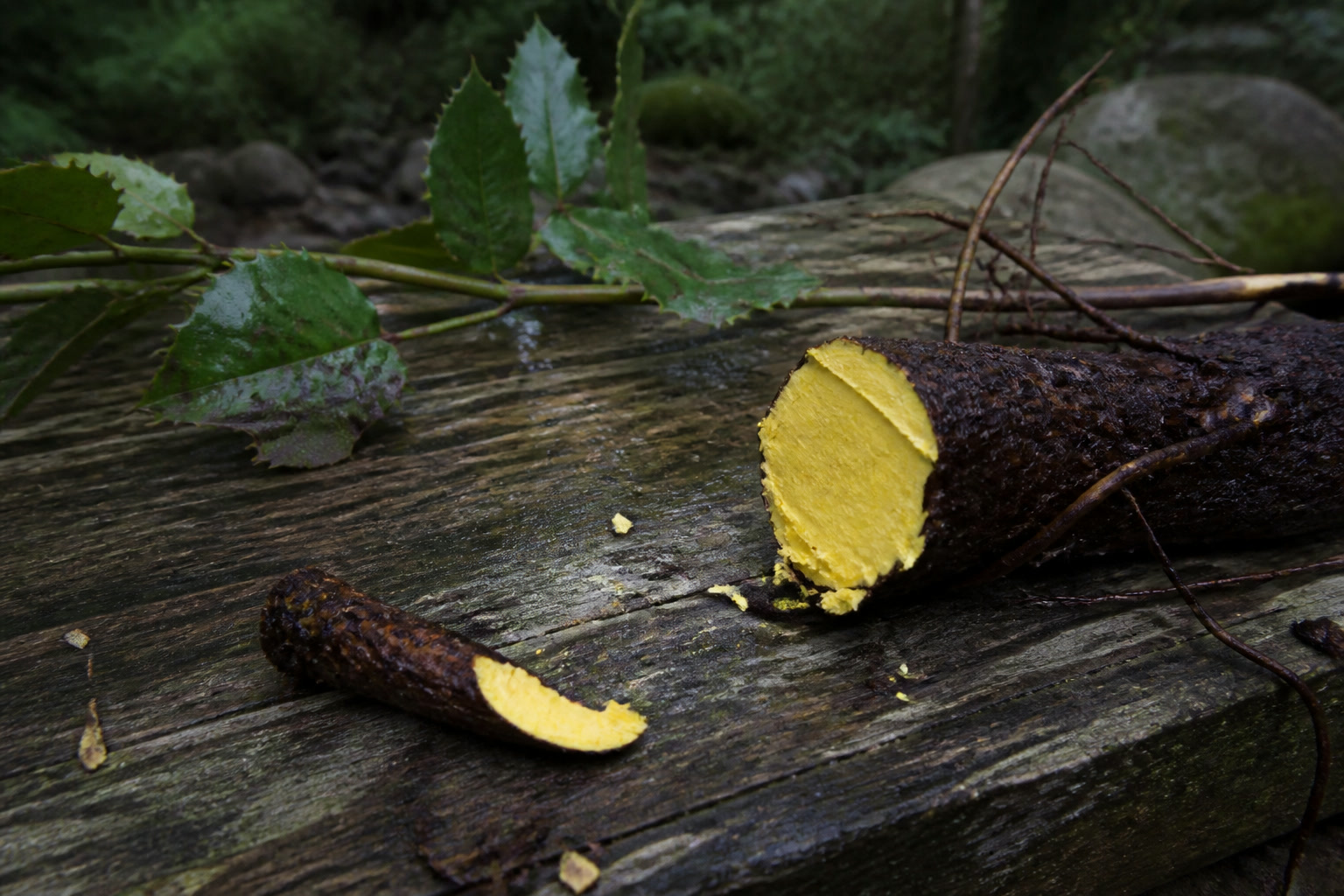
The tell that settles it — and the reason the plant is worth knowing — is the wood. Scratch the bark off a root or a lower stem and the inside is a shocking, luminous yellow. Almost nothing else in these woods does that. That yellow is berberine, the compound the plant is known for.
Say this part with me, once, plainly, the way I say it about every wild plant: never eat or prepare any wild plant on the strength of one book, one app, or one article — this one included. Confirm it against more than one reputable guide and, better, an experienced local forager, and when there is any real doubt, leave it alone. Oregon grape is forgiving to learn. The habit of confirming is what you’re really building.
The berries: tart, seedy, and honestly worth it
The berries ripen a deep blue in August and into September, and they are sour. Bracingly so, straight off the stem — more than one person has taken my word that they’re edible, tried one raw, and given me a look. But they are genuinely good cooked. High in pectin and tart as a wild currant, they make a clear, garnet-colored jelly, and mixed half-and-half with something sweeter like blackberry they round out beautifully.
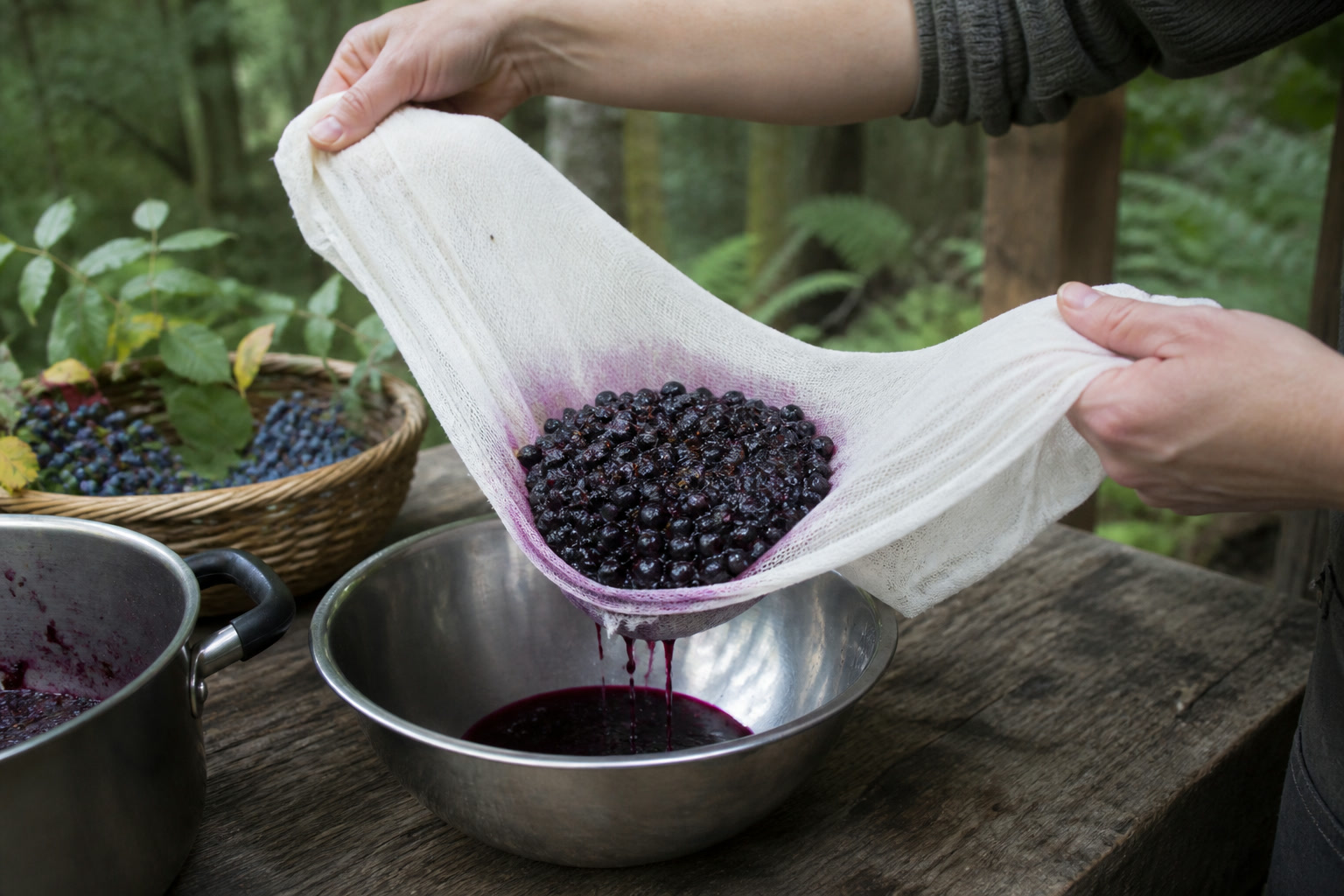
Pick whole clusters when the bloom is still on them, strip the berries at home, and simmer them soft with a little water. Then strain the pulp through a doubled layer of cheesecloth to catch the many hard seeds — that’s the only fussy part — and you’ve got a juice to jelly or freeze. Leave plenty on the shrub; the birds and the bears count on them too, and a patch you strip bare is a patch that resents you next year.
The root: dig in fall, and dig lightly
The root is the part the old herbals prize, and fall is the season for it, once the plant has pulled its energy down for the winter. Here is where restraint matters more than technique. Oregon grape spreads by underground runners, so rather than uprooting a whole plant, follow a runner out from an established stand and cut a section of the smaller lateral roots, then firm the soil back over. Take a little from here and a little from there. A stand I’ve harvested this way for twenty years is still thick and healthy, because I’ve never once been greedy with it.
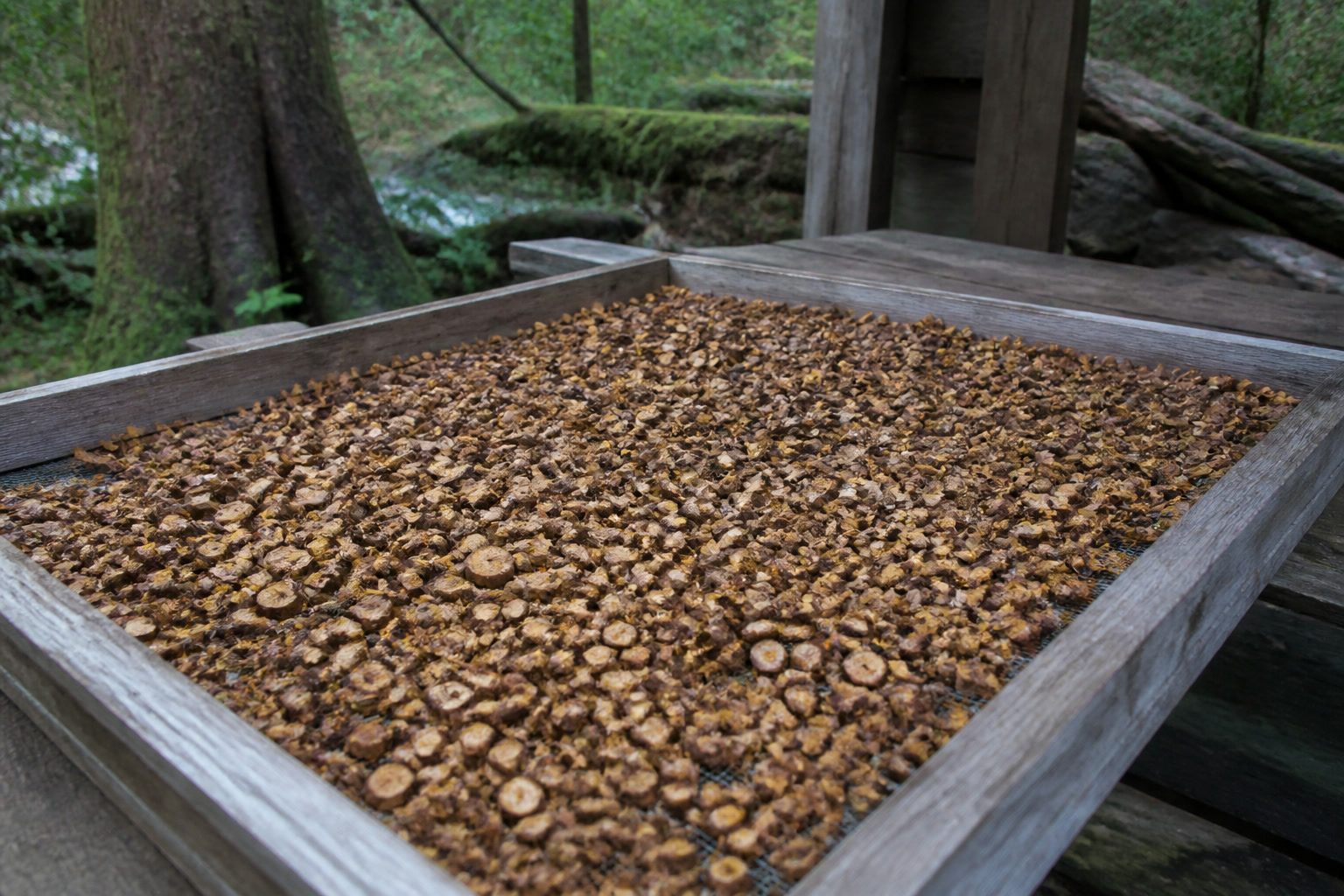
Wash the roots, and while they’re still fresh, split or chop them — dried Oregon grape root is about as cooperative as a piece of rebar, so cut it small before it hardens. Spread the pieces on a screen somewhere dry and airy, out of direct sun, until they snap rather than bend. Stored in a clean jar out of the light, well-dried root keeps its character and its yellow for a year or more.
Two traditional preparations, framed honestly
I’ll tell you how the root has traditionally been used, and I’ll be careful about how I say it, because that matters. This is folk and traditional-use information — how the generations before us prepared this plant — not medical advice, and nothing here treats or cures anything. For anything serious, see a qualified practitioner. Berberine-rich plants like this one were also traditionally avoided during pregnancy, so that’s a line I’d simply respect and not test.
A bitter root decoction or tincture. The classic use of the dried root is as a bitter. Simmered gently in water for twenty minutes and strained through cheesecloth, it makes a strikingly yellow, genuinely bitter tea that was taken in small amounts as a digestive bitter before a meal. Some prefer to tincture the chopped root in high-proof spirits in a covered jar for a month, shaking it when they pass, then strain — a bitters you keep in a dropper bottle. Bitter is the honest word for it. That bitterness is the point.
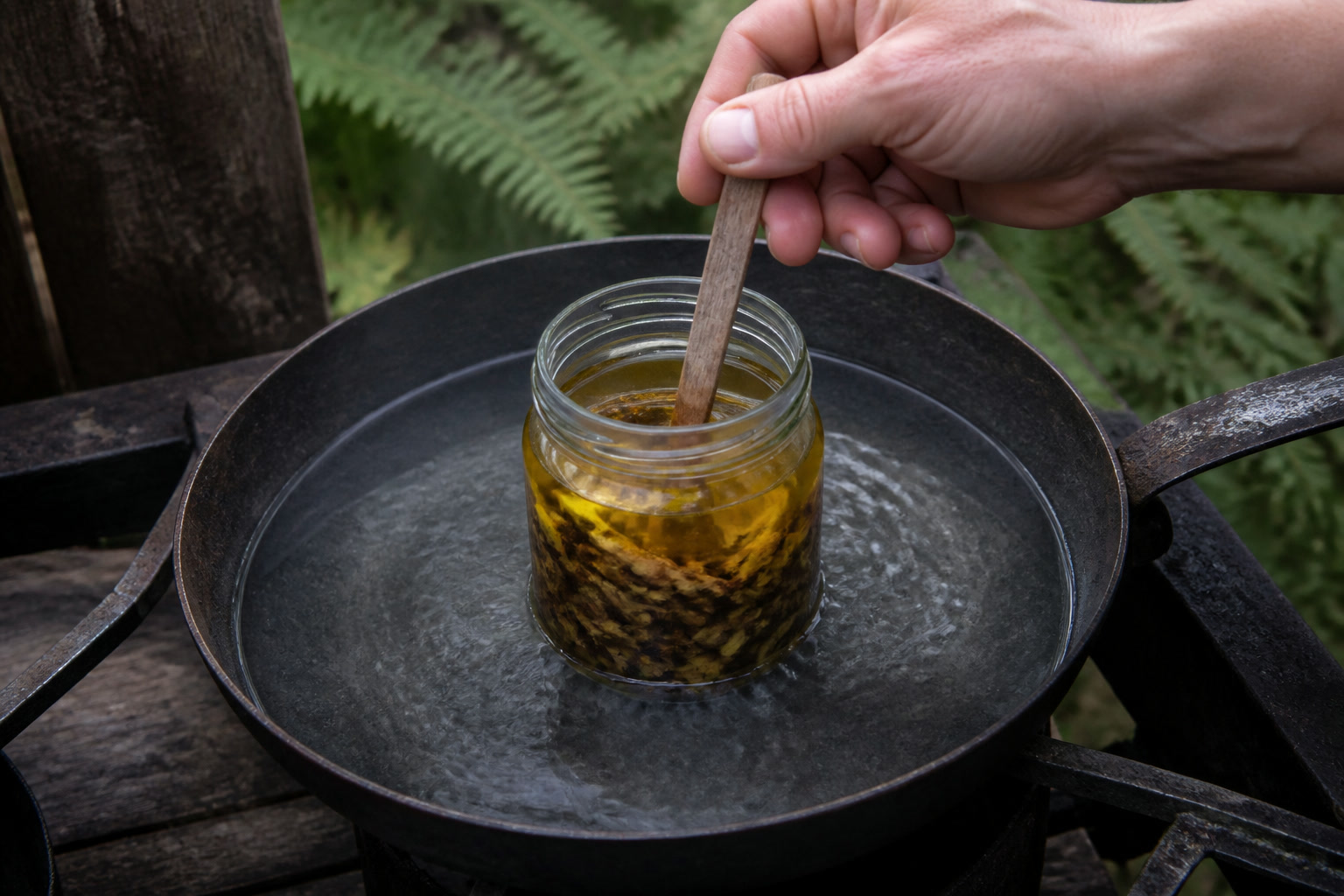
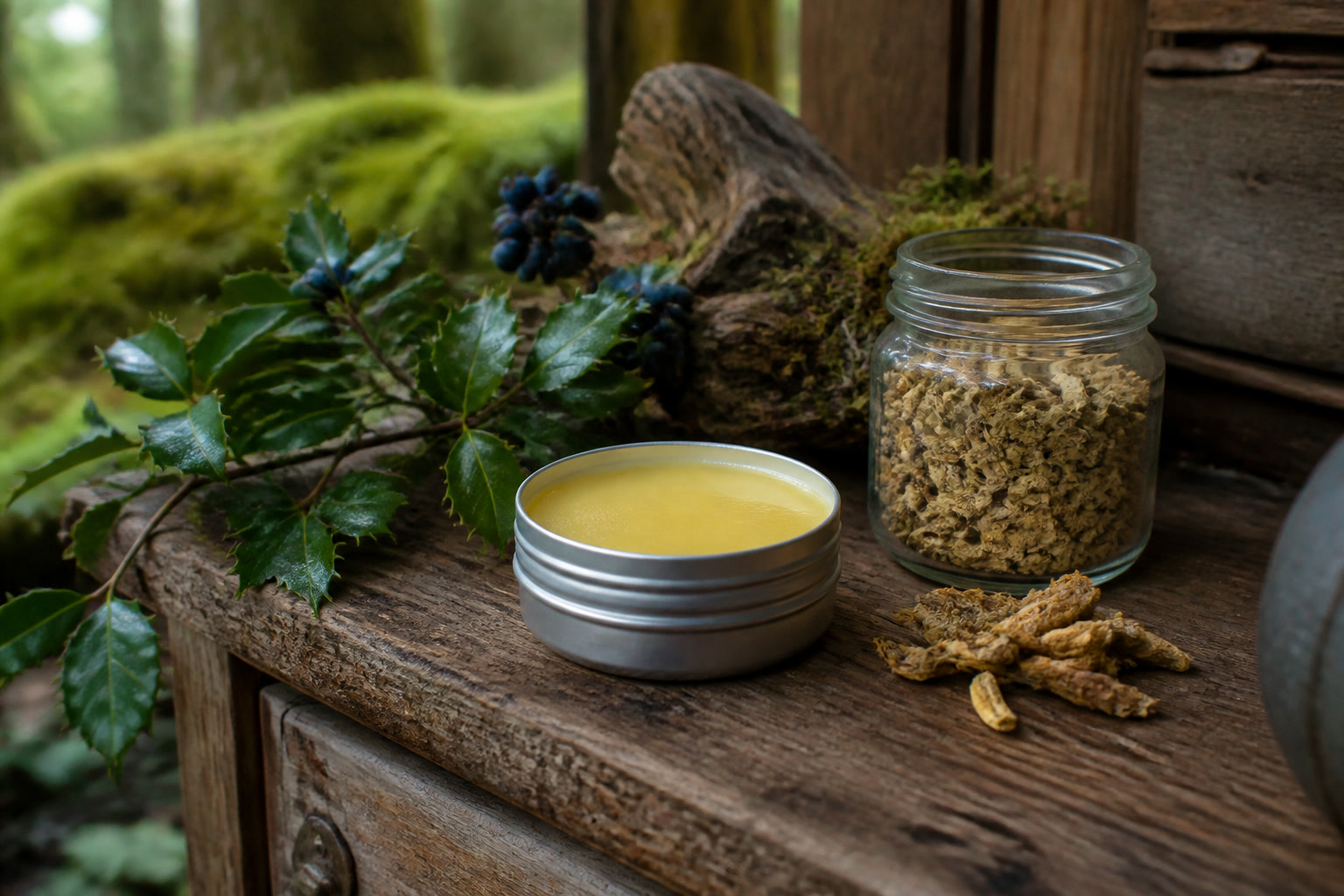
A root-infused skin oil and salve. The root was also traditionally infused into oil and made into a salve used on the skin. To make it, cover the chopped dried root with jojoba oil in a jar set in a pan of barely-simmering water and let it warm, low and slow, for a couple of hours until the oil takes on a faint gold. Strain it through cheesecloth, warm it again, and stir in beeswax pellets — roughly one part wax to four parts oil — until they melt clear, then pour into small tins to set. Label each with the plant and the date. A salve made from well-dried root and clean oil holds for a year kept cool and dark.
Where the plant ends and the knowing begins
The making is the easy afternoon. Knowing this plant apart from its neighbors in every season, knowing when to gather each part and how much to leave, knowing the plants nearby that you’d want to be sure you’re not holding — that’s the longer study, and it’s the part I care most about.
Most of what I know about Oregon grape and the hundred-odd other wild herbs of this coast is in my book, Pacific Northwest Medicinal Plants — how to identify each one without guessing, when to gather it, and how the people before us prepared it. The root and the berries are the easy start. The book is how you learn the rest of the woods they grow in.
