How to Forage Rose Hips (and Turn Them Into Syrup)
How to forage rose hips on the Olympic Peninsula — when to gather, the wild roses to look for, the seed-hair rule nobody warns you about, and how I make syrup.
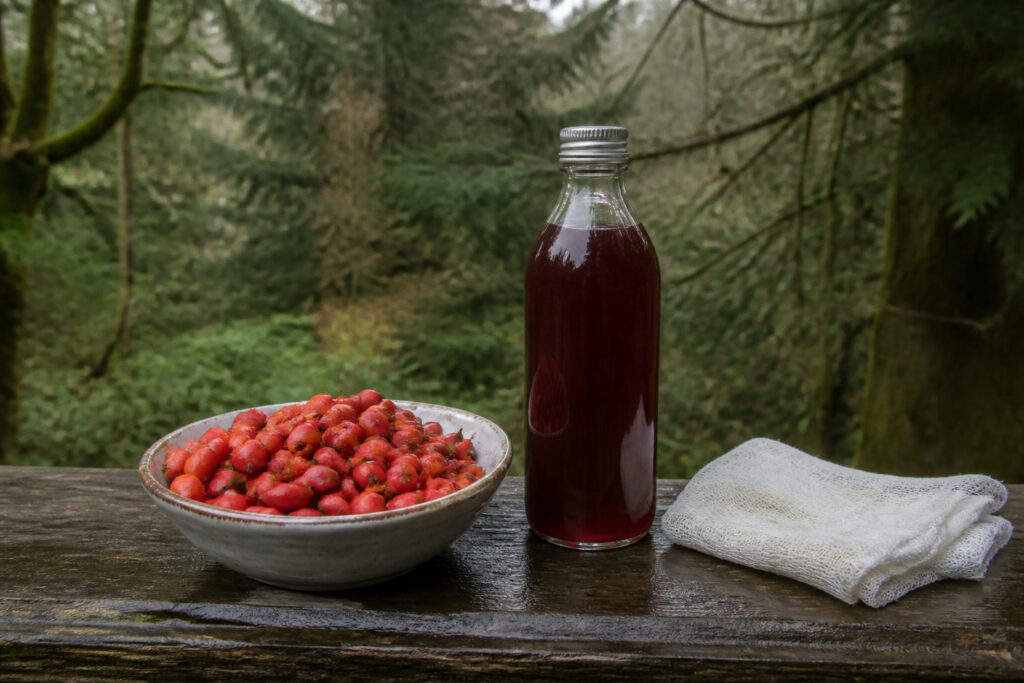
The roses on this coast do their best work after everyone has stopped looking at them. The flowers are a June thing — pink, faintly sweet, gone in a couple of weeks. What I actually wait for is October, when the petals are long dropped and the hips have swelled up red-orange along the canes at the edge of the field. A rose hip is just the fruit of the rose, the round seed-case left behind after the bloom, and along the lower Dungeness they hang on the wild roses well into the first frosts. I’ve gathered them off the same hedgerow every fall for longer than I can remember.
Rose hips are one of the easiest wild fruits to bring home, and one of the few I’ll tell a brand-new forager to start with. They’re hard to mistake for anything dangerous, they grow within reach on a shrub you already know, and they turn into a syrup that tastes like tart summer put by for winter. There’s exactly one handling rule that catches people, and I’ll get to it before you get anywhere near a pot. First, know your rose and know your timing.
You’ll also want clean bottles or jars for the finished syrup. I don’t have a specific listing I’d stand behind to point you to for those yet, so use well-washed swing-top or screw-cap bottles you already have — a couple of clean juice bottles do the job.
Know which rose you’re picking
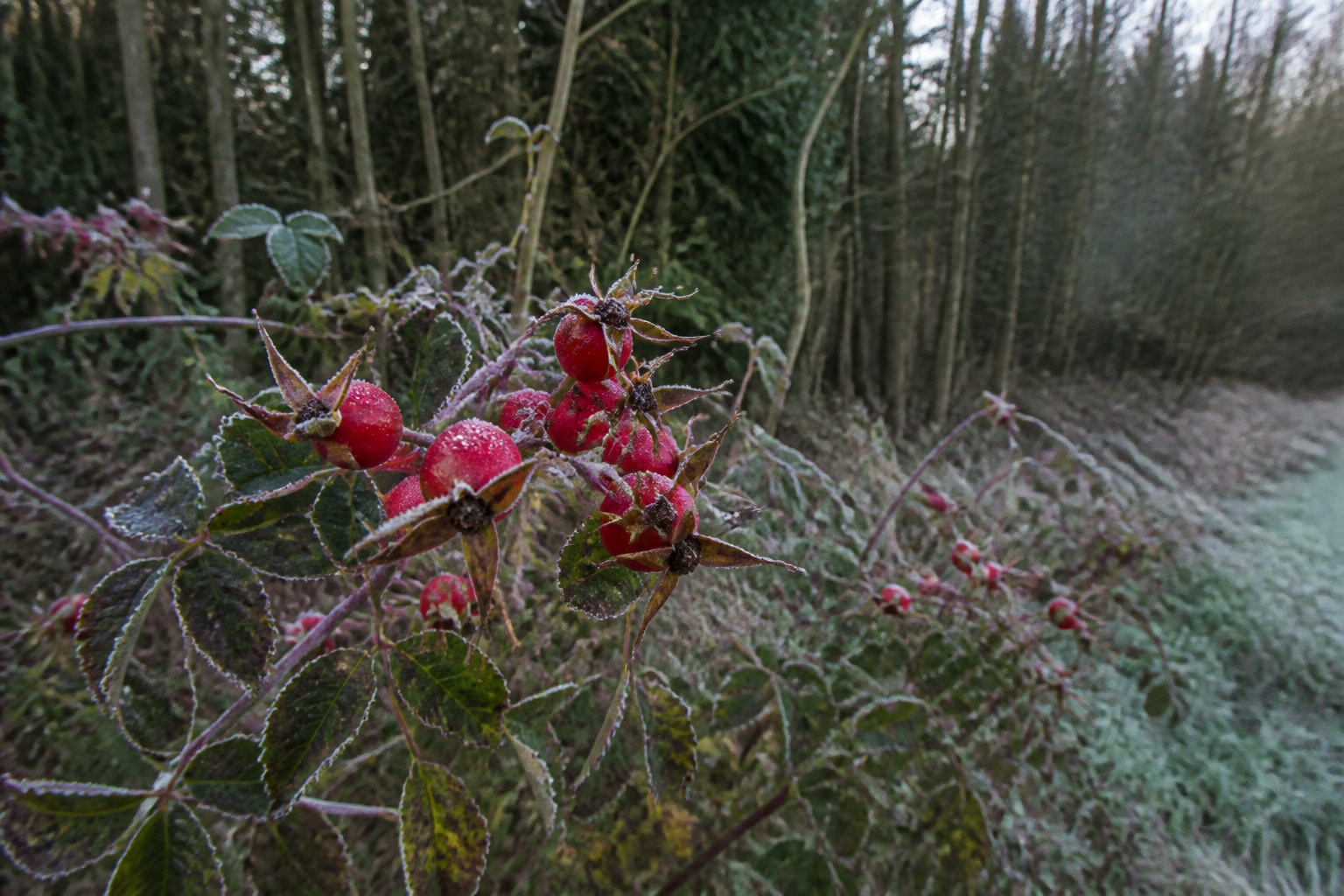
Any true rose gives you an edible hip, so this is a forgiving one. On the Olympic Peninsula the two I gather most are our native Nootka rose (Rosa nutkana), with big single pink flowers and fat round hips, and the naturalized dog rose and clustered wild multiflora types that ramble along old fence lines and roadsides. Garden roses make hips too, if you’ve let them go to fruit and haven’t sprayed them.
What you’re looking for in fall is unmistakable once you’ve seen it: firm, red to orange-red fruits, round to slightly pear-shaped, sitting where the flower was, often with a little dried crown of sepals on the far end. There’s no toxic look-alike that produces a red hip on a thorny, pinnate-leafed rose cane — but the standing rule holds for everything you gather to eat. Confirm your identification against more than one reliable source before you use it, and when in doubt, leave it be. Said once.
Two sourcing cautions that matter more than ID here. Skip roadside canes and anything along a sprayed field edge — hips soak up what the plant is standing in, and no amount of rinsing fixes a systemic pesticide. And leave plenty behind; the birds count on hips through the winter, and a hedge you strip bare one October won’t be as generous the next.
Gather after the first frost
Timing is the quiet trick with hips. Pick them too green and they’re mealy and flat. The old guidance — and it holds up — is to gather after the first light frost has touched them, usually mid-October into November here. A touch of cold converts some of the starch to sugar and softens the flesh, and the hips go from firm to just-yielding when you squeeze them. Take the ones that are fully colored and give a little; leave the rock-hard green ones and the shriveled brown ones.
Snip or pull them off into a basket and don’t crush them on the walk home. If you can’t process them the same day, spread them in a single layer rather than heaping them in a bag, where they’ll sweat and go soft on you.
The one rule nobody warns you about: the seed hairs
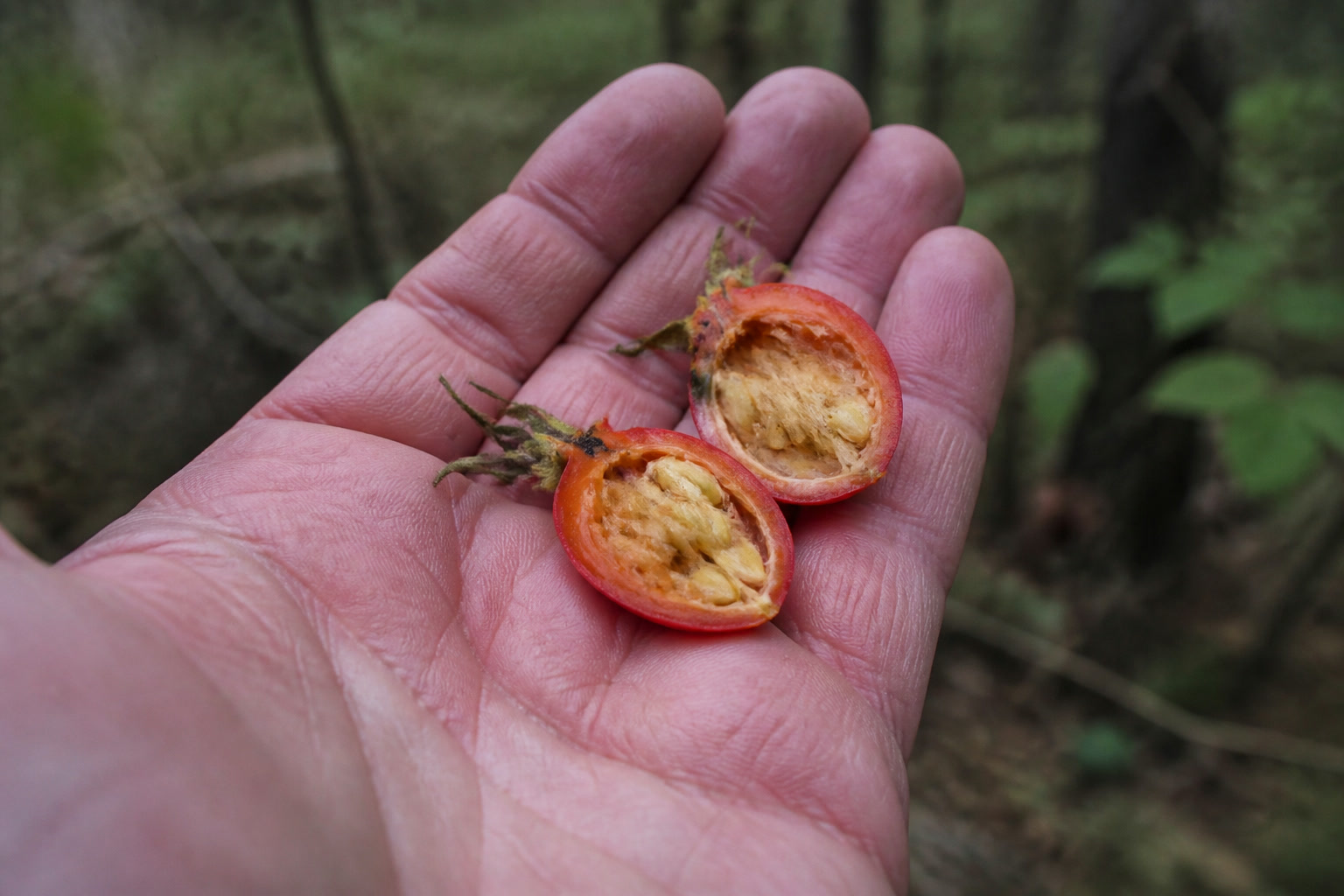
Here’s the part that catches people, and it’s the whole reason I keep good cheesecloth in the kitchen. Inside every rose hip, packed around the seeds, is a nest of fine, stiff hairs. Older kids of a certain era knew exactly what those were — they’re the classic homemade itching powder, and they will irritate your throat and your gut if they end up in your food. Getting them out is the entire craft of putting up rose hips.
You have two honest ways around them. The simple way: dry the hips whole, then use them only for tea and strain the brew well through a doubled layer of grade-90 cheesecloth before you drink it — the tight weave catches the hairs a coarse strainer lets straight through. The more thorough way, for syrup: cook the whole hips soft, mash them, and strain the pulp through that same doubled cheesecloth, pressing to get the fruit through while the seeds and hairs stay behind in the cloth. Either way, the cloth is doing the safety work. Don’t skip it and don’t rush it.
If you’d rather deseed by hand for dried hips, halve each one and scrape the seeds and hairs out with the tip of a spoon — it’s tedious, and I only do it when I want clean dried “shells” for a pretty tea blend. For syrup, cook-and-strain is far less work.
Make a simple rose hip syrup
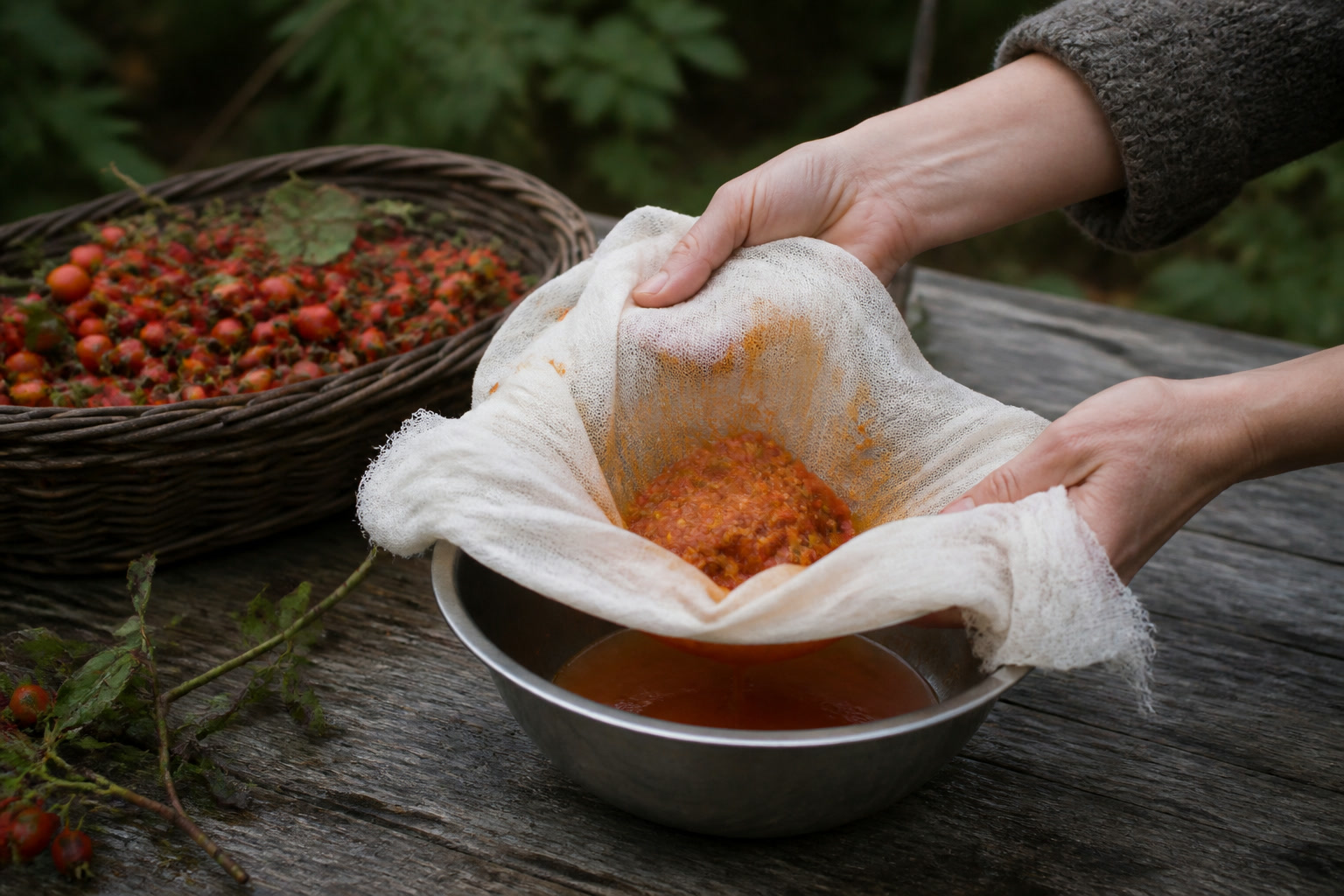
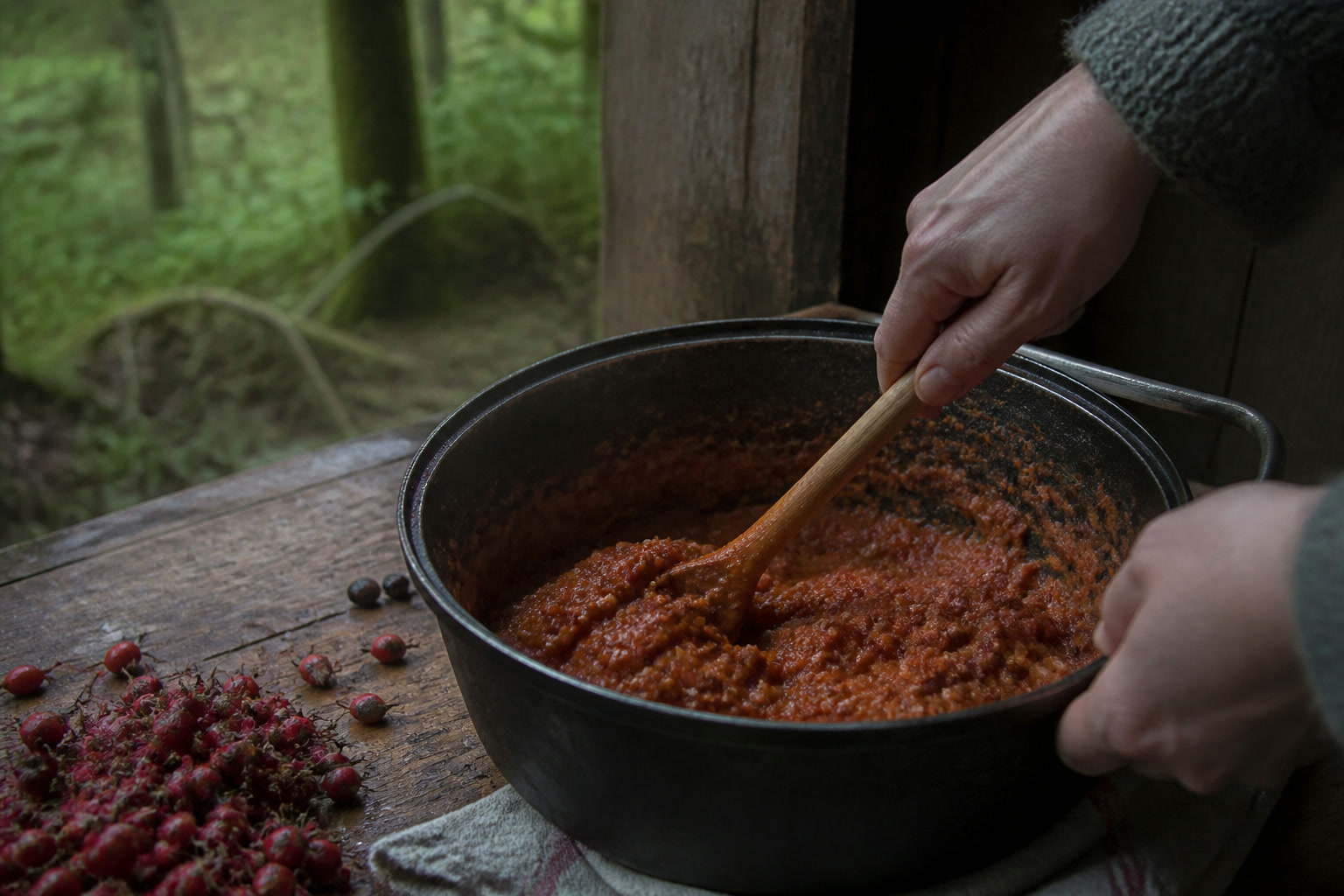
This is the preparation I make the most, and it’s plain. Rinse your hips, top and tail off any stems and blossom ends, and roughly chop or crush them. Cover them with water in a pot — a rough rule is about twice as much water as fruit by eye — bring it to a boil, then drop to a simmer until the hips are soft, fifteen or twenty minutes. Mash them in the pot and let the whole thing sit off the heat a bit to steep.
Now strain it. Set a colander over a bowl, line it with a doubled layer of cheesecloth, and pour the lot through. Let it drip, then gather the corners and press the pulp to work the juice out while the seeds and hairs stay in the cloth. For the sake of caution I strain a second time through fresh cheesecloth — hips are the one plant where I don’t mind straining twice.
Return the strained juice to a clean pot, sweeten to taste — honey or sugar, roughly to your liking; a syrup wants to be properly sweet to keep — and warm it just until it dissolves and thickens a touch. Bottle it into clean bottles while warm. It keeps a few weeks in the refrigerator, and I freeze what I won’t use soon in small bottles. A spoonful over oatmeal, stirred into tea, or splashed in seltzer is exactly the point of it.
Whatever’s left after syrup — extra whole hips — I dry hard and keep in a small lidded tin on the dark shelf for winter tea, always strained well before it goes in a cup.
An honest word on what it is
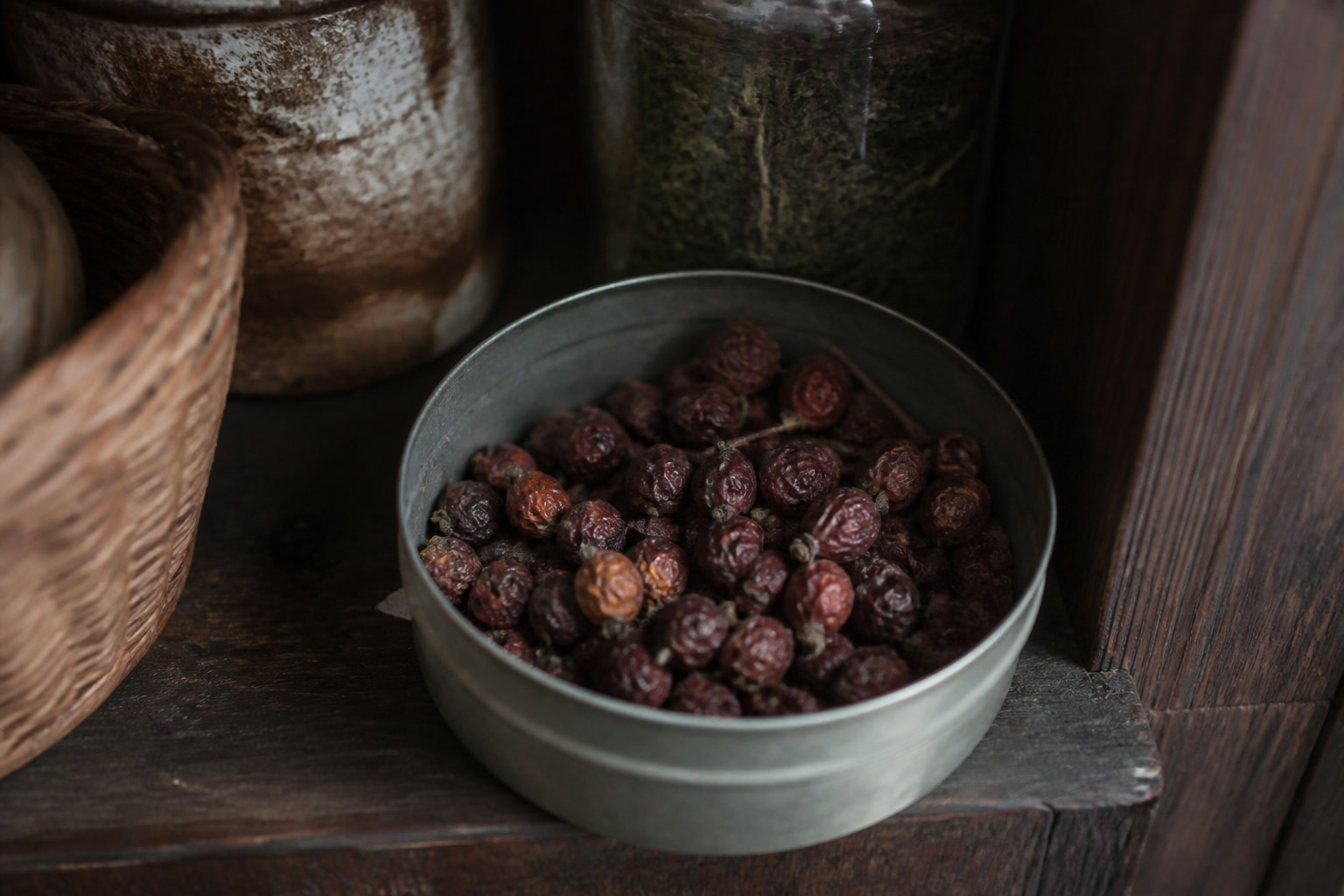
Rose hips have a long reputation as a fall tonic — they were a fixture of the old cold-weather teas, and there’s a reason people reached for them when the garden was done. I’ll share that this is what the plant has traditionally been used for, and leave it there. A jar of rose hip syrup is a tart, bright, genuinely lovely thing to have on the shelf in January. I’m not going to make a health claim about it, and you don’t need one to enjoy it. Take anything that actually needs treating to a qualified practitioner.
That kind of plant — common, generous, easy to get slightly wrong in one specific way — is exactly what I spend real time on in my book, Pacific Northwest Medicinal Plants: 115 wild plants of this region, how to tell each from its look-alikes without guessing, when to gather, and how the generations before us prepared them. The syrup is the easy October afternoon. The book is how you learn the rest of what’s fruiting along that same hedgerow.
