How to Forage and Use Salmonberry Shoots and Blossoms
Learn to forage salmonberry in the Pacific Northwest: spot the magenta blossoms and three-part leaves, pick spring shoots, and dry the leaf for tea.
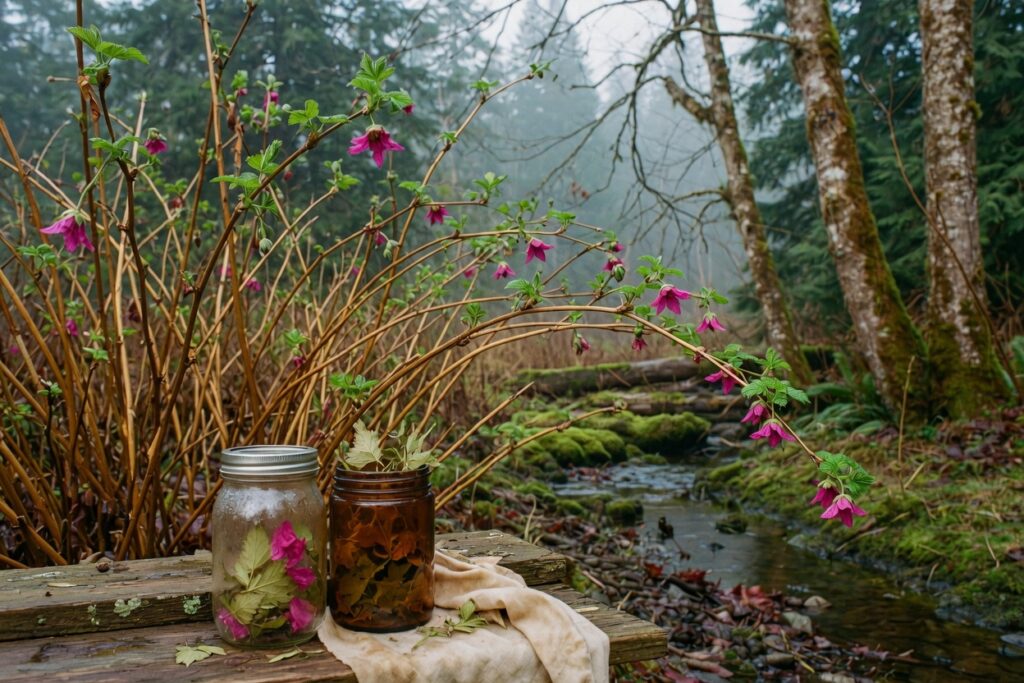
In the third week of March the first salmonberry blossom opens magenta along the Dungeness River trail, a week before I trust the weather. For twenty-two years that bloom has been the line in my notebook that says spring is real this time. Everything else on the Peninsula is still brown and dripping, and there is one bright pink flower on a bare cane, early enough that the hummingbirds are waiting for it.
Rubus spectabilis is one of the first wild foods of our year and one of the easiest to learn once you have seen it flower. I am writing this in autumn so you can plan for it. Salmonberry is a spring plant, and the people who get the most from it are the ones who scouted their patch in January.
A basket and a pair of leather gloves round out the kit. The canes carry weak prickles, not the hooks of a Himalayan blackberry, but gloves are kinder on the hands in cold March mud.
Learn to know it before you pick it
Say this part plainly, once: never eat or prepare any wild plant on the strength of one book, one app, or one article, this one included. Check it against more than one reputable guide and, better, walk it with an experienced local forager. When in doubt, leave it where it is.
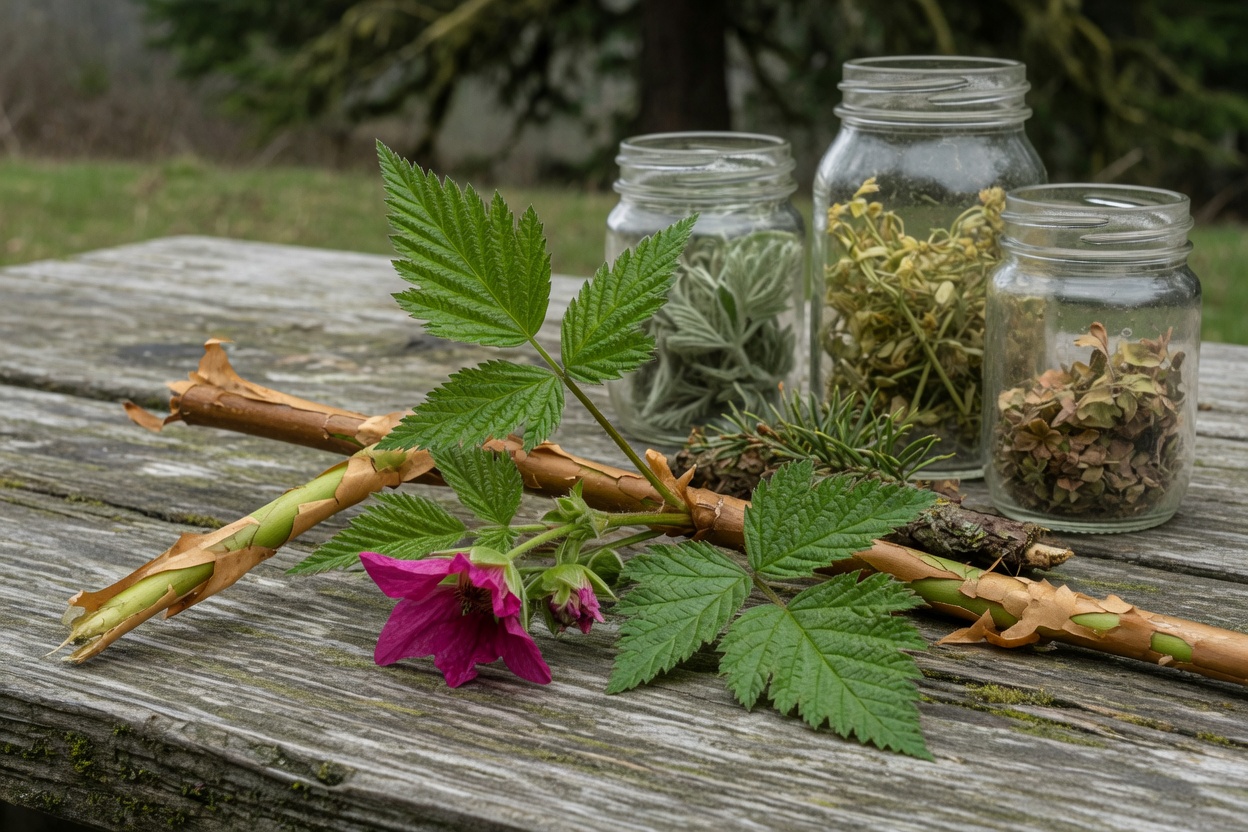
Salmonberry is a bramble, a relative of raspberry and blackberry, and it grows in wet ground: stream banks, the edges of alder stands, seepy road cuts, and the damp understory below about 2,000 feet on the west side of the Olympics. It forms dense thickets that can run for yards. The older canes have thin, golden-brown bark that peels in papery strips.
Three things sort it from its neighbors. The leaves are compound, with three leaflets, and each leaflet has a doubly toothed edge, meaning there are small teeth on top of the larger teeth. The flowers are a deep pink to magenta, one or a few at a time, appearing before or with the first leaves. And the fruit, when it comes in May and June, is a soft cluster that ranges from golden-orange to red, which is where the name comes from.
The plant most often confused with it is thimbleberry, Rubus parviflorus. Thimbleberry has big, soft, maple-shaped single leaves and white flowers, and no prickles at all. Laid side by side the two are nothing alike. I mention it because they often grow within a few steps of each other, and I have seen beginners pick the wrong one for no reason other than proximity. I wrote up thimbleberry separately in how to forage and use thimbleberry leaf.
Where to pick, and how much

Stream banks catch runoff, and runoff carries whatever was put on the land upstream. Do not harvest below a pasture, a road shoulder that gets sprayed, or a culvert outfall. I pick from patches on public forest land where I know what lies above them, and from a thicket at the back of a neighbor’s property, with permission.
Take a small share of any stand and move around instead of stripping one spot. Salmonberry spreads by suckers and it will not miss a handful of shoots, but the habit of leaving most of it is the same one that keeps wild patches healthy for the next picker.
The spring shoots
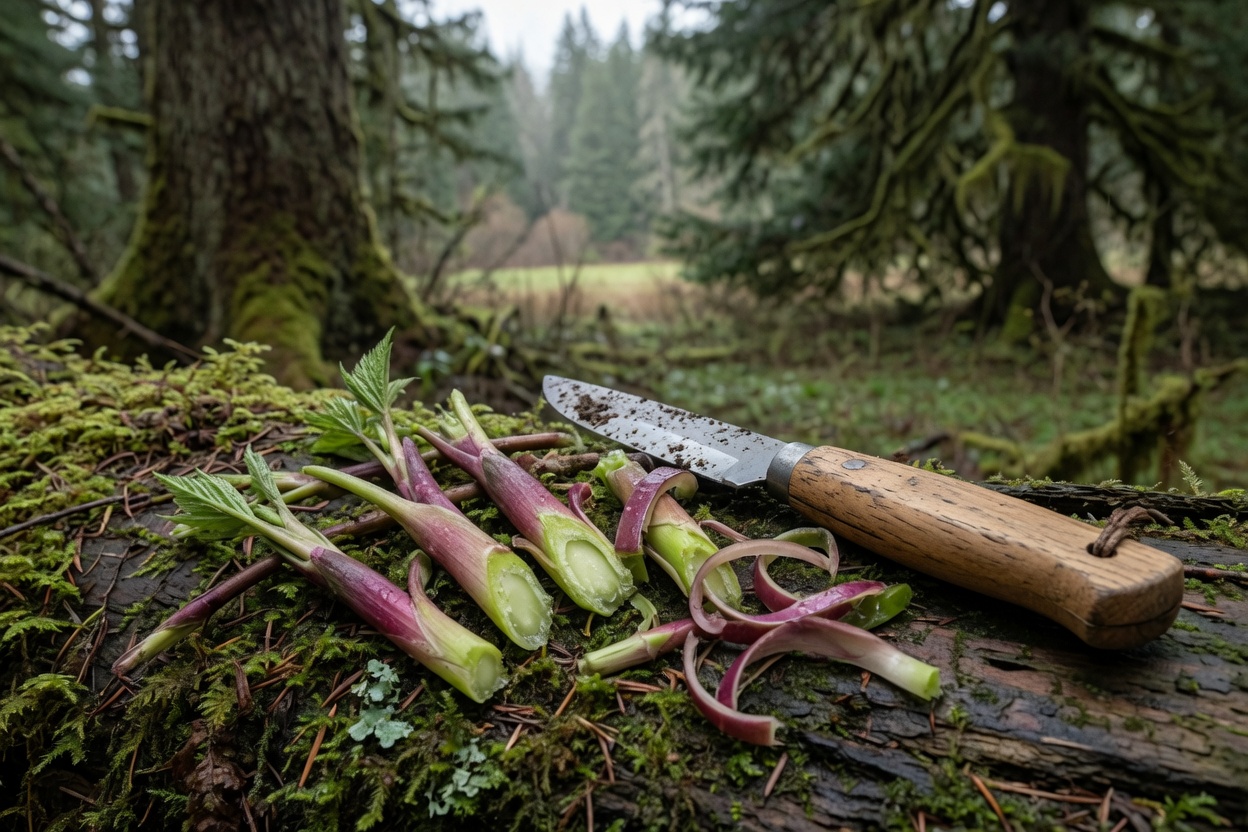
In April the new canes push up from the base of the thicket, thick as a finger, pale green to purplish, and tender enough to snap. The Makah and the Coast Salish peoples ate these peeled shoots in spring, a use recorded by the ethnobotanist Nancy Turner in her work on the food plants of coastal peoples. I credit that to them. I learned it from her book, not from a person.
Pick a shoot while it is still brittle and still under a foot or so tall, and snap it where it gives easily. If it bends instead of snapping, it has gone woody and is not worth your time. Peel the outer skin and the first few leaf scales away with your thumbnail. What is left is crisp and mild, a little like a green cucumber with a faint bramble note.
I eat most of them standing in the thicket. A few come home to go raw into a salad. I will be honest that this is a taste you decide on at the first bite; some people find it too plain, and I would not call it a flavor that changes lives.
The blossoms and the berries

The blossoms are edible and pretty, and a few scattered on a spring plate are nice. I take only a few, since each flower is a berry I will not have in June.
The berries themselves are watery and mild, nothing like a good blackberry, and they do not travel well. I eat them on the trail and leave the rest. If you want a jam, mix them with something tarter. That is the whole of the berry story, and I am fine with it.
Drying the leaf for tea
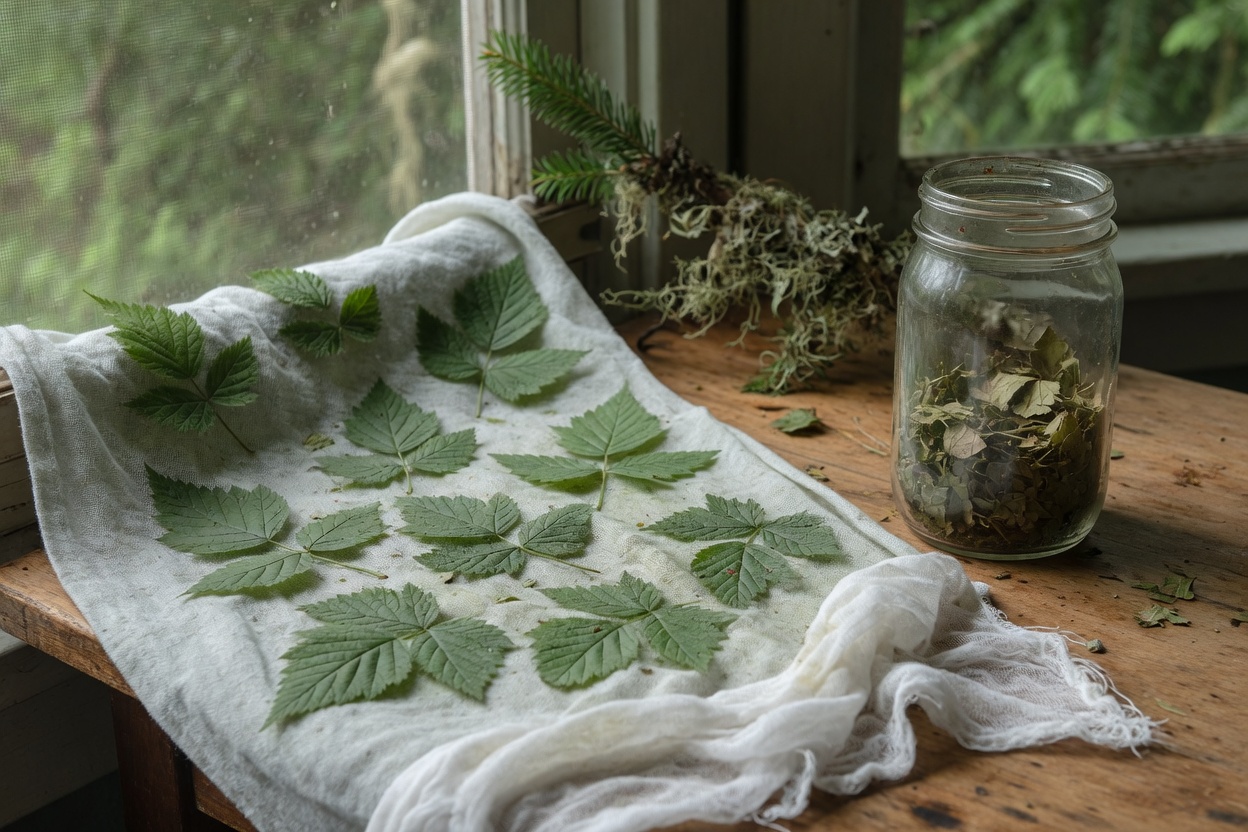
The leaves are the part I put up. Pick healthy, unblemished leaves in late spring, before the summer dust and the leaf-miners get to them. Rinse them, shake them dry, and spread them in a single layer on a screen or a clean cotton towel. Drape cheesecloth loosely over the top to keep dust and flies off, and give them several days in a warm, dry, shaded room. They are done when they crumble when you crush them. Leaves that are leathery still hold moisture and will mold in the jar.
Pack the crumbled leaf loosely in a wide-mouth pint jar and keep it in a cupboard, out of the light. I write the plant and the date on a strip of masking tape. For tea, I steep a small pinch in a cup of hot water, covered, for about ten minutes and strain it through cheesecloth if I have been sloppy with the crumbling. It tastes like a mild, slightly tannic green tea, and I find it pleasant on a wet evening.
How it has been used traditionally

Salmonberry bark and leaf appear in the ethnobotanical record as a traditional tea and wash among several coastal peoples, and the leaf was sometimes used as a poultice in the old accounts. I pass that along as history. I make no claim that it treats anything, I give no amounts, and I would not use it in place of care from a qualified practitioner. If you are pregnant, nursing, or on medication, talk with someone who knows your situation before you use any herbal tea regularly.
What I have gotten wrong

My first year I picked leaves in July after a dry spell, and the whole batch was dusty and half eaten by insects. I had to throw out two trays. Pick early, pick clean leaves, and rinse them gently, because bruised leaf browns quickly.
I also stacked the first trays too thick, and a week of March damp turned the bottom layer musty. One layer, good airflow, and patience.
Where the plant ends and the study begins

A jar of dried leaf is the easy part. The harder work is learning the thickets in your own watershed, telling salmonberry from thimbleberry in every season, and knowing which patch is safe to pick and which only looks safe. That is where I spend most of my time.
I go through it plant by plant in my book, Pacific Northwest Medicinal Plants: how to identify each plant without guessing, when to gather it, and how the people before us used it. If you are building a pantry of dried leaves, how to store dried herbs so they last and how to make herbal tea from foraged plants are good next steps.
Scout your patch in January. The bloom will tell you the rest.
