How to Forage and Use Licorice Fern Root in Winter
How to forage licorice fern root in winter — where it grows on big-leaf maples, how to harvest it without hurting the tree, and how it's traditionally used.

Most of what I forage shuts down for the year around the same time the maple leaves come down. Licorice fern doesn’t. This is the plant I send people to when they tell me winter foraging sounds like a contradiction — a green, sweet-rooted fern that’s often at its best from November through February, hanging off the mossy trunks and branches of big-leaf maples while everything around it goes bare and brown. I’ve been digging it every winter for close to twenty years, and it’s still one of the few things that makes a gray January walk in the woods feel like it has a purpose.
Polypodium glycyrrhiza — the species name tells you what you need to know, since glycyrrhiza is the same root word behind “glycyrrhizin,” the sweet compound in true licorice. The rhizome has a genuinely sweet, mildly spicy flavor when you chew a fresh piece, nothing like the fern fronds themselves. That sweetness is the whole reason it’s worth the climb.
Short list, because this isn’t a gear-heavy harvest. It’s mostly a matter of knowing where to look and being decent to the tree you’re borrowing from.
Where to find it
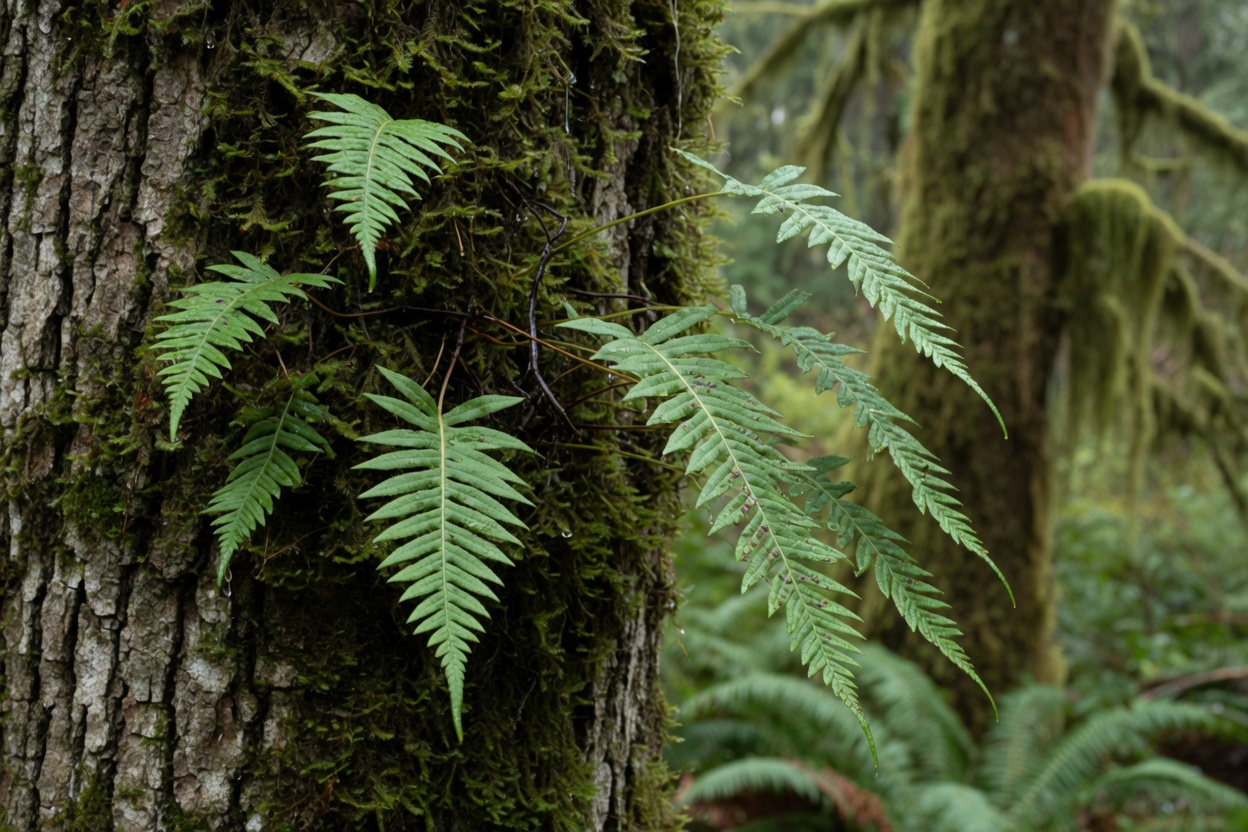
Licorice fern is an epiphyte — it grows on other plants, not in soil, which throws people the first time they hear it. Look at the trunks and larger limbs of big-leaf maple (Acer macrophyllum) in mossy, damp, mixed-conifer forest west of the Cascades. The fern roots into the moss mat itself, sending its long, jointed rhizome creeping along under a green carpet of moss on bark that never quite dries out. Vine maple and alder will occasionally carry a patch too, but big-leaf maple is your best bet — the deeply furrowed, moss-holding bark of an old maple is basically a licorice fern nursery.
The fronds themselves look like a smaller, glossier version of a sword fern, deeply cut, leathery, staying green through the coldest months. That evergreen habit is exactly why this is a winter plant for me rather than a spring or summer one — by the time deciduous ferns have died back and most of the forest floor is bare mud and fallen leaves, licorice fern is still standing there in plain sight, easier to spot against the bare wood than it ever is once everything else greens up around it.
Harvest, without hurting the tree
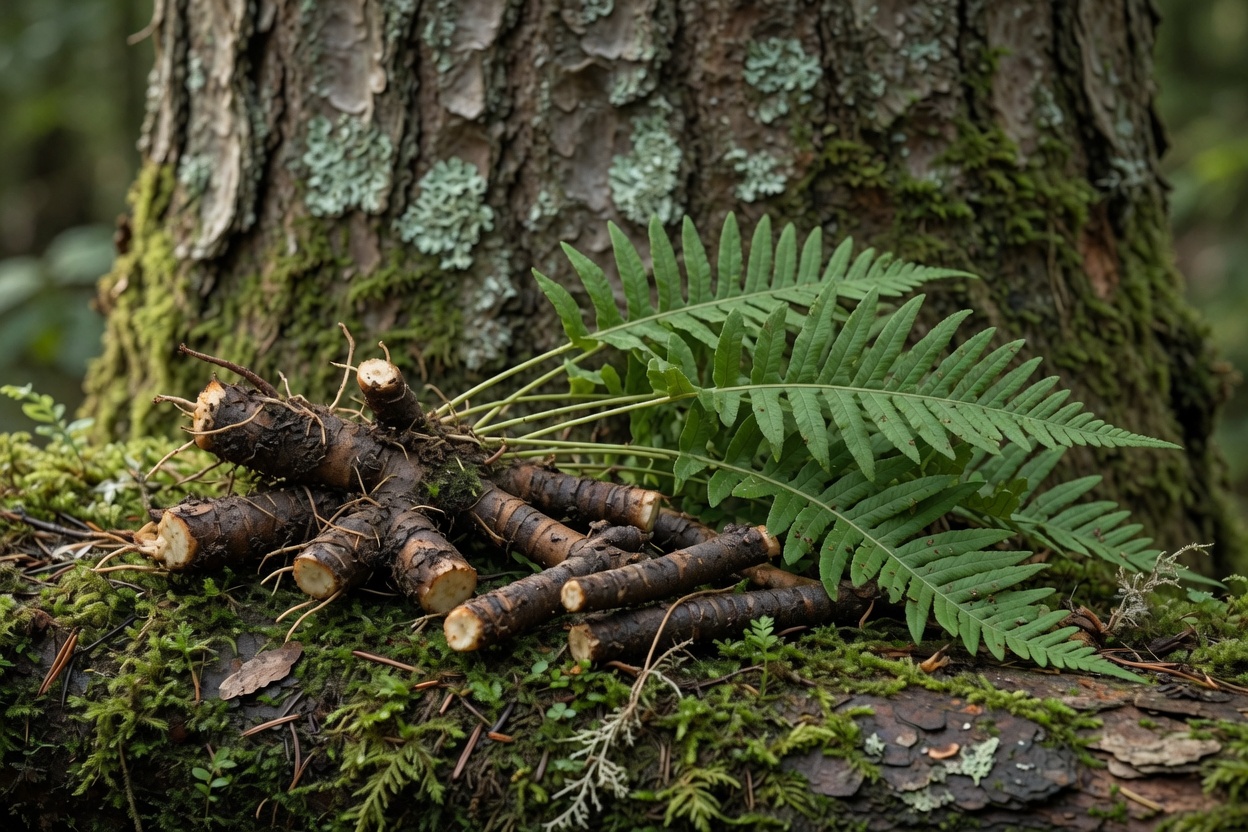
The moss mat is doing real ecological work — holding moisture, hosting insects, feeding the tree’s own root system through what falls off it — so I never strip a patch bare. My rule is to take a short section of rhizome from the edge of a healthy, well-established mat, never more than a few inches from any one patch, and never from a young or struggling tree.
Use the hori-hori’s point to lift the moss mat gently at the edge of the patch, following the jointed rhizome — it looks almost like a segmented brown root with fine roothairs along its length — and cut a short piece free with the blade rather than yanking, which tears the moss and can pull the whole mat loose. Press the moss back down over the cut end when you’re done. A healthy mat recovers from a light, spread-out harvest; it doesn’t recover from someone clearing a whole limb because they didn’t want to climb twice.
Rinse the harvested piece well once you’re home — moss holds onto grit and the occasional insect, and you want the rhizome clean before you do anything with it.
How it’s traditionally used

Coast Salish peoples, among other Pacific Northwest nations, have long chewed fresh licorice fern rhizome both for its sweet flavor and as a traditional remedy for sore throats and coughs — documented in Nancy Turner’s ethnobotanical work on Pacific Northwest plant use, which credits specific communities’ knowledge rather than a vague “Native American” attribution. I’m passing along what I’ve learned from that kind of sourced material and from my own twenty years of doing this, not claiming any of it as knowledge that originated with me.
The simplest way to use it is exactly the traditional one: peel a fresh piece and chew it slowly, the way you’d work a piece of actual licorice root. The sweetness is real but subtle, with an aftertaste that some people describe as slightly peppery. I keep it in this category — a traditional, food-like plant use, not a medicine I’m prescribing. If you have a persistent cough or sore throat that isn’t clearing up, that’s a conversation with a doctor, not a fern.
Dried and cut into cheesecloth for a simple infusion is the other traditional preparation, and it’s the one I do most at home in winter. Slice the cleaned rhizome thin, let it air-dry on a screen for a week or two, then simmer a few pieces in water for ten minutes and strain through doubled cheesecloth into a mug. What you get is a mild, faintly sweet, faintly spicy tea — pleasant on its own, and a nice quiet ritual for a cold month when most of what’s growing outside is done for the season.
A note on look-alikes

Licorice fern’s fronds resemble sword fern and deer fern closely enough that beginners sometimes confuse them. Sword fern (Polystichum munitum) grows from the ground in a large clump rather than epiphytically on bark, and its rhizome isn’t sweet — chewing a small piece of the actual rhizome (never guess by frond alone) is the surest field test, since the flavor is unmistakable when it’s really licorice fern. As always: confirm any wild plant with multiple reputable sources and, ideally, someone who’s foraged it before — when in doubt, throw it out.
If you want the fuller picture of what’s still worth foraging through a Pacific Northwest winter — not just this one plant, but the handful of things that carry a forager through the gray months — I put the whole seasonal map together in Pacific Northwest Medicinal Plants. This post is one green thing in a brown season. The book is the rest of the year.
