Dangerous Look-Alikes of Appalachian Medicinal Plants
Appalachian medicinal plant look-alikes that can hurt you: ramps vs. false hellebore, elder vs. water hemlock, yarrow vs. hemlock, and how I tell them apart.
The plants that will hurt you worst in these mountains are not the ones that look dangerous. They are the ones that look like something good. A patch of false hellebore coming up green in an April cove will stop a careless digger’s heart as surely as anything on the mountain, and it comes up right where the ramps do, at the same time, looking, to a hurried eye, like the same thing.
I grew up digging ‘seng and gathering yarbs in Madison County with my grandmother, who was a working granny-woman, and the first thing she taught me was not a plant. It was a habit. You do not gather off one feature, and you do not gather in a hurry. Forty years on, that habit is the only reason I still have all my afternoons to write this down for you.
Say this once and mean it: never eat or use a wild plant on the strength of one book, one app, or one feature you think you recognize. Confirm it against more than one reliable source, and better, against an experienced person who can put the real plant in your hand. When in doubt, leave it. Nobody up here has ever regretted the plant they walked past.
Ramps and the two that can kill you
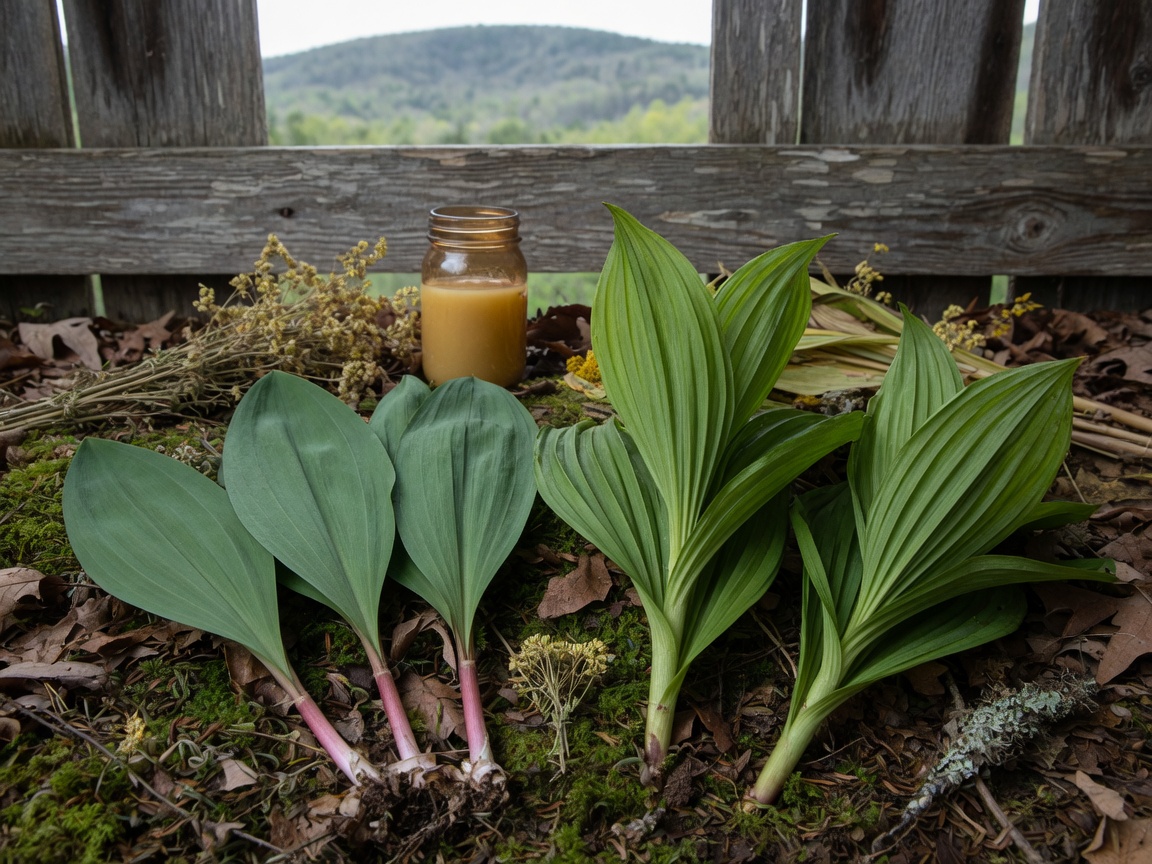
Ramps (Allium tricoccum) are the plant that pulls the most beginners into the woods each spring, and they sit next to the most dangerous mistake in these mountains. Two plants come up green and broad-leaved in the same wet coves at the same time, and both are seriously poisonous: false hellebore (Veratrum viride, what the old people around here called Indian poke) and lily of the valley (Convallaria majalis, escaped from home yards into the woods).
The tell is the one your grandmother’s nose already knows. Crush a leaf. A ramp smells unmistakably of onion and garlic, sharp and green and true. False hellebore and lily of the valley have no onion smell at all. If it does not smell like an onion, it is not a ramp, and you set it down.
Beyond the smell, look at how the leaf is built. A ramp leaf is smooth and flat, one or two per plant, tapering to a stalk that runs pink or burgundy where it meets the ground. False hellebore leaves are heavily pleated, ribbed like a folding fan, and they clasp and wrap the stem in a whorl going up — the plant grows as a tall leafy stalk, not a low tuft. Lily of the valley comes up in pairs of smooth leaves but never smells of onion and never has that colored stalk-base. When I take a grandchild out for their first ramp season, I make them crush and smell every single leaf before it goes in the bag, until the check is automatic. It is a small price for a spring that ends well.
The Cherokee, whose homeland this is, ate ramps as an early spring food and tonic long before any settler wrote it down; Daniel E. Moerman’s Native American Ethnobotany is a careful, documented place to read that history with proper attribution. Ramps are also slow to recover from hard digging, so take a few leaves and leave the bulb, or take no more than one plant in ten from a healthy patch. That is how these coves still have ramps in them, and how I mean to keep it that way. I go deeper into the spring greens and their hazards in what to forage in Appalachia in spring.
Elderberry and water hemlock
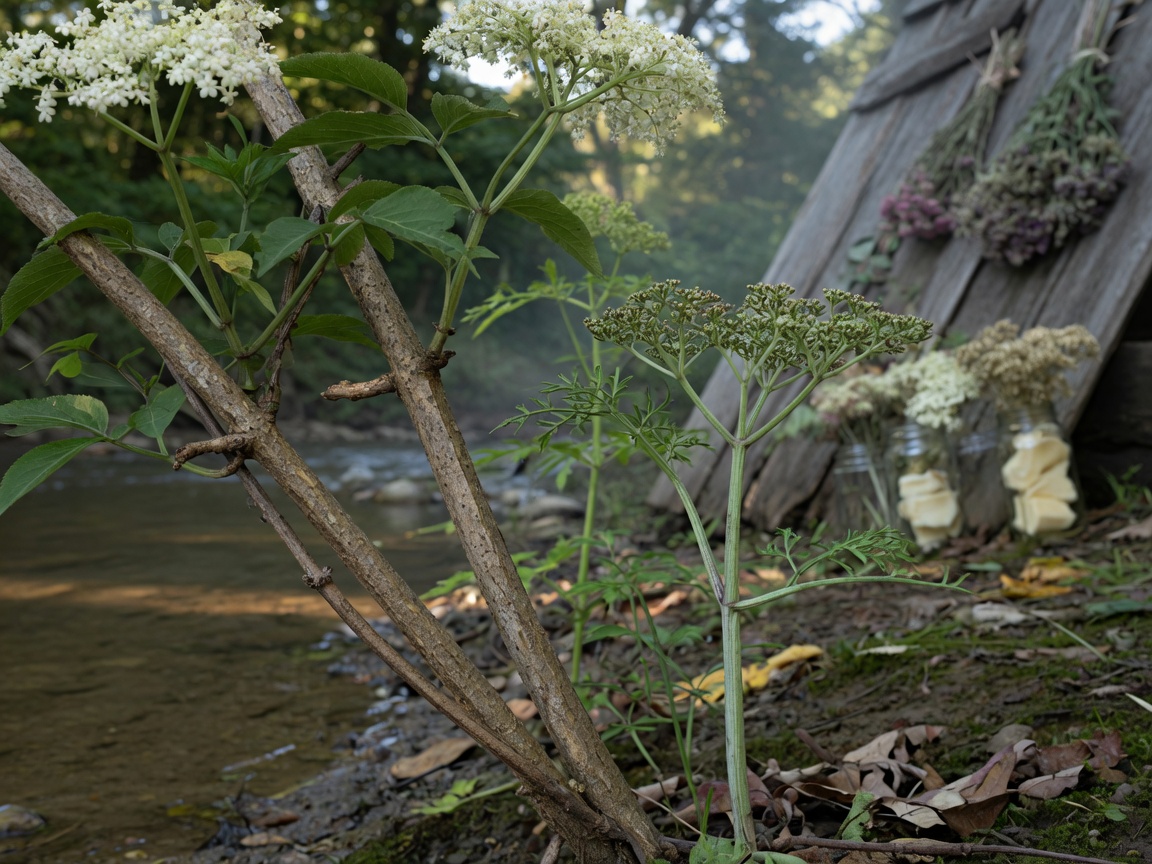
Black elder (Sambucus canadensis) gives us flower and berry that mountain families have used for generations, and it grows in the same wet, low ground as one of the most poisonous plants on the continent: water hemlock (Cicuta maculata). Both throw up flat-topped clusters of tiny white flowers near creeks and ditches in early summer, and a glance is not enough to tell them apart.
Start with the stem, because it settles the question. Elder is a woody shrub — a bush with real bark and soft white pith at the center of the older canes. Water hemlock is a smooth green herb, no bark at all, with a hollow stem that is often streaked or mottled purple, and if you were to cut the base you would find chambered roots that smell rank and carroty. I do not cut into a suspect plant to check, and neither should you; I am telling you what is there so you know how different these two really are underneath a surface that looks alike.
Then look at the leaves. Elder leaves are pinnately compound with broad, evenly toothed leaflets. Water hemlock leaves are more finely divided and sharply toothed, and here is the diagnostic the old botanists trusted: on a water hemlock leaflet the veins run to the notches between the teeth, not to the tips. Elder is a shrub you learn as a shrub; the hemlocks are herbs. Keep that shape difference first in your mind and you will not confuse a berry bush for a stalk of poison.
The carrot-family trap: yarrow, Queen Anne’s lace, and the hemlocks
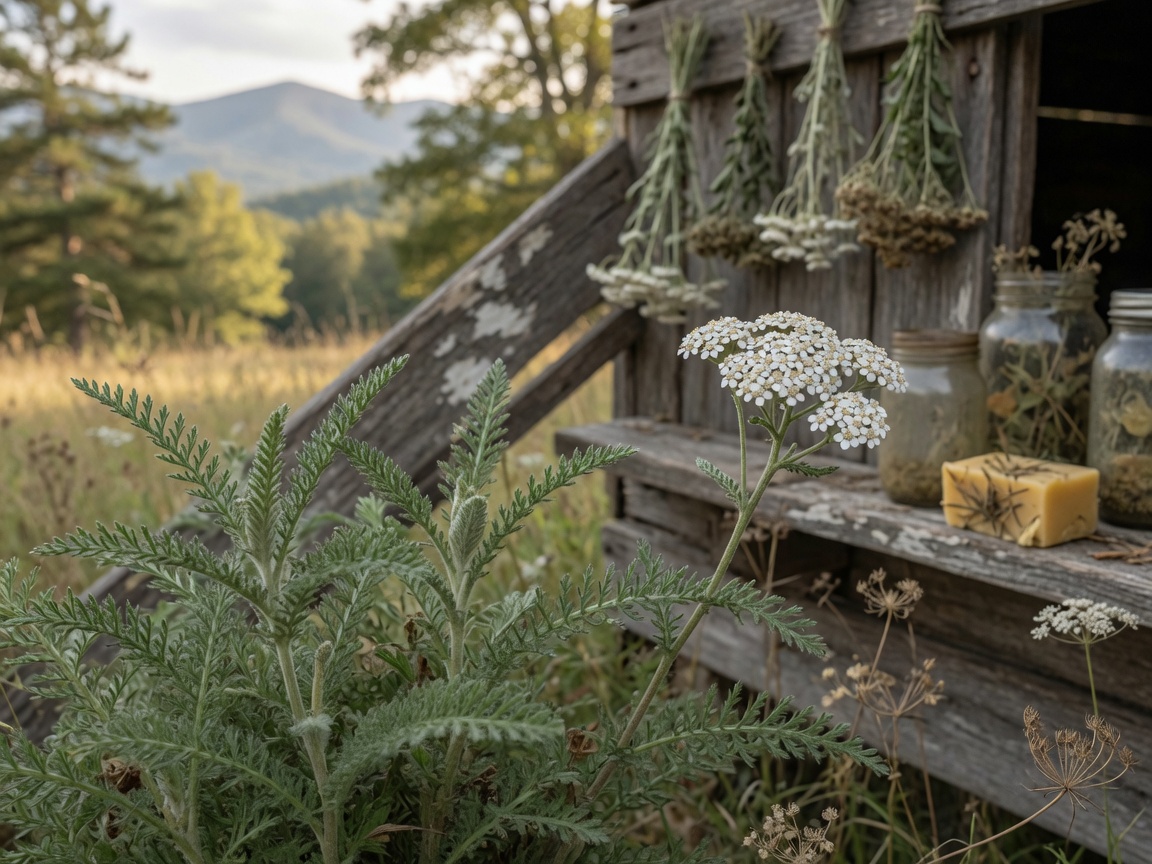
The plants in the carrot family — the ones with lacy, fern-like leaves and umbrella-shaped flower clusters — are where a lot of good foragers get careless, because the useful ones and the deadly ones share that whole general shape. Yarrow (Achillea millefolium), which I use for salve, has soft, feathery, many-times-divided leaves that can, from a distance, resemble the young growth of poison hemlock (Conium maculatum).
Yarrow gives itself away close up. Its leaves are soft and almost mossy to the touch, arranged along a single main axis so each leaf looks like a little green feather, and the plant carries a clean, distinctive herbal smell. Poison hemlock is hairless with purple blotches staining the lower stem, and when bruised it throws off a musty, mousy, unpleasant odor that yarrow never has. Queen Anne’s lace (wild carrot, Daucus carota), another common look-alike, has a hairy stem, and “the Queen has hairy legs” is the old saying worth remembering, while poison hemlock and water hemlock are smooth. A hairy stem is reassuring; a smooth, purple-spotted, musty-smelling one sends me on my way.
If you are still building your eye, do your carrot-family learning with a hand lens and a good regional guide before you ever handle these for use, not after. This is the family I tell true beginners to admire and leave alone the first year or two. There is no shame in it. I left them alone longer than that.
Ginseng and its harmless doubles
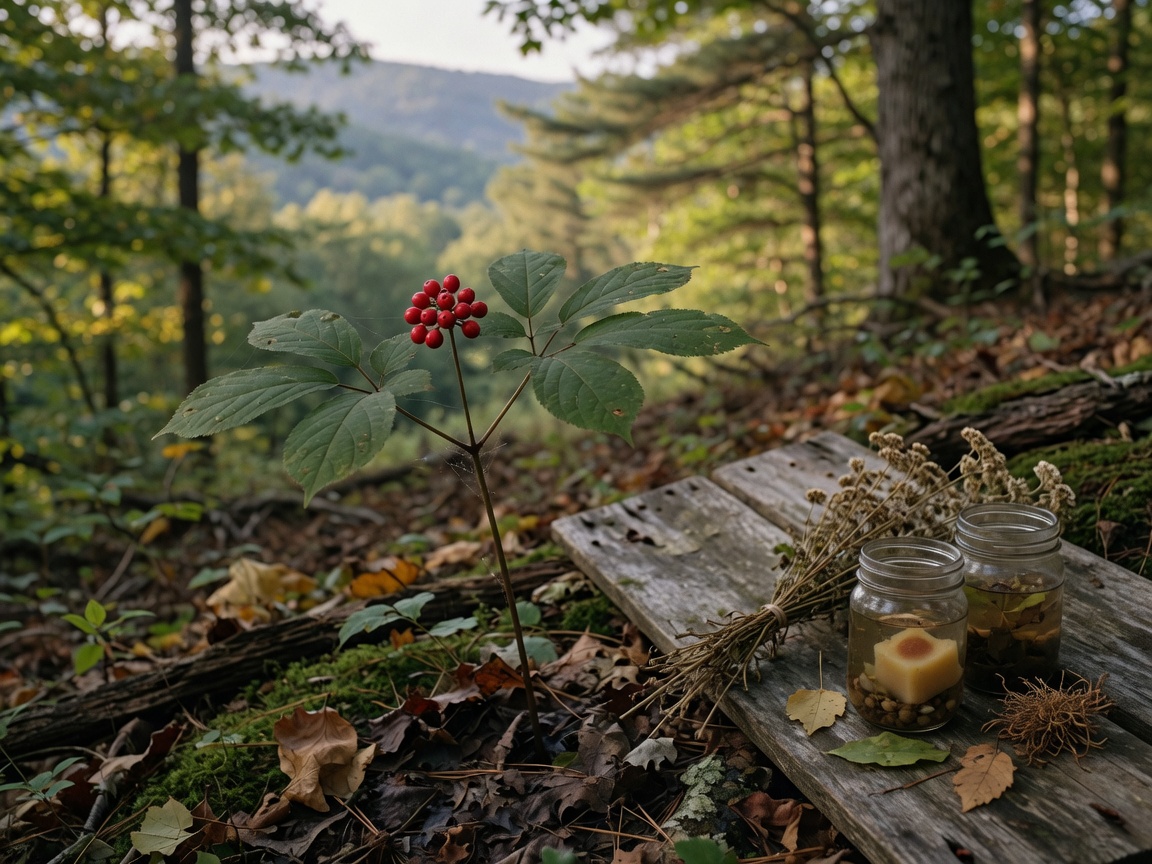
Wild ginseng (Panax quinquefolius) is the root that built the mountain herb trade, and its look-alikes are the gentler kind of problem — plants that will not hurt you, but that will waste your time or, worse, get you digging where you have no business digging. Beginners most often confuse young ginseng with Virginia creeper, wild sarsaparilla, and buckeye seedlings, all of which can show a five-part leaf arrangement to an eager eye.
Mature ginseng settles it: a single stem topped by a whorl of usually three (sometimes more) compound leaves, each with five toothed leaflets, two small at the base and three larger, with the red berry cluster standing in the center come late summer. Virginia creeper is a climbing vine, ginseng is not. Buckeye leaflets radiate from a single point like fingers from a palm; ginseng’s grow as distinct stalked leaves. When the berries redden in the fall, a real ginseng plant is unmistakable, which is exactly the season a careful digger waits for.
Two hard rules on this one, because ginseng is at risk and its harvest is regulated in North Carolina and Tennessee. Dig only in season, only with the landowner’s permission or a legal permit on public ground, and plant the ripe red berries back where the plant stood. Take the old roots, leave the young, and you leave the patch for your grandchildren. The Cherokee dug and traded ‘seng here for centuries; that we still have any to argue over is because the mountain people, at their best, treated it as a crop to steward and not a mine to strip.
The knowing is the medicine
The making of a salve or a tea is the easy afternoon’s work. Knowing, past all doubt, that the green thing in your hand is the plant you think it is, and not the one that grows beside it wearing the same coat, is the part that takes years, and it is the part I care most about. Learn a plant three ways before you trust it: leaf and stem and smell, in every season, against a real guide and a real person. I have been wrong about a plant. I have never been wrong about a plant I checked three ways.
I put every plant in this piece, and a good many more, into my book, Appalachian Medicinal Plants — how to know each one without guessing, the dangerous doubles it grows next to, when to gather it, and how the generations before us in these mountains used it. Keep a real field guide in the truck and this one on the shelf, and take your time. The mountain is not going anywhere, and neither, if you are careful, are you.